

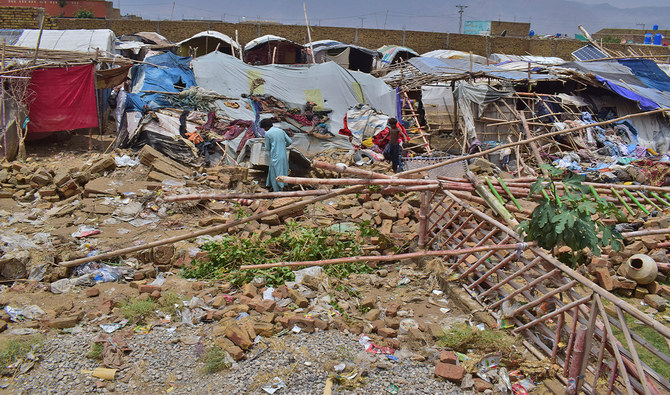

QUETTA: At least nine people, including women and children, were killed as torrential rains wreaked havoc in the southwestern Pakistani province of Balochistan on Monday, officials said.
The rains, which came with the onset of monsoon season in southwest Pakistan, destroyed hundreds of mud houses in the provincial capital of Quetta.
In an alert this week, the Pakistan Meteorological Department (PMD) said strong monsoon currents, which were likely to prevail for 10 days, could trigger flash floods in Balochistan and southern Sindh provinces.
“Seven people, including three children and two women, were killed after monsoon rains hit Quetta city on July 04, 2022, while more than 300 mud houses collapsed in different neighborhoods of the city,” Naseer Khan Nasir, director-general of the Provincial Disaster Management Authority (PDMA), told Arab News.
“We have recovered two bodies in the flood-hit Eastern Bypass area, while rescue operation is still continued in various areas affected by torrential rains.”
He said more than 13 people were injured in different rain-related incidents, while two young girls among five others had gone missing after a flash flood hit Bhosa Mandi area of the city.
Nasir said rescue teams were searching for the missing persons, while the district administration was distributing relief goods among people affected by the downpours.
Sevak Kumar, who hails from Thul area of Sindh, lost six of his family members after a wall collapsed on their tent accommodation on Quetta’s Link Badini Road.
“The family members were sitting inside the tent when the mud wall collapsed due to heavy rain,” said Kumar, who along with his family came to work as laborers. “The women and children were killed on the spot.”
The rains affected telecommunication and power supply remained suspended for more than nine hours as 53 out of 90 electricity feeders tripped across the city.
Hameed Khan Awan, a Quetta Electricity Supply Company (QESCO) official, said supply through major feeders in the city had been restored, but nearly two dozen feeders were still not functional and QESCO staffers were working on them.
“The rains caused a breakdown in the city as dozens of electricity pylons collapsed in different areas,” Awan said. “Efforts are now under way to restore supply to areas on the outskirts of Quetta.”
The Quetta district administration has established a flood emergency control room to monitor and address any emergency situation in the city and adjacent areas.
According to the Met Office, Quetta has so far received 22 millimeters of rain.
Provincial Minister Mir Zia Langove, who oversees the PDMA, said the government was making relief efforts during the monsoon spell.
“PDMA teams have reached all major affected areas and distributed food and goods among people rendered homeless after Monday’s downpour,” he told reporters in Quetta.


