

Pakistan says mastermind of Karachi University attack entered from ‘neighboring country’

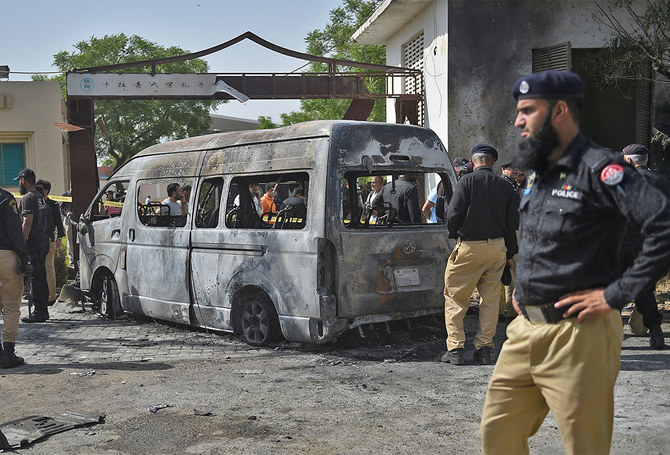
Police inspect a site around damaged vehicles following a suicide bombing near the Confucious Institute affiliated with the Karachi University, in Karachi, Pakistan, on April 26, 2022. (AFP)
Short Url
Updated 05 July 2022
Follow

Pakistan says mastermind of Karachi University attack entered from ‘neighboring country’

  • Sindh minister says message to be conveyed to neighboring country according to diplomatic norms
  • Three Chinese nationals were killed in April by woman suicide bomber outside Karachi University

KARACHI: A provincial minister in Pakistan’s Sindh province said on Tuesday the mastermind of a suicide bombing at Karachi University in which three Chinese teachers were killed in April had entered Pakistan from a ‘neighboring country.’

Though the minister, Sharjeel Inaam Memon, did not name a specific country, Pakistan has often blamed neighbors India and Afghanistan, and sometimes Iran, for allowing militants to use their soil to launch attacks across the border.

On April 26, a bomb blast that ripped through a passenger van killed three Chinese nationals and a Pakistani in the southern port city of Karachi. Pakistan said the attack was carried out by a woman suicide bomber linked to a separatist group, the Baloch Liberation Army (BLA), which is based in southwestern Balochistan province bordering Afghanistan and Iran.

Militant groups based in Balochistan have frequently targeted Chinese interests in Pakistan, where Beijing has invested over $60 billion in infrastructure and energy projects as part of the China-Pakistan Economic Corridor (CPEC).

Police in Karachi said on Monday a key suspect in the April bombing had been arrested.

“Zaib, mastermind of Karachi university suicide attack, entered Pakistan from a neighboring country and upon reaching Karachi he resided with female suicide bomber Shari Hayat Baloch alias Barmash and her husband Habitan Bashir, in a flat in Dehli colony of Karachi,” Memon, Sindh minister for information, told reporters about what had been revealed in interrogations with the arrested suspect, identified as Dad Bux.

Memon said Bux had disclosed that the mastermind, an expert in making IEDs, had fled to Balochistan immediately after the blast on the order of BLF [Baluch Liberation Front] commander Khalil Baloch alias Musa.

“The terrorists were in contact through telegram. This network of the terrorists uses soil of a foreign country and the network of these proscribed organizations is spread to several foreign countries,” Memon said, adding that the Karachi university blast was the joint work of the separatist BLA and BLF groups.

Memon said it was “inappropriate” to name the neighboring country in front of reporters but a message would be conveyed by the federal government through proper diplomatic channels.

“But whichever country is involved [...] our work is to trace and give strict punishment to those involved and give the message that nobody can cast a dirty eye on Pakistan,” Memon said. “A message will also be conveyed by the federal government that your soil is being used for terrorism ... and then that country will also be warned while taking care of whatever diplomat norms.”

At a meeting on Monday, CM Murad Ali Shah and a Chinese delegation led by deputy director-general of China’s Counter-Terrorism Department (CTD) Gao Fei, discussed security arrangements for Chinese nationals working in Sindh, according to a statement.

The chief minister said his government had deployed 3,361 security officials, including 1,500 police, 517 army personnel, 173 Rangers, 28 Frontier Corps (FC) personnel and 1,143 private security guards, for the security of 3,637 Chinese nationals, who were working on eight CPEC projects in Sindh.

“The Chinese delegation told the chief minister that they were technically strengthening CTD and the Special Branch of Sindh Police,” the statement read.

The Karachi University bombing was the first major attack on Chinese nationals in Pakistan since last year, when a suicide bomber blew up a passenger bus, killing 13 people, including nine Chinese nationals working on the Dasu Hydropower project in the northwestern Khyber Pakhtunkhwa province.


Pakistan orders four-day workweek, shuts schools to save fuel amid Middle East oil crisis

Updated 09 March 2026
Follow

Pakistan orders four-day workweek, shuts schools to save fuel amid Middle East oil crisis

  • The development comes as ongoing US-Israeli strikes on Iran disrupt oil supplies in Strait of Hormuz, push prices past $119 a barrel
  • Islamabad bans government purchases, cuts fuel allocation for vehicles as well as workforce in public and private offices by 50 percent

ISLAMABAD: Prime Minister Shehbaz Sharif on Monday announced austerity measures, including a four-day work week, cuts in government expenditures and closure of schools, to offset the impact of rising global oil prices due to an ongoing conflict in the Middle East.

Global fuel supply lines have been disrupted in the Strait of Hormuz, which supplies nearly a fourth of world oil consumption, after Tehran blocked it following United States-Israeli strikes on Iran and counterattacks against US interests in the Gulf region.

Oil prices surged more than 25 percent globally on Monday to $119.50 a barrel, the highest levels since mid-2022, as some major producers cut supplies and fears of prolonged shipping disruptions gripped the market due to the expanding US-Israeli war with Iran.

In his televised address on Sunday night, Sharif said global oil prices were expected to rise again in the coming days but vowed not to let the people bear their brunt, announcing austerity measures to lessen the impact of fuel price hikes.

“Fifty percent staff in public and private entities will work from home,” he announced, adding this would not be applicable to essential services. “Offices will remain open for four days a week. One-day additional off is being given to conserve oil, but it would not be applicable to banks.”

Sharif didn’t specify working days of the week and the government was likely to issue a notification in this regard.

He said a decrease of 50 percent was being made in fuel allocation for government vehicles immediately for the next two months, but they would not include ambulances and public buses.

“Cabinet members, advisers and special assistants will not draw salaries for the next two months, 25 percent salaries of parliamentarians are being deducted, two-day salaries of Grade 20 and above officers, or those who are paid Rs300,000 ($1,067) a month, are being deducted for public relief,” he said.

Similarly, there will be 20 percent reduction in public department expenses and a complete ban on the purchase of cars, furniture, air conditioners and other goods, according to the prime minister.

Foreign trips of ministers and other government officials will also be banned along with government dinners and iftar buffets, while teleconferences and online meetings will be given priority.

“All schools will be off for two weeks, starting from the end of this week, and all higher education institutions should immediately begin online classes,” he said.

Sharif’s comments were aired hours after Pakistani authorities said the country had “comfortable levels” of petroleum stocks and the supply chains were functioning smoothly, despite intensifying Middle East conflict.

Petroleum Minister Ali Pervaiz Malik said three oil shipments were due to reach Pakistan this week, state media reported.

Meanwhile, Pakistan Navy (PN) launched ‘Operation Muhafiz-ul-Bahr’ to safeguard national energy shipments, the Pakistani military said on Monday, amid disruptions to critical sea lanes due to the conflict.

The navy is conducting escort operations in close coordination with the Pakistan National Shipping Corporation (PNSC), according to the Inter-Services Public Relations (ISPR), the military’s media wing. It is fully cognizant of the prevailing maritime situation and is actively monitoring and controlling the movement of merchant vessels to ensure their safe and secure transit.

“With approximately 90 percent of Pakistan’s trade conducted via sea, the operation aims to ensure that vital sea routes remain safe, secure, and uninterrupted,” the ISPR said on Monday. “Currently, PN ships are escorting 2 x Merchant Vessels, one of which is scheduled to arrive Karachi today.”