Top general says military to leave Sudan political talks

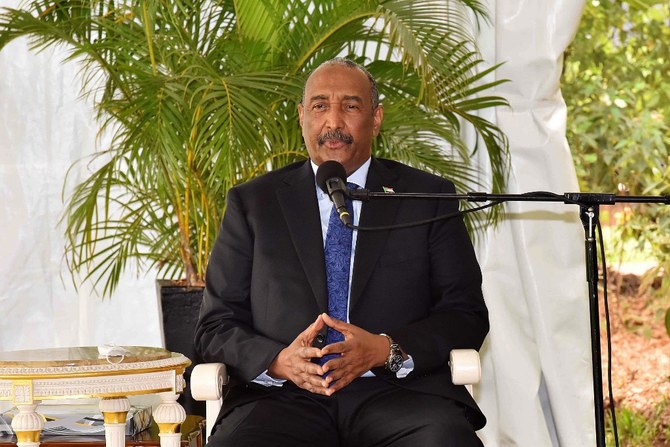
The Chairman of the Transitional Sovereignty Council of Sudan General Abdel Fattah Al-Burhan. (File/AFP)
Short Url
Updated 04 July 2022
Follow

Top general says military to leave Sudan political talks

  • The sovereign council, which has military and civilian members, will be dissolved after the formation of the new government, Burhan said

CAIRO: Sudan’s leading general said Monday the country’s military will withdraw from negotiations meant to solve the ongoing political crisis after a coup last year, allowing civil society representatives to take their place.
In televised statements aired on Sudan’s state television, Gen. Abdel-Fattah Burhan also promised that he will dissolve the sovereign council that he leads after a new transitional government is formed. The council has governed the country since the military took power in a coup last year.
Since the coup, the UN political mission in Sudan, the African Union and the eight-nation east African regional Intergovernmental Authority in Development group have been trying to broker a way out of the political impasse. But talks have yielded no results so far. Pro-democracy groups have repeatedly said they will not negotiate with the military, and have called for them to immediately hand the reins to a civilian government.
Burhan did not specify any dates or who would replace the military at the negotiating table. He said that after the ruling council is dissolved, the army and the powerful paramilitary known as the Rapid Support Forces will be placed under a new governing body that will be responsible for the country’s defense and security.
Sudan has been plunged into turmoil since the military takeover upended its short-lived transition to democracy after three decades of repressive rule by former strongman Omar Al-Bashir. Al-Bashir and his Islamist-backed government were removed by the military in a popular uprising in April 2019.


How attacks on hospitals in Kordofan are pushing Sudan’s health system toward collapse

Updated 7 sec ago
Follow

How attacks on hospitals in Kordofan are pushing Sudan’s health system toward collapse

  • Recent drone strikes on two hospitals in Kadugli underscore Sudan’s deepening health crisis, with medical facilities increasingly on the front lines of the war
  • Health services in South Kordofan are deteriorating rapidly after two years of blockade and ongoing military operations, local medical officials warn

LONDON: Fighting between the Sudanese Armed Forces and the paramilitary Rapid Support Forces has pushed Sudan’s fragile health system to the brink, with hospitals increasingly caught on the front lines.
On Feb. 3, a drone strike on Al-Shartai Health Center in Kadugli, the state capital of South Kordofan, killed eight civilians — five of them children — and wounded 11 others, according to the Sudan Doctors Network.
In a statement on X, the group said the RSF carried out the attack. The Geneva-based Committee for Justice said the strike had rendered the health center out of service at a time when the city was already facing severe humanitarian challenges.
The organization added in a Feb. 4 statement that targeting medical facilities and civilians “constitutes a grave violation of international humanitarian law and amounts to a war crime.”
The assault came shortly after the SAF announced it had lifted a siege that had choked the city since June 2023.
The following day, the RSF and its ally, the Sudan People’s Liberation Movement-North, reportedly struck Kadugli’s Al-Kuweik Military Hospital, killing one person and injuring eight others, the network said.
The RSF has not publicly commented on the allegations at the time of writing.
Razan El-Mahdi, a spokesperson for the Sudan Doctors Network, condemned the attacks, saying that targeting health facilities and personnel “constitutes a clear violation of international law.”
In a statement on Feb. 4, she added that the two facilities “have been providing services to patients and civilians after 50 percent of medical facilities were rendered inoperable due to shelling and the siege.”
Aid workers say the repeated strikes are part of a wider pattern.
Dr. Aman Alawad, Sudan country director for the US-based NGO MedGlobal, said health facilities and cadres “are targeted consistently, whether in Kadugli, Dalang, Al-Obeid, or Al-Fasher.”
“That makes it harder for state-supported facilities, as well as those run by international and national organizations, to continue operating,” Alawad told Arab News from Sudan.
He added that many peripheral health centers have been forced to close or operate with minimal staff, as the risks to medical workers increase and the cost of maintaining services rises.
Alawad also said drone strikes on hospitals and patients have occurred repeatedly during the war, “making it harder for humanitarian groups to balance staff safety with the need to deliver care near front lines.”
Al-Kuweik Hospital was struck again on Feb. 5, killing 22 people, including the facility’s medical director and three staff members, and injuring eight others, the Sudan Doctors Network said.
These incidents reflect a broader collapse of health services in South Kordofan. Last month, the Sudan Doctors Network warned that two years of blockade, combined with ongoing military operations, had caused a severe deterioration in health conditions, particularly in Kadugli.
The city has five government hospitals and 10 public health centers, but most are operating at no more than half capacity, the network said, while many others have shut down entirely because of fighting, shortages of personnel and dwindling supplies, including blood bags.
The crisis in South Kordofan is part of a wider humanitarian catastrophe that has unfolded since Sudan’s civil war erupted on April 15, 2023.
The conflict has killed tens of thousands of people, displaced millions and fueled widespread hunger and disease in what aid agencies describe as the world’s worst humanitarian crisis.
The Integrated Food Security Phase Classification declared famine in Kadugli in September, citing months without reliable access to food or medical care after the RSF and its allies imposed a siege in the early months of the war.
In a Feb. 5 analysis, the IPC warned that intensifying conflict in the Greater Kordofan region is “driving a rapid deterioration in food security,” with more people likely to face extreme hunger, acute malnutrition, and rising hunger‑related deaths.
Aid organizations say that as famine conditions expand to include more parts of the country — most recently the Um Baru and Kernoi localities — children are among the most vulnerable.
“In many parts of Sudan, children’s lives are hanging by a thread, and some are already dying from hunger‑related causes,” Mohamad Abdiladif, country director for Save the Children in Sudan, said in a statement.
“Families who have escaped bullets and bombs and those who are in difficult to access areas are now facing extreme and life-threatening shortages of food,” he warned, adding that parents are being forced to sell their last possessions simply to keep their children alive.
“Without immediate action, more lives will be lost,” Abdiladif said.
Aid officials who have visited the region describe conditions in stark terms. During a recent trip to South Kordofan, Jan Egeland, secretary-general of the Norwegian Refugee Council, called the situation “the worst conflict within the worst humanitarian crisis in the world today.”
In a Feb. 1 post on X, he wrote: “Tens of thousands have fled hunger and bombing in the main city of Kadugli, where an armed blockade prevents us from getting in aid to the famine-stricken population.”
In a separate post the following day, the NRC chief wrote: “This is a man-made disaster, and it is accelerating towards a nightmare scenario.”
Conditions have been similarly dire in Dilling, about 100 kilometers north of Kadugli, where Sudanese forces broke another RSF siege in late January, according to media reports.
The RSF holds most of the western Darfur region, controlling four of its five states and parts of a fifth, while the SAF retains most of the territory across the south, north, east and center, including the capital Khartoum.
Fighting in the Kordofan region intensified in October 2025 after RSF forces captured North Darfur’s capital, Al-Fasher, enabling further advances.
Between Oct. 25, 2025, and Jan. 15 this year, the International Organization for Migration estimated that more than 88,000 people were displaced from Kordofan alone.
On Jan. 29, the UN agency said at least 285 people were newly displaced over a two-day period from Kadugli and the town of Al-Kuweik.
As front lines shift, the health system has continued to deteriorate, and hospitals have increasingly been drawn directly into the conflict.
In November, the Sudan Doctors Network reported that RSF fighters had converted large sections of Al-Nuhud Hospital in West Kordofan into a military command center and barracks after seizing the city months earlier.
Officials say the broader health infrastructure is nearing collapse. In January, Sudan’s Health Ministry told Al-Hadath TV that Kordofan faces a severe crisis because of shortages of medical staff and supplies, warning that only six of its 27 hospitals remain partially operational.
International health authorities have repeatedly called for an end to attacks on medical facilities.
In early December, Tedros Adhanom Ghebreyesus, director-general of the World Health Organization, urged all parties to halt strikes on hospitals, warning that ongoing violence was depriving civilians of essential care.
In a post on X, he said attacks on health services were continuing and that large parts of Al-Nuhud Hospital remained under the control of armed groups, preventing residents from receiving adequate treatment.
According to WHO data, 198 attacks on health services have been verified across Sudan since the conflict began in 2023, killing 1,735 health workers and patients and injuring 438 others.
The agency estimates that more than 20 million people in Sudan now require health assistance, while about 33.7 million — about two-thirds of the population — are expected to need humanitarian aid this year.
Unless fighting eases and humanitarian access improves, aid agencies warn that both the health and food crises in Sudan are likely to worsen in the months ahead.