

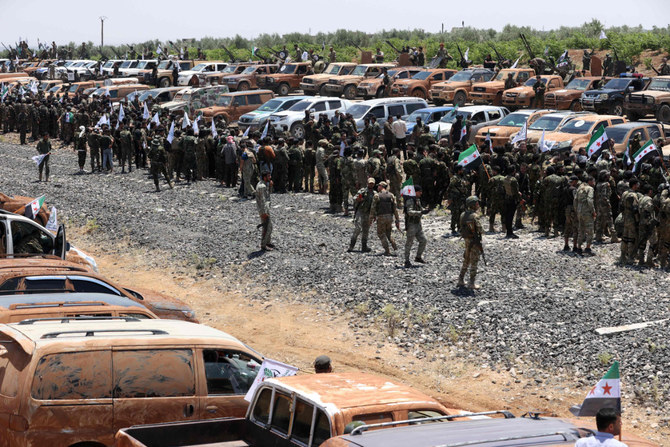

ANKARA: Turkish President Recep Tayyip Erdogan said on Friday that Turkey is in no rush to stage a new military operation against armed Kurdish militants.
But regional actors have voiced their concerns over the potential Turkish offensive against the towns of Tal Rifaat and Manbij.
“No need for hurry. We don’t need to do that,” Erdogan told journalists in Madrid, where he met with US President Joe Biden on the sidelines of the NATO summit. Erdogan offered no timeline for the planned operation.
The stakes are high. Experts believe that Turkey still lacks Russian backing for a military intervention against Syrian Kurdish People’s Protection Units (YPG), which Ankara considers to be a terror group with direct links to the outlawed Kurdistan Workers’ Party (PKK).
Oytun Orhan, coordinator of Syria studies at the ORSAM think tank in Ankara, said that Russia’s failure to back the operation remains its major obstacle.
“Ankara decided to launch a military offensive on Syria while the world’s attention is focused on the war in Ukraine — and after thousands of Russian troops withdrew from Ukraine. However, Russia cannot risk looking weak in both Ukraine or Syria by giving the greenlight to a Turkish operation now,” he told Arab News.
Orhan noted that Turkey only hit targets along the Turkish-Syrian border as retaliation against attacks by the YPG.
“I don’t expect a larger-scale operation in which the Syrian National Army would serve as ground forces and the Turkish military would give aerial support,” he said.
Ankara has previously conducted three military operations in the area: Euphrates Shield in 2016, Olive Branch in 2018, and Peace Spring in 2019.
Troop numbers from both Russia and the Syrian regime have been increasing in northern Syria since early June ahead of a potential Turkish operation.
Iran has also been very vocal in its opposition of any Turkish military operation in the area.
Iranian Foreign Ministry spokesperson Saaed Khatibzadeh recently said: “The Syria file is a matter of dispute between us and Turkey.”
On Saturday, Iran’s foreign minister paid a visit to Damascus following Turkey’s threats to launch the new offensive.
“Both from an ideological and strategic perspective, Iran accords importance to protecting Shiite settlements — especially the two Shiite towns of Nubl and Al-Zahra. And there are also some Shiite militia fighting along with the YPG in Tal Rifaat,” Orhan said.
“However, at this point, Russia’s position is much more (important to Turkey) than Iran’s concerns, because Russia controls the airspace in northern Syria and it would have to withdraw Russian forces before approving any Turkish operation,” he added.
Some experts have suggested that Turkey used its potential Syria operation as a bargaining chip during its recent negotiations with Washington. When Erdogan met Biden on June 29, they discussed the importance of maintaining stability in Syria, according to the White House readout.
The US-backed Syrian Democratic Forces (SDF), mainly led by the YPG, still holds large areas of northeast Syria. Syrian Kurds are regarded by Washington as an important ally against Daesh.
Although the Biden administration has repeatedly said that it acknowledges Turkey’s security concerns, it has also warned that any Turkish operation in northern Syria could put US troops at risk, and undermine the fight against Daesh.
Hamidreza Azizi, CATS fellow at the German Institute for International and Security Affairs, thinks that, given the course of events, the Turkish operation is inevitable.
“It (will) happen sooner or later. Because Turkish leaders have been maneuvering on what they see as threats Turkey is facing from northern Syria, we should expect some kind of military operation,” he told Arab News.
“But the scope of the operation has been a matter of speculation because, in the beginning, Turkish officials were talking about a vast area from Tal Rifaat and Manbij to east of the Euphrates, but they reconsidered after US opposition to the expansion of the operation east of the Euphrates,” Azizi said.
Azizi expects a limited operation to happen, the main aim of which would be to expand Turkey’s zone of influence in the area.
Turkey’s original plan had been to establish a 30 kilometer-deep security zone along its southern border both to push back the YPG and to repatriate around 1 million Syrian refugees in a wider safe zone.
President Erdogan recently announced a reconstruction plan to enable Syrians to return to their homeland.
Azizi believes that “the main friction” over this potential operation would be between Iran and Turkey.
“Iran is worried because if Turkey — or Turkish-backed troops — control Tal Rifaat, they have access to Aleppo, where Iran is present, which will give them further access to central Syria.”
Iran is still a key ally of Syrian President Bashar Assad, but also an important trade partner for Turkey.
Unless Turkey is able to come up with a new plan that alleviates Iran’s concerns, Azizi expects a response from the Iranian side — albeit an indirect one via proxy forces.
“Such a move could push Turkey to further strengthen ties with Arab states and cooperate further with Israel,” he said.
-ENDS-


