RAMALLAH/JERUSALEM: The Palestinian Authority handed the bullet that killed Al Jazeera journalist Shireen Abu Akleh to US forensic experts on Saturday as it seeks to prove conclusively that it was fired by an Israel soldier.
The announcement came just over a week before President Joe Biden is to visit Israel and the occupied West Bank for meetings with Israeli and Palestinian leaders. It signaled that both sides may be working to find a solution to the deadlock.
The Palestinian Authority was assured that no modifications would be made to the bullet that killed Abu Akleh during an Israeli raid in the occupied West Bank, and that it would be returned as soon as the assessment was complete, Palestinian Attorney General Akram Al-Khatib told AFP.
The Palestinian Authority gave the green light to hand over the bullet to the United States, the Palestinians’ official Wafa news agency reported.
Israel says it has identified the rifle that may have shot her, but that it cannot draw any conclusions unless it is compared to the bullet. The Palestinians have refused to turn over the bullet, saying they don’t trust Israel. Rights groups say Israel has a poor record investigating shootings of Palestinians by its troops, with probes languishing for months or years before they are quietly closed.
Al-Khatib reiterated the Palestinian refusal to share the bullet with the Israelis but said the Palestinians welcome the participation of any international bodies to “help us confirm the truth.”
“We are confident and certain of our investigations and the results we have reached,” he said.
It was not immediately clear what the American experts could discover without also studying the Israeli weapon. It also was not clear whether Israel would turn over the rifle to the Americans. The Israeli military declined comment, and US Embassy’s Office of Palestinian Affairs said it had “no new information to offer.”
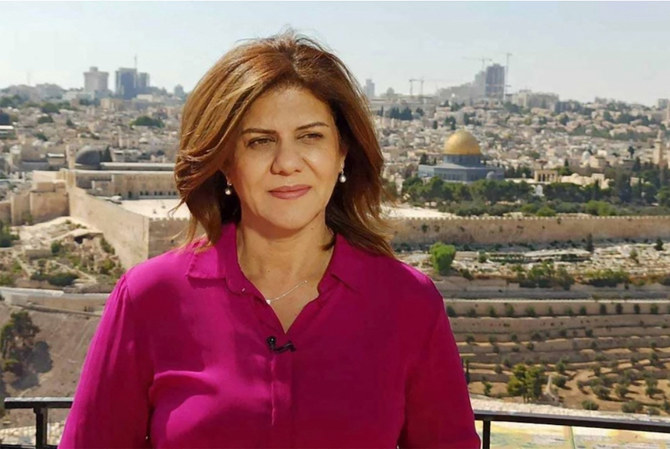
The Palestinian-American journalist, who was wearing a vest marked “Press” and a helmet, was killed on May 11 while covering an Israeli army operation in Jenin camp in the northern West Bank.
The official Palestinian investigation found that the Qatar-based television channel’s star reporter was killed after being hit by a bullet just below her helmet.
It found that Abu Akleh was killed with a 5.56 millimeter armor-piercing round fired from a Ruger Mini-14 rifle.
US Secretary of State Antony Blinken had promised last month to pursue accountability over the killing of Abu Akleh wherever the facts might lead.
“We are looking for an independent, credible investigation. When that investigation happens, we will follow the facts, wherever they lead. It’s as straightforward as that,” said Blinken.
A Palestinian official, speaking on condition of anonymity because he was discussing a diplomatic matter, said the issue was raised in a phone call between Palestinian President Mahmoud Abbas and Secretary of State Antony Blinken and that both sides hope to resolve the issue before Biden’s arrival on July 13.
Investigations by the UN, as well as several journalistic probes, have found that the shot that killed Abu Akleh was fired by Israeli forces.
“We find that the shots that killed Abu Akleh came from Israeli security forces,” UN Human Rights Office spokeswoman Ravina Shamdasani told reporters in Geneva.
“It is deeply disturbing that Israeli authorities have not conducted a criminal investigation,” she said.
The UN rights office inspected photo, video and audio material, visited the scene, consulted experts, reviewed official communications and interviewed witnesses.
The probe examined submissions from the Israeli army and the Palestinian attorney general.
However, the Israeli army branded the UN’s findings unfounded, insisting it was “not possible” to determine how Abu Akleh was killed.
“The IDF (Israel Defense Force) investigation clearly concludes that Ms. Abu Akleh was not intentionally shot by an IDF soldier and that it is not possible to determine whether she was killed by a Palestinian gunman shooting indiscriminately... or inadvertently by an IDF soldier,” the military said.
Israel has repeatedly called on the Palestinian Authority to give it the bullet but the Palestinians have refused to do so and have rejected any collaboration with Israel in the investigation.
Abu Akleh, who was 51, was a widely known and respected on-air correspondent who rose to fame two decades ago during the second Palestinian intifada, or uprising, against Israeli rule. She documented the harsh realities of life under Israeli military rule — now well into its sixth decade with no end in sight — for viewers across the Arab world.
(With AFP and AP)


![]()

Palestinians hand bullet that killed Al Jazeera journalist Shireen Abu Akleh to US
Short Url
https://arab.news/meh7a
Palestinians hand bullet that killed Al Jazeera journalist Shireen Abu Akleh to US
- Palestinian attorney general says authorities agreed to allow the US side to conduct ballistic works on the bullet
- Abu Akleh was killed while covering an Israeli military raid in Jenin in the occupied West Bank


Latest updates


© 2026 SAUDI RESEARCH & PUBLISHING COMPANY, All Rights Reserved And subject to Terms of Use Agreement.