- Moazzam Shah Bukhari Syed has helped provide early education to over 3,000 children, send over 1,400 to schools
- After Hyderabad and Tharparkar, Syed plans to expand his Walkway School initiative to Sindh’s Jamshoro district
KARACHI: A young Pakistani, Moazzam Shah Bukhari Syed, on Friday bagged the prestigious Diana Award for his Hyderabad-based ‘The Walkway School’ initiative, which has been striving to enroll poor, out-of-school children in rural areas of Pakistan’s southern Sindh province.
Established in memory of Diana, Princess of Wales, the Diana Award is the most prestigious accolade a young person aged 9-25 can receive for their social action or humanitarian work. The results for the award’s 2022 Roll of Honour were announced on Friday.
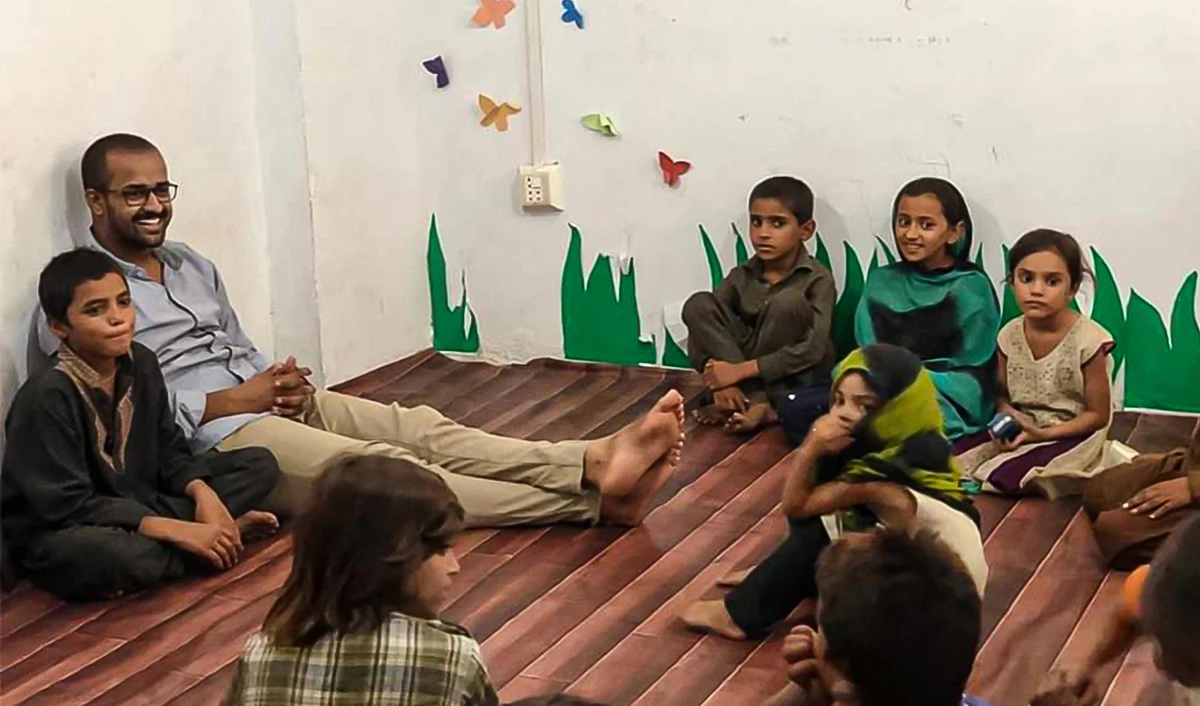
Syed was nominated for the honor in February by the United Nations Development Programme (UNDP) in Asia Pacific. Through his Walkway School, a youth-led initiative launched in 2018, he has helped provide early childhood education to over 3,000 children, send over 1,400 children to schools on fully funded scholarships and open multiple schools for over 1,500 children in Sindh’s Hyderabad and Tharparkar districts. He now plans to expand the initiative to Jamshoro district.
“This endorsement of our cause and winning this prestigious award will open a lot more doors of opportunities for us and it will obviously inspire a lot of other people to get into this work,” he told Arab News on Friday.
“All of the responsibility is not of the government, some responsibility is ours too toward our society.”
The Walkway School bridges the gap between communities and public/private sector institutions, and tries to reduce the ratio of out-of-school children by seizing existing opportunities, according to Syed.
“In primary school, we outsource children from communities,” Syed explained. “We induct them through mobilization and then we process their mainstreaming after which we get them enrolled to private schools with multi-year fully funded scholarships.”
As a young child, Syed says, he was lucky enough to attend an excellent private school, but that all changed when his family experienced a huge financial crisis. Experiencing the stark difference between the best and the rest of educational opportunities became his inspiration to build a school that would help all children get quality education regardless of their financial status.
“It was rather a personal trauma which turned into an inspiration where I wanted to do something sustainable that benefits people in the long run instead of feeding them temporarily,” he told Arab News.
“I know how it feels when you cannot avail an opportunity due to lack of finances. I do relate a lot with it.”
The Walkway School now has three fully built educational facilities in Hyderabad and Tharparkar districts.
“Our secondary way of intervention is we create one or two-room spaces, with water sanitation as well as access to clean energy, in rural areas where schools are registered but the buildings do not exist,” Syed said. “So that children can study there without any hindrance.”
As part of his 2025 expansion plan, Syed wishes to create at least 50 cost-effective, sustainable safe spaces where children from diverse backgrounds can study without having to worry about finances. He intends to go abroad in the next few months to raise funds for the expansion.