Ukraine army accuses Russia of firing phosphorus bombs on Snake Island

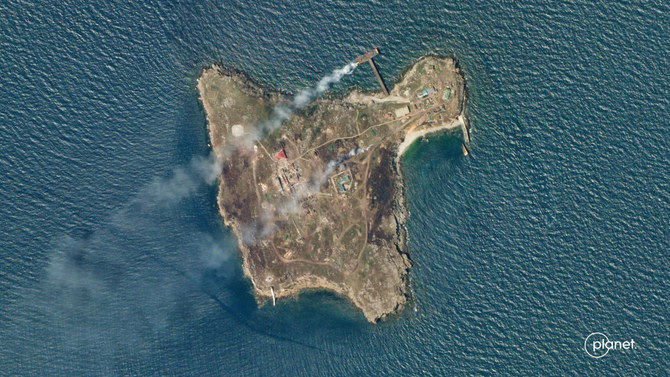
A satellite image shows smoke rising from Snake Island, off the coast of Ukraine, on Wednesday. (Reuters)
Short Url
Updated 01 July 2022
Follow

Ukraine army accuses Russia of firing phosphorus bombs on Snake Island

  • Russian air force SU-30 planes twice conducted strikes with phosphorus bombs on Zmiinyi island
  • The Russian defence ministry on Thursday described the retreat as "a gesture of goodwill"

KYIV: Ukraine’s army accused Russia of carrying out strikes using incendiary phosphorus munitions on Snake Island Friday, just a day after Moscow withdrew its forces from the rocky outcrop in the Black Sea.
“Today at around 18:00... Russian air force SU-30 planes twice conducted strikes with phosphorus bombs on Zmiinyi island,” it said in a statement, using another name for Snake Island.
The Russian defense ministry on Thursday described the retreat as “a gesture of goodwill” meant to demonstrate that Moscow will not interfere with UN efforts to organize protected grain exports from Ukraine.
The Ukrainian army on Friday accused the Russians of being unable to “respect even their own declarations.”
Its statement was accompanied by a video that showed a plane drop munitions at least twice on the island, and what appeared to be white streaks rising above it.
Phosphorus weapons, which leave a signature white trail in the sky, are incendiary weapons whose use against civilians is banned under an international convention but allowed for military targets.
Ukraine has accused Russia of using them several times since it invaded its neighbor in late February, including on civilian areas, allegations Moscow has denied.
Ukraine claimed the Russians were forced to retreat from the island after coming under a barrage of artillery and missile fire.
Snake Island became famous after a radio exchange went viral at the start of the war, in which Ukrainian soldiers respond using bad words to a Russian warship that called on them to surrender.


Indonesia sets rules limiting use of AI for schoolchildren

Updated 4 sec ago
Follow

Indonesia sets rules limiting use of AI for schoolchildren

  • Indonesian children spend about 7.5 hours daily on tablets, smartphones
  • Gen Zs make up the majority of AI users in the country of 280m people

JAKARTA: The Indonesian government introduced on Thursday a new policy regulating the use of digital technology in education, limiting access to artificial intelligence for students.

Generation Alphas and Gen Zs make up almost half of Indonesia’s online population, which reached nearly 230 million people in 2025, according to a survey conducted by the Association of Indonesian Internet Service Providers.

As Indonesian children clock around 7.5 hours of daily screen time, the joint ministerial decree seeks to boost the benefits of digital technology and AI in formal and informal educational institutions, while also protecting the youth from risks in digital spaces.

“There are a lot of factors but the number of teenagers with mental health issues are high and continue to increase, and one of the suspected triggers — that have been proven academically — is the uncontrolled, unmitigated use of digital technology,” said Pratikno, Indonesia’s Coordinating Minister for Human Development and Cultural Affairs.

“The effects on education are also concerning, such as how it weakens brain activity due to dependence on digital technology tools and reduces critical thinking and cognitive and reflective abilities. This is what we have to regulate.”

Among Indonesia’s 280 million population, around a quarter of internet users are already using AI, with Gen Zs making up about 43 percent of that segment.

The joint decree, which Pratikno described as “comprehensive” and encompasses early childhood education to higher education, was signed in Jakarta by seven ministers, including Higher Education, Science and Technology Minister Brian Yuliarto and Primary and Secondary Education Minister Abdul Mu’ti.

“This decree seeks to ensure that our children are not controlled by technology but become the masters of technology for good, that is our goal. (It prioritizes) digital wellness, (for tech to be used) wisely and intelligently,” Pratikno said.

The policy is important to support young Indonesians, many of whom are internet users from adolescence, said Communication and Digital Affairs Minister Meutya Hafid, who also signed the ministerial decree.

“Indonesia has a significant number of children using the internet. Therefore, we must ensure that they are not only a target market for the technology industry, but also able to utilize technology according to their readiness,” she said.

“Every kind of technological advance has to consider the readiness of its users, especially children.”