

Riyadh no longer one of the 100 most expensive cities for expats: Mercer

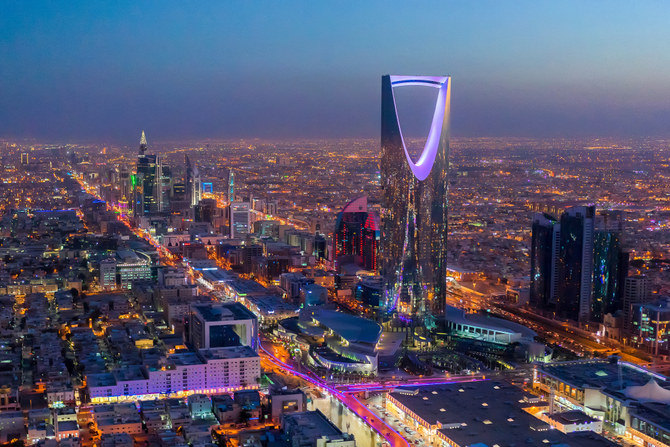
Riyadh was positioned at 103 in Mercer's Cost of Living Index 2022, falling from 29 in the previous year’s list (Shutterstock)
Short Url
Updated 03 July 2022
Follow

Riyadh no longer one of the 100 most expensive cities for expats: Mercer

RIYADH: Saudi Arabia’s capital, Riyadh, has dropped 72 places in a ranking of the world’s most expensive cities for expats as it tumbled out of the top 100, according to a report issued by Mercer.

Riyadh was positioned at 103 in Mercer’s Cost of Living Index 2022, falling from 29 in the previous year’s list. 

Commenting on Riyadh’s fall, Khaled Al-Mobayed, CEO of Menassat Reality Co., a Riyadh-based real estate developer, said: “The results came in contrary to the expectations, due to the pandemic’s ongoing consequences and the rising cost of logistics and supply chain.”

“Being out of the 100 top expensive cities is a good sign despite the challenges that the economy has gone through,” he added.
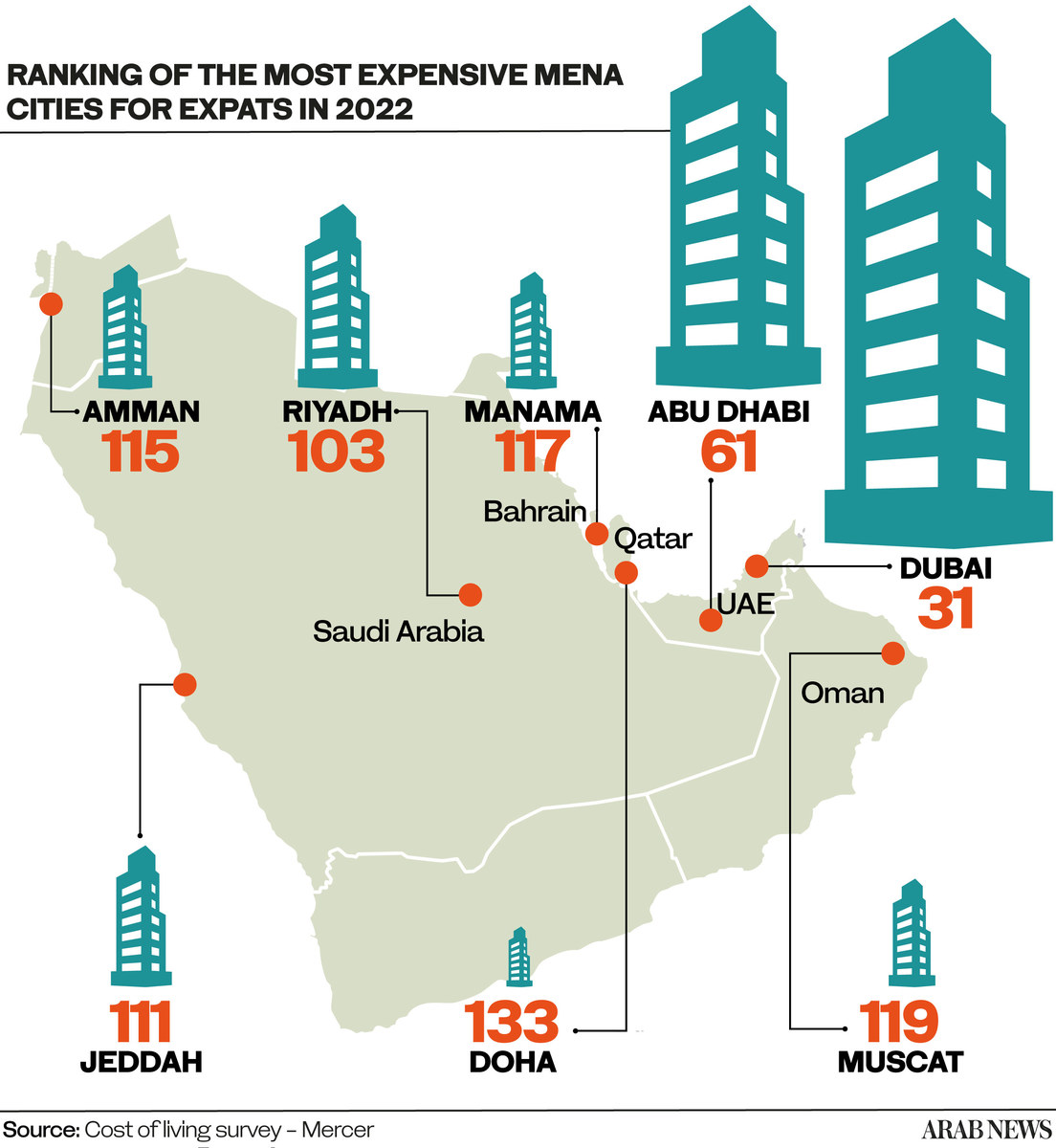
UAE's Dubai took over Lebanon's capital, Beirut, as the most expensive city among Arab countries in the region, ranking 31.

Despite being placed third in 2021, Beirut was not even on this year’s list of 227 cities due to the country’s economic turmoil.

The city’s fall reflects the severe drop in value of the Lebanese pound, according to Lebanese economic analyst Bassel Al-Khatib, who pointed out the minimum wage is now worth $20, while it was $450 before the economic crisis gripping the country. 

“Lebanon is extremely expensive to those who get paid in Lebanese pounds yet very cheap for those who get pain in US dollars,” he told Arab News, adding: “Lebanon was expensive for both citizens and foreigners, and with the currency dropping 95 percent and the dollar reaching record levels, the situation changed.”

“Everything has become expensive but not for foreigners who have dollars. All services by the government such as water, electricity fees, or internet are still the same but food prices skyrocketed,” he added.

Abu Dhabi was the second highest Arab city from the region, ranked at 61, while Jeddah came in at 111 this year compared to 94 in 2021.

Jordan's capital Amman ranked 115, followed by Bahrain's Manama at 117, Oman's Muscat at 119 and Kuwait city at 131.

Egypt's capital, Cairo, was placed at 154 while Rabat, Algiers and Tunis came as the least expensive in the region, ranking 162, 218 and 220 respectively.

Hong Kong topped the list as the most expensive city in the world in 2022, moving from second rank last year and taking the top spot from Turkmenistan’s capital, Ashgabat.

Switzerland’s Zurikh and Geneva followed as second and third most expensive cities, replacing Hong Kong and Beirut respectively.

Turkey’s capital, Ankara, came in as the least expensive city, ranking 227, taking the spot from Kyrgyzstan’s capital Bishkek.


Acwa signs key terms to develop 5GW of renewable energy capacity in Turkiye

Updated 23 February 2026
Follow

Acwa signs key terms to develop 5GW of renewable energy capacity in Turkiye

JEDDAH: Saudi utility giant Acwa has signed key investment agreements with Turkiye’s Ministry of Energy and Natural Resources to develop up to 5 gigawatts of renewable energy capacity, starting with 2GW of solar power across two plants in Sivas and Taseli.

Under the investment agreement, Acwa will develop, finance, and construct, as well as commission and operate both facilities, according to a press release.

The program builds on the company’s first investment in Turkiye, the 927-megawatt Kirikkale Independent Power Plant, valued at $930 million, which offsets approximately 1.8 million tonnes of carbon dioxide annually, the statement added.

A separate power purchase agreement has been concluded with Elektrik Uretim Anonim Sirketi for the sale of electricity generated by each facility.

Turkiye aims to boost solar and wind capacity to 120GW by 2035, supported by around $80 billion in investment, while recent projects have already helped prevent 12.5 million tonnes of CO2 emissions and reduced reliance on imported natural gas.

Turkiye’s energy sector has undergone a rapid transformation in recent years, with renewable power emerging as a central pillar of its strategy.

Raad Al-Saady, vice chairman and managing director of ACWA, said: “The signing of the IA (implementation agreement) and PPA key terms marks a pivotal moment in Acwa’s partnership with Turkiye, reflecting the country’s strong potential as a clean energy leader and manufacturing powerhouse.”

He added: “Building on our long-standing presence, including the 927MW Kirikkale Power Plant commissioned in 2017, this step elevates our partnership to a new level,” Al-Saady said.

In its statement, Acwa said the 5GW renewable energy program will deliver electricity at fixed prices, enhancing predictability for grid planning and supporting long-term industrial investment.

By replacing imported fossil fuels with domestically generated clean energy, the initiative is expected to reduce Turkiye’s exposure to global energy market volatility, strengthening energy security and lowering long-term power costs.

The company added that the economic impact will extend beyond the anticipated investment of up to $5 billion in foreign direct investment, with thousands of jobs expected during the construction phase and hundreds of high-skilled roles created during operations.

The energy firm concluded that its existing progress in Turkiye reflects a strong appreciation for Turkish engineering, construction, and manufacturing capacity, adding that localization has been a strategic priority, and it has already achieved 100 percent local employment at its developments in the country.