

OPEC meeting ends without making any policy decisions

Sources are saying a big policy change is unlikely this month, according Reuters (Shutterstock)
Short Url
Updated 30 June 2022
Follow

OPEC meeting ends without making any policy decisions

No major decisions were reached at the end of a meeting of ministers from the Organization of the Petroleum Exporting Countries on Wednesday, according to Reuters.

The news agency reported unnamed delegates as saying that administrative issues were discussed during the first of two-days of meetings.

On Thursday, ministers from the joint ministerial monitoring committee of OPEC+ — which is OPEC and its allies including Russia, will begin discussions from 1100 GMT and then hold a full online OPEC+ meeting.

Sources are saying a big policy change is unlikely this month, according Reuters.

At its last gathering in early June, OPEC+ decided to raise output each month by 648,000 barrels per day (bpd) in July and August, compared with a previous plan to add 432,000 bpd over three months.

Washington welcomed the producers’ decision in June that followed months of pressure from the West on OPEC+ to raise production to help lower oil prices.

International prices hit their highest since the record levels of 2008 after the West imposed sanctions on Russia over its invasion of Ukraine begun on Feb. 24, which Moscow calls “a special military operation.”
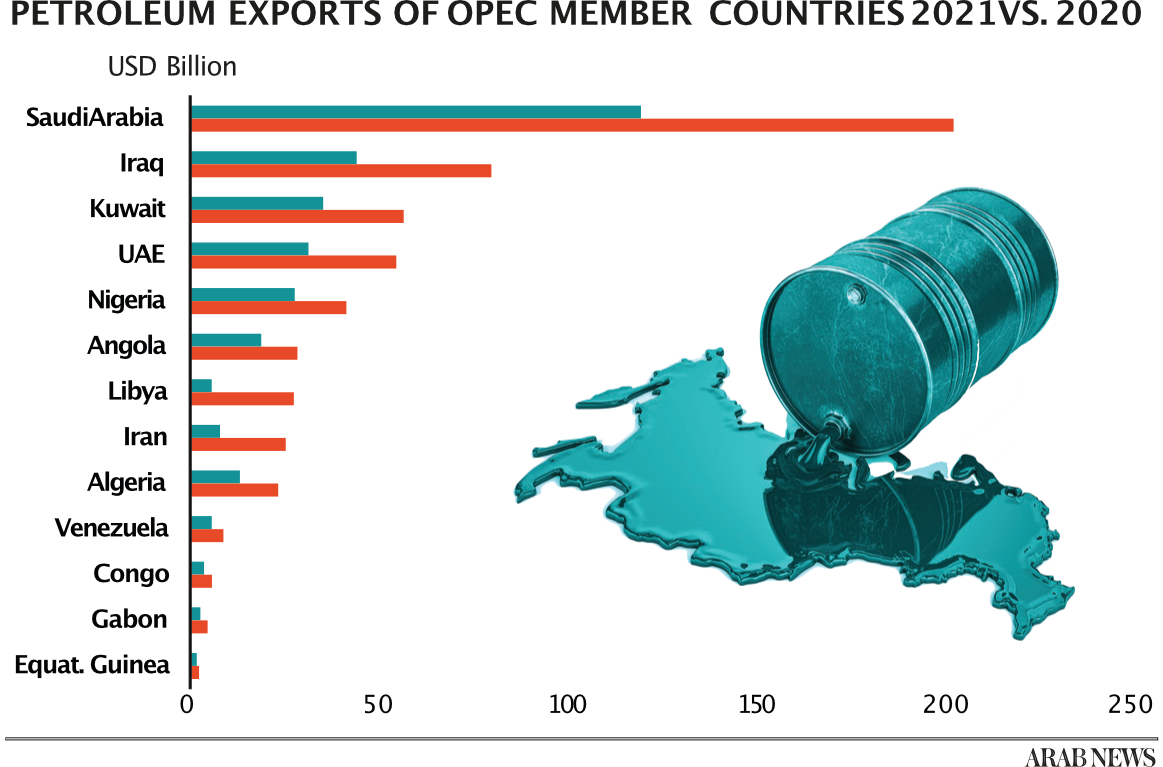
They have eased since this year’s March peaks, but rose for a fourth day on Wednesday to approach $120 a barrel because of tight supply and concern OPEC has little ability to raise output.

French President Emmanuel Macron told US President Joe Biden this week he had been told that Saudi Arabia and the United Arab Emirates, considered the only OPEC members with significant spare capacity, can barely increase oil production.

Biden will travel to the Middle East, including Saudi Arabia next month, and is widely expected to press Riyadh to raise production.

At least five OPEC+ delegates said this week’s meeting will focus on confirming August output policies and would not discuss September.

Two other delegates said the issue of production after August could emerge but it was unclear what steps could be taken.

Oil prices

Oil prices gained for a fourth straight session on Wednesday with tight supply worries offset- ting concerns about a weaker global economy.

Brent crude futures for August were up 87 cents to $118.85 a barrel by 1132 GMT. The August contract will expire on Thursday and the more-active September contract was at $114.79, up 99 cents, or 0.87 percent.

US West Texas Intermediate crude futures were up $1.20, or 1.1 percent, to $112.96 a barrel.

Both contracts rose more than 2 percent on Tuesday as concerns over tight supplies due to Western sanctions on Russia outweighed fears that demand may slow in a potential future recession.


With input from Reuters


Kuwait to boost Islamic finance with sukuk regulation

Updated 05 February 2026
Follow

Kuwait to boost Islamic finance with sukuk regulation

  • The move supports sustainable financing and is part of Kuwait’s efforts to diversify its oil-dependent economy

RIYADH: Kuwait is planning to introduce legislation to regulate the issuance of sukuk, or Islamic bonds, both domestically and internationally, as part of efforts to support more sustainable financing for the oil-rich Gulf nation, Prime Minister Sheikh Ahmad Abdullah Al-Ahmad Al-Sabah said on Wednesday.

Speaking at the World Governments Summit in Dubai, Al-Sabah highlighted that Kuwait is exploring a variety of debt instruments to diversify its economy. The country has been implementing fiscal reforms aimed at stimulating growth and controlling its budget deficit amid persistently low oil prices. Hydrocarbons continue to dominate Kuwait’s revenue stream, accounting for nearly 90 percent of government income in 2024.

The Gulf Cooperation Council’s debt capital market is projected to exceed $1.25 trillion by 2026, driven by project funding and government initiatives, representing a 13.6 percent expansion, according to Fitch Ratings.

The region is expected to remain one of the largest sources of US dollar-denominated debt and sukuk issuance among emerging markets. Fitch also noted that cross-sector economic diversification, refinancing needs, and deficit funding are key factors behind this growth.

“We are about to approve the first legislation regulating issuance of government sukuk locally and internationally, in accordance with Islamic laws,” Al-Sabah said.

“This enables us to deal with financial challenges flexibly and responsibly, and to plan for medium and long-term finances.”

Kuwait returned to global debt markets last year with strong results, raising $11.25 billion through a three-part bond sale — the country’s first US dollar issuance since 2017 — drawing substantial investor demand. In March, a new public debt law raised the borrowing ceiling to 30 billion dinars ($98 billion) from 10 billion dinars, enabling longer-term borrowing.

The Gulf’s debt capital markets, which totaled $1.1 trillion at the end of the third quarter of 2025, have evolved from primarily sovereign funding tools into increasingly sophisticated instruments serving governments, banks, and corporates alike. As diversification efforts accelerate and refinancing cycles intensify, regional issuers have become regular participants in global debt markets, reinforcing the GCC’s role in emerging-market capital flows.

In 2025, GCC countries accounted for 35 percent of all emerging-market US dollar debt issuance, excluding China, with growth in US dollar sukuk issuance notably outpacing conventional bonds. The region’s total outstanding debt capital markets grew more than 14 percent year on year, reaching $1.1 trillion.