KREMENCHUK: France’s president denounced Russia’s fiery airstrike on a crowded shopping mall in Ukraine as a “new war crime” Tuesday and vowed the West’s support for Kyiv would not waver, saying Moscow “cannot and should not win” the war.
The strike, which killed at least 18 people in the central city of Kremenchuk, came as leaders from the Group of Seven nations met in Europe. It was part of unusually intense barrage of Russian fire across Ukraine, including in the capital of Kyiv, that renewed international attention as the war drags on.
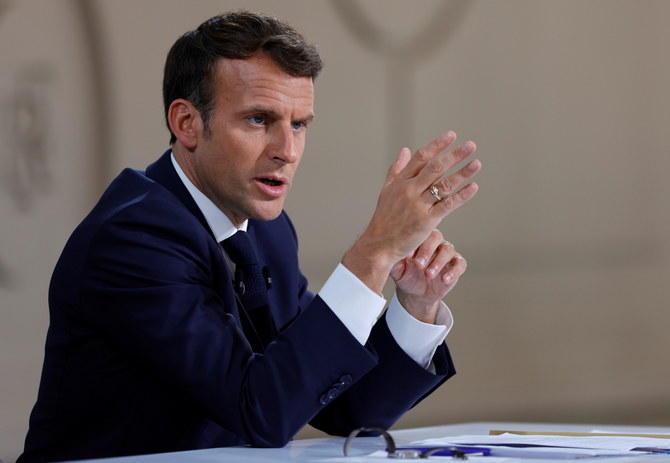
Speaking at the end of the G-7 summit in Germany, French President Emmanuel Macron appeared to address that concern, vowing that the seven leading industrialized democracies would support Ukraine and maintain sanctions against Russia “as long as necessary, and with the necessary intensity.”
“Russia cannot and should not win,” he said. He called Monday’s attack on the mall “a new war crime.”
As they have in other attacks, Russian authorities claimed that the shopping center was not the target.
How to counter Russia and back Ukraine will also be the focus of a summit this week of the western NATO alliance, whose support has been critical to Kyiv’s ability to fend off Moscow’s larger and better equipped forces. Ukrainian leaders, however, say they need more and better weapons if they are to hold off and even drive back Russia, which is pressing an all-out assault in Ukraine’s eastern region of the Donbas.
As Macron spoke, rescuers combed through the charred rubble of the shopping mall that authorities said was struck when more than 1,000 afternoon shoppers and workers were inside.
Kateryna Romashyna, a local resident, told The Associated Press that she had just arrived at the mall when an explosion knocked her down. When another blast came about 10 minutes later, she realized she needed to get away.
“I ran away from the epicenter with all of my strength,” she said. Fighting back tears, she added: “You have to be a real monster” to strike a shopping mall.
Many of those inside quickly fled the building when an air raid siren sounded and took shelter across the street, Ukrainian Interior Minister Denis Monastyrsky said. Several of the bodies of those who didn’t make it out in time are burned beyond recognition, he said.
In addition to the 18 killed, authorities said 59 were wounded. Another 21 people are still missing, Monastyrsky said.
The attack recalled strikes earlier in the war that hit a theater, a train station, and a hospital. Ukrainian President Volodymyr Zelenskyy called it “one of the most daring terrorist attacks in European history.”
Rocket attacks continued elsewhere in Ukraine, with authorities in the city of Dnipro reporting that workers at a diesel car repair shop were trapped in rubble after a strike from a cruise missile fired from the Black Sea, Ukrainian news agencies reported. The Ukrainian military managed to intercept and destroy other missiles fired at the city, the agencies said.
At Ukraine’s request, the U.N. Security Council scheduled an emergency meeting in New York on Tuesday to discuss the Kremenchuk attack.
As condemnation came in from many quarters, Kremlin spokesman Dmitry Peskov struck a defiant note, saying Russia would press its offensive until it fulfills its goals. He said the hostilities could stop “before the end of the day” if Ukraine were to surrender and meet Russia’s demands, including recognizing its control over territory it has taken by force.
Russian Defense Ministry spokesman Lt. Gen. Igor Konashenkov claimed that warplanes fired precision-guided missiles at a depot that contained Western weapons and ammunition, which detonated and set the mall on fire. Ukrainian authorities said that in addition to the direct hit on the mall, a factory was struck, but denied it housed weapons.
Konashenkov also alleged that the mall was not in use, a false claim that witnesses contradicted.
One survivor, Oleksandr, a mall employee, told the AP from a hospital bed that the shopping center was packed with customers. He recalled stepping outside with a colleague for a cigarette when the air raid siren went off.
“There was a black tunnel, smoke, fire,” he said. “I started to crawl. I saw the sun up there, and my brain was telling me I need to save myself.”
Ukraine’s prosecutor general, Iryna Venediktova, said the missile attack was one of Russia’s “crimes against humanity.” She emphasized the need for all Ukrainians to remain alert and expect a similar strike “every minute.”
On Tuesday, Russian forces struck the Black Sea city of Ochakiv, damaging apartment buildings and killing two, including a 6-year-old child. A further six people, four of them children, were wounded. One of them, a 3-month-old baby, is in a coma, according to officials.
The unusually intense spate of fire came as the G-7 leaders pledged continued support for Ukraine and prepared new sanctions against Russia, including a price cap on oil and higher tariffs on goods.
Zelenskyy has called for more air defense systems from his Western allies to help his forces fight back. NATO’s support for Ukraine will be a major focus of a summit starting this week in Madrid, and an early signal of unity came Tuesday when Turkey agreed to lift its opposition to Sweden and Finland joining NATO.
Russia’s invasion of Ukraine prompted the Nordic pair to abandon their long-held nonaligned status and apply to join NATO. But Turkish President Recep Tayyip Erdogan had blocked the move, insisting the Nordic pair change their stance on Kurdish rebel groups that Turkey considers terrorists.
Russian Foreign Minister Sergey Lavrov warned the West that “the more weapons are pumped into Ukraine, the longer the conflict will continue and the longer the agony of the Nazi regime backed by Western capitals will last.”
Russia has falsely called the war a campaign to “de-Nazify” Ukraine — a country with a democratically elected Jewish president who wants closer ties with the West.
In a sinister message to NATO leaders, Russia’s state space corporation Roscosmos published satellite images and the precise coordinates of the conference hall where their summit will be held.
It also posted images and the coordinates of the White House, the Pentagon and the government headquarters in London, Paris and Berlin — referring to them as “decision-making centers supporting the Ukrainian nationalists” in a message on the Telegram app. That wording echoes Russian President Vladimir Putin’s warnings that he could target such centers in response to what he has called Western aggression.
In other developments, the two fighting countries continued a sporadic series of prisoner exchanges. Ukraine exchanged 15 Russian prisoners-of-war for 16 Ukrainian soldiers and one civilian, the Ukrainian Pravda news outlet reported Tuesday.
Ukrainian Pravda also reported that in the Russian-occupied city of Kherson, the mayor was detained Tuesday and occupying authorities seized his computer hard drive and documents after he had refused to cooperate with Russian-appointed local officials. Russia’s Tass news agency confirmed the detention.
Meanwhile, Bulgaria said Tuesday it was expelling 70 Russian diplomats designated “a threat to national security,” ordering them to leave within 5 days.
A Bulgarian foreign ministry statement said this would reduce Russia’s Sofia embassy staff “to up to 23 diplomatic and 25 administrative and technical staff.”


![]()

Macron says Russia can’t win in Ukraine after strike on mall
Short Url
https://arab.news/j5umh
Macron says Russia can’t win in Ukraine after strike on mall
- France’s president has denounced Russia’s fiery airstrike on a crowded shopping mall in Ukraine as a “new war crime” and vowed the West’s support for Kyiv would not waver.
Latest updates


© 2026 SAUDI RESEARCH & PUBLISHING COMPANY, All Rights Reserved And subject to Terms of Use Agreement.