

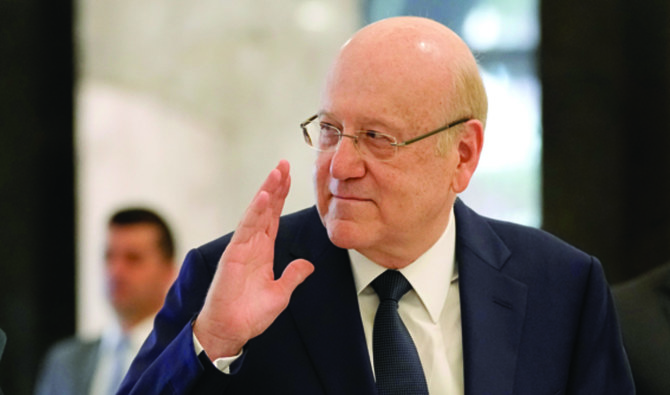

BEIRUT: Lebanon’s Prime Minister-designate Najib Mikati has held an initial round of nonbinding parliamentary consultations to discuss the formation of the country’s new government.
After the end of the consultations on June 28, Mikati is expected to submit a draft government to President Michel Aoun. The mission of the new government will be defined in a brief ministerial statement, including the urgent issues that could be accomplished in the few remaining months of Aoun’s presidency, which ends on Oct. 31.
If the proposed government fails to receive Aoun’s approval, then Lebanon will face fresh political gridlock.
That scenario could further damage the country’s ability to tackle urgent issues, “because we are running out of time and crises are succeeding one another, and are getting magnified,” one political observer said.
They warned that if Aoun blocks the proposal, “it means that the term of the new government will not exceed two months.
“If we take into consideration that drafting the ministerial statement, approving it and submitting it to the parliament for the government to gain the confidence vote, then this means that the government term will be of two months and would not be expected to resolve the crises or start the necessary 27 administrative and financial reforms determined by the International Monetary Fund.”
The Development and Liberation bloc headed by Parliament Speaker Nabih Berri called for “forming the government as soon as possible.”
After the bloc met Mikati, lawmaker Ali Hassan Khalil said: “We stressed the necessity of approving the financial recovery plan — which has not yet been referred to Parliament according to the constitutional procedures — while preserving the depositors’ credits in full.”
Berri’s bloc stressed the “necessity of resolving the issue of the electricity plants away from the debates that have been taking place lately, and of restructuring this sector.”
Khalil said: “We did not propose the form of the government because Mikati is aware of the current balances of power, and what concerns us is that the government be efficient.”
After meeting with Mikati, Deputy Parliament Speaker Elias Bou Saab said that he is “keen on forming the government fast in collaboration with President Aoun.”
Bou Saab, a member of the Free Patriotic Movement bloc, a Hezbollah ally, stressed the need to “form a government of political representation,” and called on the new government “to communicate with the Syrian government to resolve the crisis of Syrian refugees in Lebanon.”
The new government must repatriate Syrian refugees and revive the Kuwaiti initiative to rehabilitate Lebanon’s relations with the Gulf countries, he added.
The Lebanese Forces bloc said: “The Lebanese Forces will not participate in the new government.”
Lawmaker Georges Adwan said: “We want a government that recuperates the state’s decision and that rehabilitates Lebanon’s relations with other countries.”
Adwan called on Parliament to “elect a new president of the republic as soon as possible.”
The Democratic Gathering bloc, which represents the Progressive Socialist Party, declared that it would not feature in the new government. However, Taymur Jumblatt, president of the bloc, said: “We will help in forming it.”
President of the Hezbollah bloc, lawmaker Mohammed Raad, said: “We are not against the participation of anybody in the government, and we tender our hand to everybody.”
Before the parliamentary consultations began, Hezbollah Deputy Secretary-General Sheikh Naim Qassim called for amendments to be made to the standing caretaker government “in order not to waste time and exhaust the formation of the government with conditions and counter-conditions.”
He said: “Let anybody who wants to participate in the government to do so and cooperate, or let the prime minister-designate change some ministers in order not to fall into the trap of new names, which might take a long time.”
In Sunday’s sermon, Maronite Patriarch Mar Bechara Boutros Al-Rai said that he opposed the Christian blocs’ refusal to nominate a leader of the new government during compulsory consultations last week. He called on political parties to cooperate with Mikati “away from conditions that are not adequate for this crucial period, nor for the time available to them.”
He urged the need to “form a national government fast, and focus on preparing for the election of a rescue president to save the country, for any delay would only be explained by the desire to distract us from this constitutional duty.”
The two biggest Christian parties in Lebanon, the Lebanese Forces and the Free Patriotic Movement, did not nominate Mikati to head the new government. Political observers fear that Aoun’s party, the FPM, will try to impose strict conditions on the formation of a new government.
After meeting with Mikati, reform lawmakers declared that they will not take part in the new government. Lawmaker Halime El-Kaakour said: “We will not participate in any quota government. We demanded a small government of independents with exceptional prerogatives.”
Independent lawmaker Abdul Rahman Bizri said: “We might be heading towards a minority parliamentary government,” adding: “As independent political powers, we had remarks on the performance of the previous governments, especially the ones that were headed by Mikati.
“Had these government made achievements we would not have reached this point. We will not obstruct, and our dealing with Mikati will be based on his handling of hot issues.”
Meanwhile, employees of the Banque Du Liban declared a warning strike for one day on Tuesday in protest against legislative prosecutions and accusations by the prosecutor general of Mount Lebanon, judge Ghada Aoun, against BDL and its employees.
The BDL syndicate threatened open strikes that would paralyze Lebanon’s banking sector, unless the Supreme Judicial Council and the minister of justice intervene to put an end to the actions of the judge.


