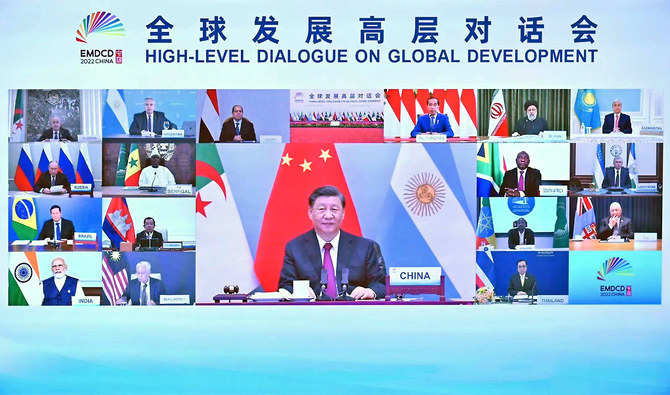

ISLAMABAD: Pakistan said on Monday its participation in a ‘High-level Dialogue on Global Development,’ held virtually and hosted by China on the sidelines of BRICS meetings this month, had been blocked by India, though foreign affairs experts said this would not have a negative effect on relations between longtime allies Islamabad and Beijing.
The BRICS countries comprise Brazil, Russia, India, China and South Africa.
China hosted the 14th BRICS summit on June 23 and focusing on an agenda regarding the expansion of the group, invited leaders of other non-member countries including Saudi Arabia, Argentina, Kazakhstan, Egypt, the United Arab Emirates, Indonesia, Nigeria, Senegal, and Thailand to its sideline meetings.
Asim Iftikhar Ahmed, the Pakistani foreign office spokesperson, confirmed to Arab News that India had blocked Pakistan’s participation in sideline meetings.
Pakistan and India have fought three wars and engaged in numerous smaller armed clashes, mostly over the disputed Himalayan territory of Kashmir.
“China being the host country engaged with Pakistan prior to the BRICS meetings, where decisions are taken after consultations with all BRICS members, including extending the invitation to non-members,” the foreign office said in a statement earlier in the day. “Regrettably one member blocked Pakistan’s participation.”
The spokesperson hoped future engagement of the organization would be based on the “principles of inclusivity, keeping in view the overall interests of the developing world and in a manner that is devoid of “narrow geopolitical considerations.”
“Pakistan stands ready to work with all developing countries, including the BRICS members for addressing the challenges faced by the global community,” he said.
When questioned by Arab News on the impact on Pak-China relations of Pakistan’s absence from the BRICS meeting, the foreign office spokesperson declined comment.
China caving in to ostensible Indian pressure comes even as ties between New Delhi and Beijing remain strained after a fatal border clash in the Galwan valley in June 2020 left at least 20 Indian and four Chinese soldiers dead.
Beijing has repeatedly said that the border standoff, which is ongoing, does not represent the entirety of China-India relations, while New Delhi has maintained that peace along the frontier is essential for the two countries to work together.
China is India’s largest trading partner, with bilateral trade expanding exponentially since the turn of the century to $95.02 billion in 2021/22. More than 100 Chinese companies, including state-owned enterprises, operate in India, including electronics manufacturers that have come to dominate the country’s mobile phone market.
Abdul Basit, a former Pakistani ambassador who has served in India, said the recent dialogue was merely a sideline meeting and would not have much impact but cautioned that Pakistan be more careful about upcoming multilateral meetings where India could attempt to harm Islamabad’s interests.
“Pakistan must also ensure that India should not be invited to the upcoming Organization of Islamic Cooperation summits as their participation would be harmful to Pakistan,” Basit added.
Naghmana Hashmi, Pakistan’s former ambassador to China, said Pakistan missing the sideline meeting would not have “any kind of negative impact” on Pakistan’s relations with China.
“China wanted Pakistan to be on the table but because of the regulation of unanimous decision by all the BRICS members, they [Chinese] did not have any option left,” she added.
Syed Muhammad Ali, a foreign and strategic affairs expert, said the Indian approach toward Pakistan’s participation was driven by “narrow and short-term geopolitical goals,” instead of a spirit of inclusivity, accommodation and cooperation.
“This Indian attitude has also prevented SAARC, another important regional forum, from playing a more substantive and constructive role in regional cooperation and progress,” he told Arab News, referring to
the South Asian Association for Regional Cooperation (SAARC), an economic and political organization of eight countries in South Asia.
Pakistan, perpetually in a brittle relationship with the United States, has leaned closely to longtime partner China in recent decades, offering its “all-weather friendship” with Beijing as an alternative to Washington.
In 2015, China and Pakistan launched a plan for energy and infrastructure projects in Pakistan worth over $60 billion, linking their economies and underscoring China’s economic ambitions in Asia and beyond. In March this year, the Pakistan Air Force showed off the latest addition to its fleet, next-generation Chinese J-10 C fighter jets, as the longtime allies counter what they see as the threat from regional military rival India.
“Pakistan and China are all-weather strategic partners and our iron brotherhood remains rock solid,” the foreign office statement said. “The two countries are fully committed to take our all-round cooperation to higher levels both bilaterally and multilaterally.”