

Pakistan says difficult to outbid European nations for LNG procurement amid war in Ukraine

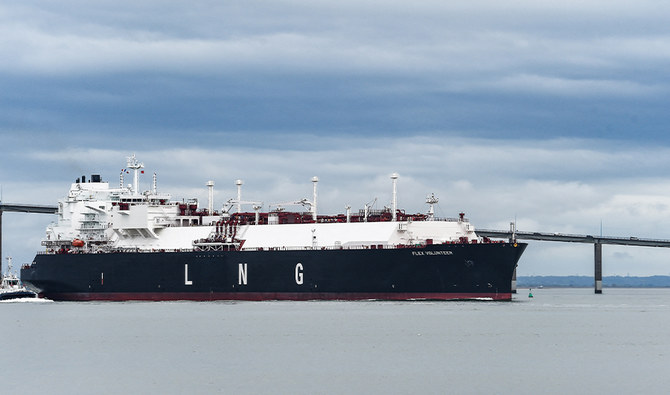
The LNG (liquefied natural gas) tanker Flex Volunteer, sailing under the flag of the Marshall Islands, near Saint-Nazaire, western France, on April 12, 2022. (AFP)
Short Url
Updated 26 June 2022
Follow

Pakistan says difficult to outbid European nations for LNG procurement amid war in Ukraine

  • The state minister for petroleum says Pakistan does not have enough energy at this stage
  • Musadik Malik says the country is importing furnace oil and coal to run energy production units

ISLAMABAD: Pakistan’s state minister for petroleum Musadik Masood Malik admitted on Saturday his country was finding it difficult to procure liquefied natural gas (LNG) from international market since it could not outbid rich European nations that stopped their energy imports from Russia earlier this year.


President Vladimir Putin ordered the armed forces of his country to invade Ukraine in February, causing massive disruption to the global energy market. While European nations hit Moscow with painful economic sanctions, they turned to other oil and gas producers to meet their energy demand.


Speaking at a two-day conference organized by the Center of Excellence in Journalism at the Institute of Business Administration in Karachi, Malik said Pakistan had carried out two rounds of tenders for LNG but failed to find a bidder.


“Since supply from Russia is suspended due to its war with Ukraine, European countries are also buying gas from everywhere it is available,” he was quoted by Dawn newspaper as saying.
Malik added the cost of LNG, which was $4 about two-and-a-half years ago, had exceeded to $40 due to the war.


He told the audience that Pakistan did not have enough energy and could not afford expensive gas.


“So, what we are doing is arranging alternates,” he added. “The recent increase in production, imports of coal and furnace oil is part of the same strategy.”


The minister disclosed that Pakistan had imported five ships of furnace oil within a month while acquiring coal in large quantities to run its energy production units. He hoped the increased imports of furnace oil and coal would provide some relief to the masses after July 15 when the monsoon season is also expected to improve water flows for hydel power generation.


Malik said these were tough decisions, though he added the government could not “sit idle and keep watching as the country turns into Sri Lanka.”


Sindh assembly passes resolution rejecting move to separate Karachi

Updated 21 February 2026
Follow

Sindh assembly passes resolution rejecting move to separate Karachi

  • Chief Minister Shah cites constitutional safeguards against altering provincial boundaries
  • Calls to separate Karachi intensified amid governance concerns after a mall fire last month

ISLAMABAD: The provincial assembly of Pakistan’s southern Sindh province on Saturday passed a resolution rejecting any move to separate Karachi, declaring its territorial integrity “non-negotiable” amid political calls to carve the city out as a separate administrative unit.

The resolution comes after fresh demands by the Muttahida Qaumi Movement (MQM) and other voices to grant Karachi provincial or federal status following governance challenges highlighted by the deadly Gul Plaza fire earlier this year that killed 80 people.

Karachi, Pakistan’s largest and most densely populated city, is the country’s main commercial hub and contributes a significant share to the national economy.

Chief Minister Syed Murad Ali Shah tabled the resolution in the assembly, condemning what he described as “divisive statements” about breaking up Sindh or detaching Karachi.

“The province that played a foundational role in the creation of Pakistan cannot allow the fragmentation of its own historic homeland,” Shah told lawmakers, adding that any attempt to divide Sindh or separate Karachi was contrary to the constitution and democratic norms.

Citing Article 239 of Pakistan’s 1973 Constitution, which requires the consent of not less than two-thirds of a provincial assembly to alter provincial boundaries, Shah said any such move could not proceed without the assembly’s approval.

“If any such move is attempted, it is this Assembly — by a two-thirds majority — that will decide,” he said.

The resolution reaffirmed that Karachi would “forever remain” an integral part of Sindh and directed the provincial government to forward the motion to the president, prime minister and parliamentary leadership for record.

Shah said the resolution was not aimed at anyone but referred to the shifting stance of MQM in the debate while warning that opposing the resolution would amount to supporting the division of Sindh.

The party has been a major political force in Karachi with a significant vote bank in the city and has frequently criticized Shah’s provincial administration over its governance of Pakistan’s largest metropolis.

Taha Ahmed Khan, a senior MQM leader, acknowledged that his party had “presented its demand openly on television channels with clear and logical arguments” to separate Karachi from Sindh.

“It is a purely constitutional debate,” he told Arab News by phone. “We are aware that the Pakistan Peoples Party, which rules the province, holds a two-thirds majority and that a new province cannot be created at this stage. But that does not mean new provinces can never be formed.”

Calls to alter Karachi’s status have periodically surfaced amid longstanding complaints over governance, infrastructure and administrative control in the megacity, though no formal proposal to redraw provincial boundaries has been introduced at the federal level.