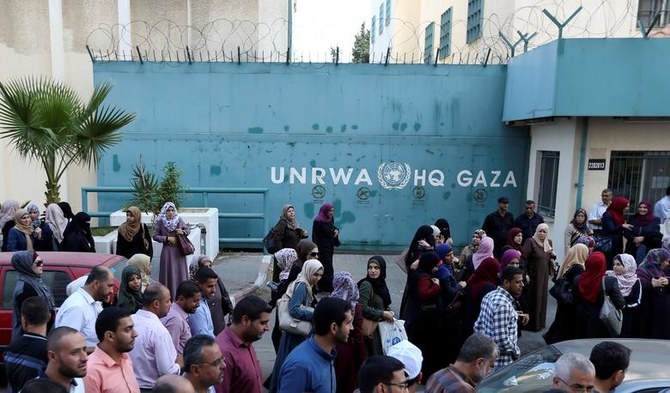

UNITED NATIONS: The solution to the chronic underfunding of the UN agency helping Palestinian refugees lies in a “political will” that matches declarations of support for its work, the head of the UN Relief and Works Agency told Arab News.
Philippe Lazzarini’s comments came at a press briefing a day after a pledging conference that raised $160 million from international donors.
This leaves the agency short of $100 million needed to support education for more than half a million Palestinian children, health care services for over 2 million people, and cash assistance for the poorest among them.
The $100 million shortfall is about the same as UNRWA has faced every year for almost a decade.
This year, however, skyrocketing costs mean the agency will not be able to absorb the shortfall through austerity and cost-control measures as “there’s very little left to cut without cutting services,” Lazzarini said, adding that the money should tide UNRWA over until September, but things are up in the air after that.
“We’re in an early warning mode,” he said. “Right now, I’m drawing attention that we’re in a danger zone and we have to avoid a situation where UNRWA is pushed to cross the tipping point, because if we cross the tipping point that means 28,000 teachers, health workers, nurses, doctors, engineers can’t be paid.”
He added that UNRWA has a very strong donor base in Europe, and last year the Biden administration restored funding, reversing former US President Donald Trump’s aid freeze.
But Lazzarini said the overall contribution from the Arab world has dropped to less than 3 percent of the agency’s income.
“What’s also true is that the Arab world and the Gulf countries have always shown great solidarity with Palestinian refugees, and have always been involved in financing the construction of schools and clinics, and whenever there was a humanitarian emergency, to contribute to the humanitarian response,” he added. “This is very important to keep.”
He said the Arab League has been discussing for two years that its contribution to UNRWA should at least amount to 7-8 percent of the agency’s core budget.
“There’s room for increased solidarity, and having the region committed means a lot to the Palestinians,” he added.
The COVID-19 pandemic and the war in Ukraine cast a shadow over the donor conference, where some admitted to financial difficulties and donor fatigue.
“Funding the agency’s services has been put at risk today because of de-prioritization, or maybe increased indifference, or because of domestic politics,” Lazzarini said. “We’ll know better at the end of the year how much it will impact the agency.”
Some donors have already warned UNRWA “that we might not have the traditional top-up at the end of the year, which would be dramatic” for the agency, he added.
UNRWA was established in 1949 following a resolution by the UN General Assembly to carry out relief efforts for the 750,000 Palestinians who were forced from their homes when Israel was established in 1948.
There are now about 6 million Palestinian refugees living in camps in the occupied West Bank, East Jerusalem and Gaza, as well as in Jordan, Syria and Lebanon.
“Today, we have some classrooms with up to 50 kids,” Lazzarini said. “We have a double shift in our schools. We have doctors who can’t spend more than three minutes in medical consultation. So if we go beyond that, it will force the agency to cut services.”
UNRWA’s problem is that “we’re expected to provide government-like services to one of the most destitute communities in the region, but we’re funded like an NGO because we depend completely on voluntary contributions,” he added.
Ahead of Thursday’s donor conference, Gilad Erdan, Israel’s permanent UN representative, had urged countries to stop contributions until UNRWA fires teachers that his country claims support terrorism and killing Jews.
Lazzarini said UNRWA received a letter from Israel’s UN Mission on Friday that he had not read, but all allegations will be investigated and if there is a breach of UN values and misconduct, “we’ll take measures in line with UN policies.”
He added that UNRWA’s detractors are usually civil society organizations that “seek to undermine the agency, usually target lawmakers, and talk about (UNRWA’s) textbooks and education in schools without acknowledging the extraordinary efforts exerted by the agency to ensure quality education in line with UNESCO standards.
“I keep reminding we’re the only ones having reached gender equality, having a proper human rights curriculum in the region, that we’re regularly assessed by third parties.
“The World Bank assessed that we’re high value for money when it comes to education. Children are one year ahead compared to public education in the region.
“We have extraordinary human success stories of kids who have gone to our schools and succeeded at international level.”
He said UNRWA’s operations are among the most heavily scrutinized but “despite that, there’s smear campaign on issues — which sometimes need indeed to be addressed — but which never acknowledge the efforts being put by the agency.”