

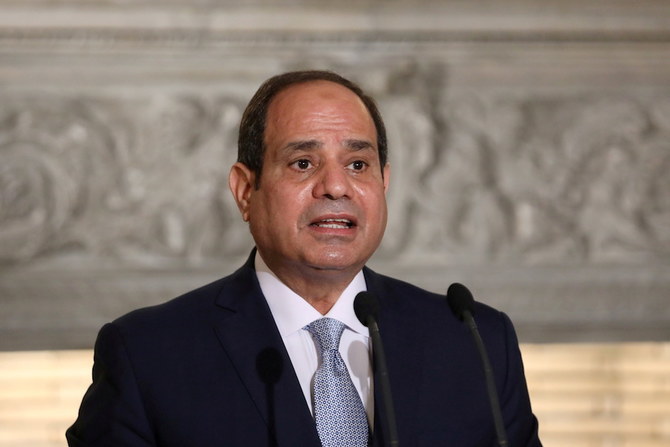
El-Sisi: ‘Terrorism among greatest challenges facing humanity’

Egypt’s president Abdel Fattah El-Sisi praised “the BRICS group’s keenness to adopt a common vision toward political and economic issues of interest to developing countries”. (Reuters/File)
Short Url
Updated 25 June 2022
Follow

El-Sisi: ‘Terrorism among greatest challenges facing humanity’

  • Egyptian president was speaking at BRICS Summit
  • ‘Terrorism violates the basic rights of citizens, foremost of which is the right to life’

CAIRO: Terrorism remains among the greatest challenges facing humanity,” Egypt’s president said during his speech at a summit in Beijing that brought together Brazil, Russia, India, China and South Africa.

Abdel Fattah El-Sisi praised “the BRICS group’s keenness to adopt a common vision toward political and economic issues of interest to developing countries, especially with regard to exploring prospects for development cooperation and support for development financing.”

He added: “The efforts focused on addressing the repercussions of the current economic crisis should not come at the expense of supporting sustainable development in the least developed and developing countries, countries that still suffer from a lack of development financing.”

El-Sisi said: “Achieving development goals must come in parallel with all international efforts to address traditional and non-traditional challenges, top of which are the issues of terrorism and climate change.”

He added: “The phenomenon of terrorism violates the basic rights of citizens, foremost of which is the right to life, and hinders the efforts of governments toward achieving the economic and social goals of their people.”

He said: “Egypt stresses the need to adopt a comprehensive approach that includes various dimensions to dry up the sources of terrorism and prevent the provision of funding, safe havens and media platforms for terrorist organizations, as well as addressing the economic and social conditions and factors that push some to extremism and joining terrorist groups.”

Egypt previously participated as a guest in the BRICS Summit hosted by China in September 2017.


Algeria parliament to vote on law declaring French colonization ‘state crime’

Updated 24 December 2025
Follow

Algeria parliament to vote on law declaring French colonization ‘state crime’

  • The vote comes as the two countries are embroiled in a major diplomatic crisis

ALGERIA: Algeria’s parliament is set to vote on Wednesday on a law declaring France’s colonization of the country a “state crime,” and demanding an apology and reparations.
The vote comes as the two countries are embroiled in a major diplomatic crisis, and analysts say that while Algeria’s move is largely symbolic, it could still be politically significant.
The bill states that France holds “legal responsibility for its colonial past in Algeria and the tragedies it caused,” according to a draft seen by AFP.
The proposed law “is a sovereign act,” parliament speaker Brahim Boughali was quoted by the APS state news agency as saying.
It represents “a clear message, both internally and externally, that Algeria’s national memory is neither erasable nor negotiable,” he added.
France’s colonization of Algeria from 1830 until 1962 remains a sore spot in relations between the two countries.
French rule over Algeria was marked by mass killings and large-scale deportations, all the way to the bloody war of independence from 1954-1962.
Algeria says the war killed 1.5 million people, while French historians put the death toll lower at 500,000 in total, 400,000 of them Algerian.
French President Emmanuel Macron has previously acknowledged the colonization of Algeria as a “crime against humanity,” but has stopped short of offering an apology.
Asked last week about the vote, French foreign ministry spokesman Pascal Confavreux said he would not comment on “political debates taking place in foreign countries.”
Hosni Kitouni, a researcher in colonial history at the University of Exeter in the UK, said that “legally, this law has no international scope and therefore is not binding for France.”
But “its political and symbolic significance is important: it marks a rupture in the relationship with France in terms of memory,” he said.