

Pakistan confirms jail term for alleged mastermind of 2008 Mumbai attacks

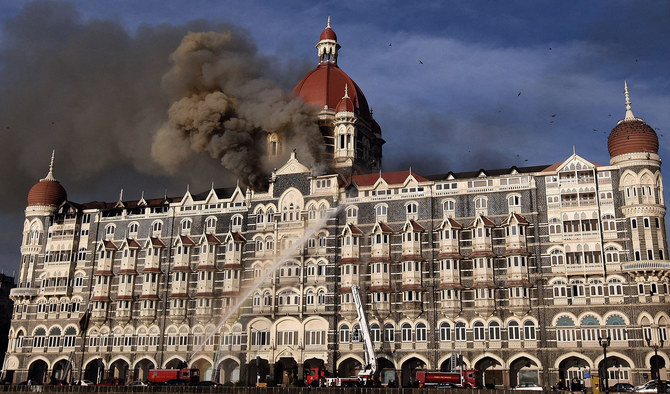
Indian firefighters attempt to put out a fire as smoke billows out of the historic Taj Mahal Hotel in Mumbai on November 27, 2008, one of the sites of attacks by gunmen. (AFP/File)
Short Url
Updated 25 June 2022
Follow

Pakistan confirms jail term for alleged mastermind of 2008 Mumbai attacks

  • Sajid Mir is one of the FBI’s most-wanted terrorists in connection to a series of deadly attacks in Mumbai in 2008
  • His sentencing is seen Pakistan in relation to the government’s efforts to get out of FATF grey list

KARACHI: Pakistani authorities confirmed on Saturday that the alleged mastermind of the 2008 Mumbai attacks was in their custody and has been sentenced to 15 years in jail on charges of terrorism financing.

Sajid Mir has been on the FBI’s list of most-wanted terrorists with a $5 million bounty on his head, and has been sought by the US and India for over a decade in connection to a series of attacks in Mumbai in late November 2008, where militants killed more than 170 people, including six American nationals.

Mir is believed to be a leader of Lashkar-e-Taiba, the Pakistan-based militant group accused of carrying out the attacks. According to the FBI most-wanted list, he allegedly served as the “chief planner of the attacks, directing preparations and reconnaissance, and was one of the Pakistan-based controllers during the attacks.”

He was sentenced by a court in Lahore earlier this month to 15 and a half years in prison and is serving his sentence at the Kot Lakhpat jail.

“The sentencing in a TF (terrorism financing) case is confirmed,” Asim Iftikhar Ahmad, spokesperson of the Pakistani foreign office, told Arab News.



An undated file photo of Sajid Mir. (Photo courtesy: Dawn.com)

Mir was indicted in the US by court in Illinois in April 2011 and his arrest warrant was issued the same month. The American court charged him with “conspiracy to injure property of foreign government; providing material support to terrorists; killing a citizen outside of the U.S. and aiding and abetting; and bombing of places of public use.”

His sentencing is seen Pakistan in relation to the government’s efforts to get out of the Financial Action Task Force’s (FATF) grey list.

In June 2018 the global watchdog downgraded Pakistan to its increased monitoring list, for lacking measures to curb money-laundering and terrorism financing.
During its plenary meeting last week, FATF kept Pakistan on its grey list but said an onsite inspection — expected in October — could verify the country’s progress in fulfilling the watchdog’s action plan and lead to the removal of the designation.

“This issue rather became a major sticking point in FATF’s assessment of Pakistan’s progress on the action plan late last year. This was where things finally started moving in Mir’s case,” Dawn, a leading Pakistani daily, reported on Saturday.

“His conviction and sentencing were, therefore, major achievements that Pakistani officials showcased in their progress report given to FATF on its action plan during the latest plenary.”

Being on the FATF’s grey list severely restricts a country’s international borrowing capabilities. Exiting it is likely to increase foreign inflows, specifically direct investment, into Pakistan, which desperately needs funds amid dwindling foreign exchange reserves.


Pakistan nears $1.5 billion deal to supply weapons, jets to Sudan

Updated 09 January 2026
Follow

Pakistan nears $1.5 billion deal to supply weapons, jets to Sudan

  • Deal may include drones, air defense systems and Karakoram-8 aircraft, with possible JF-17 fighters
  • The sale is expected to bolster Sudan’s army in the ongoing civil war with the Rapid Support Forces

ISLAMABAD: Pakistan is in the final phases of striking a $1.5-billion deal to supply weapons and jets to Sudan, a former top air force official and three sources said, promising a major boost for Sudan’s army, battling the paramilitary Rapid Support Forces.

Their conflict has stoked the world’s worst humanitarian crisis for more than 2-1/2 years, drawing in myriad foreign interests, and threatening to fragment the strategic Red Sea country, a major gold producer.

The deal with Pakistan encompasses 10 Karakoram-8 light attack aircraft, more than 200 drones for scouting and kamikaze attacks, and advanced air defense systems, said two of the three sources with knowledge of the matter, who all sought anonymity.

It was a “done deal,” said Aamir Masood, a retired Pakistani air marshal who continues to be briefed on air force matters.

Besides the Karakoram-8 jets, it includes Super Mushshak training aircraft, and perhaps ‌some coveted JF-17 ‌fighters developed jointly with China and produced in Pakistan, he added, without giving figures ‌or ⁠a delivery ‌schedule.

Pakistan’s military and its defense ministry did not immediately respond to requests for comment.

A spokesman for Sudan’s army did not immediately respond to a message requesting comment.

Assistance from Pakistan, especially drones and jets, could help Sudan’s army regain the air supremacy it had toward the start of its war with the RSF, which has increasingly used drones to gain territory, eroding the army’s position.

PAKISTAN’S DEFENSE AMBITIONS

The deal is another feather in the cap for Pakistan’s growing defense sector, which has drawn growing interest and investment, particularly since its jets were deployed in a conflict with India last year.

Last month, Islamabad struck a weapons deal worth more than $4 billion with the Libyan National Army, officials said, for one of the South Asian nation’s largest arms sales, which includes JF-17 fighter jets and training aircraft.

Pakistan has also held talks with Bangladesh on a defense deal that could includes the Super Mushshak training jets and JF-17s, as ties improve ties with Dhaka.

The government sees Pakistan’s burgeoning industry as a catalyst to secure long-term economic stability.

Pakistan is now in a $7-billion IMF program, following a short-term ‌deal to avert a sovereign default in 2023. It won IMF support after Saudi Arabia and other Gulf allies provided financial and deposit rollovers.