GENEVA: The United Nations said Friday that its findings showed that the shot that killed Al Jazeera TV journalist Shireen Abu Akleh on May 11 was fired by Israeli forces.
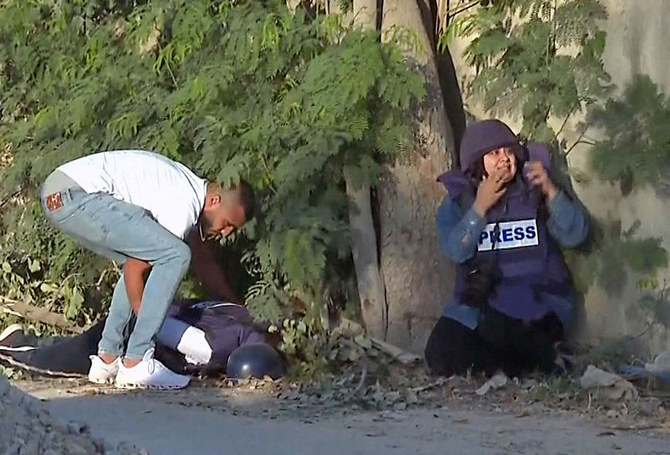
The Palestinian-American journalist, who was wearing a vest marked “Press” and a helmet, was killed on May 11 while covering an Israeli army operation in Jenin camp in the northern West Bank.
“We find that the shots that killed Abu Akleh came from Israeli security forces,” UN Human Rights Office spokeswoman Ravina Shamdasani told reporters in Geneva.
“It is deeply disturbing that Israeli authorities have not conducted a criminal investigation.
“We at the UN Human Rights Office have concluded our independent monitoring into the incident.
“The shots that killed Abu Akleh and injured her colleague Ali Sammoudi came from Israeli security forces and not from indiscriminate firing by armed Palestinians, as initially claimed by Israeli authorities” she said.
She added that the information came from the Israeli military and the Palestinian attorney general.
“We have found no information suggesting that there was activity by armed Palestinians in the immediate vicinity of the journalists,” Shamdasani said.
In line with its human rights monitoring methodology, the UN rights office inspected photo, video and audio material, visited the scene, consulted experts, reviewed official communications and interviewed witnesses.
The findings showed that seven journalists arrived at the western entrance of the Jenin refugee camp soon after 6:00 am.
At around 6:30 am, as four of the journalists turned into a particular street, “several single, seemingly well-aimed bullets were fired toward them from the direction of the Israeli security forces.
“One single bullet injured Ali Sammoudi in the shoulder; another single bullet hit Abu Akleh in the head and killed her instantly.”
UN human rights chief Michelle Bachelet has urged Israel to open a criminal investigation into Abu Akleh’s killing and into all other killings by Israeli forces in the West Bank and in the context of law enforcement operations in Gaza.

UN says Al Jazeera journalist killed by Israeli fire
https://arab.news/jcmw5
UN says Al Jazeera journalist killed by Israeli fire
- Palestinian-American journalist was killed on May 11 while covering an Israeli army operation in Jenin camp
- UN finds no information suggesting presence of armed Palestinians in vicinity of journalists
Media watchdogs condemn Israeli airstrike that killed 3 journalists in Gaza, call for investigation
- International Press Institute, Committee to Protect Journalists and Reporters Without Borders among organizations demanding urgent action
DUBAI: Media watchdogs including the International Press Institute, the Committee to Protect Journalists and Reporters Without Borders have spoken out against Israel’s treatment of media workers following an airstrike that killed 3 journalists in Gaza on Wednesday.
Those killed were Mohammed Salah Qashta, Abdul Raouf Shaat and Anas Ghneim.
The Israeli military said the attack targeted what it had identified as “several suspects” operating a drone and “affiliated with Hamas.”
According to eyewitnesses, the journalists were using a drone to record aid distribution by the Egyptian Relief Committee when the strike hit one of the committee’s vehicles.
The IPI called for an “immediate and credible investigation” and renewed pressure on the international community to take “concrete actions” to hold Israel accountable.
IPI executive director Scott Griffen said the Israeli government has “failed to credibly investigate attacks on journalists” and that the “international community has failed to hold Israel to account for its pattern of targeting and killing journalists.”
He urged strong action, saying that “it is long past time for the international community to take concrete steps to end the cycle of complete impunity for killings of journalists in Gaza.”
The International Federation of Journalists and the Palestinian Journalists Syndicate also condemned the killings and attacks on journalists, calling for an immediate investigation.
The IFJ appealed to all “combatants in this conflict to do their utmost to safeguard journalists and media professionals,” said IFJ general secretary Anthony Bellanger.
“Media workers in areas of armed conflict must be treated and protected as civilians and allowed to perform their work without interference,” he added.
The PJS said that the direct shelling of the journalists’ vehicle constitutes a war crime and a crime against humanity under international humanitarian law, in violation of the Geneva Conventions and UN resolutions that guarantee the protection of journalists during armed conflicts.
The syndicate called on the International Criminal Court to open “urgent and serious investigations” and to “issue arrest warrants against those responsible for the killing of journalists.”
It also urged the UN and other international organizations to take action “rather than limiting their response to statements of condemnation.”
The CPJ condemned the strike, which took place amid a ceasefire, said regional director Sara Qudah.
“Israel, which possesses advanced technology capable of identifying its targets, has an obligation under international law to protect journalists,” she said.
On Thursday, CPJ and RSF called on the 29 member states of the Media Freedom Coalition, in a joint letter, to take concrete steps toward guaranteeing media access to the Gaza Strip.
The move comes ahead of the Israeli Supreme Court hearing on Jan. 26 that will determine whether the press will have independent access to Gaza.
The signatories asked governments to send official representatives to the Jan. 26 hearing and to prioritize press freedom in their engagement with the new technocratic government, formed under a US-backed plan to govern Gaza.
They also urged states to ensure that the International Stabilization Force applies UN Security Council Resolution 2222, which recognizes journalists as civilians during armed conflict and affirms their right to protection and access.
“The inaction of states around the world encourages censorship and sets a dangerous precedent for other conflicts, to the detriment of civilian populations, humanitarian aid and political decisions based on verified facts,” said RSF director general Thibaut Bruttin.
More than 200 Palestinian journalists and media workers have been killed since the start of the war in October 2023, according to multiple reports.


