WASHINGTON: The United States will send another $450 million in military aid to Ukraine, including some additional medium-range rocket systems, to help push back Russian progress in the war, officials announced Thursday.
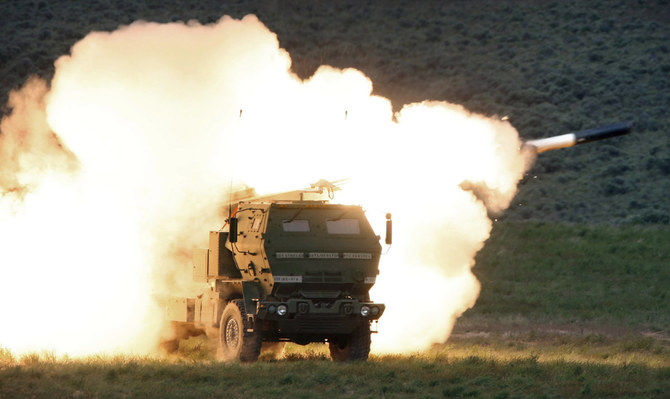
The latest package includes four High Mobility Artillery Rocket Systems, or HIMARS, which will double the number they have now. All four were prepositioned in Europe, and training on those systems has already begun with the Ukrainian troops who will use them, said Marine Corps Lt. Col. Anton Semelroth, a Pentagon spokesman. The first four HIMARS that the US previously sent have already gone to the battlefield in Ukraine and are in the hands of troops there.
According to the Pentagon, the aid also includes 18 tactical vehicles that are used to tow howitzers, so the weapons can be moved around the battlefield, as well as 18 coastal and riverine patrol boats, thousands of machine guns, grenade launchers and rounds of ammunition, and some other equipment and spare parts.
The new aid comes just a week after the US announced it was sending $1 billion in military aid to Ukraine, and as the Russian military continues to slowly expand its control in the eastern Donbas region. Ukrainian leaders have persistently asked for the more advanced, precision rocket systems in order to better fight back against Russia.
The Russian military captured two villages in eastern Ukraine on Thursday and is fighting for control of a key highway in a campaign to cut supply lines and encircle frontline Ukrainian forces, according to British and Ukrainian military officials.
Russian forces have been bombarding the city of Sievierodonetsk for weeks with artillery and air raids, and fought the Ukrainian army house-to-house. The HIMARS gives Ukraine the ability to strike Russian forces and weapons from further away, making it less risky for Ukrainian troops. The systems are mounted on trucks, which carry a container with six precision-guided rockets that can travel about 45 miles (70 kilometers).
It took about three weeks to train Ukrainian troops on the first four HIMARS, before the systems were moved to the fight.
The aid is part of the $40 billion in security and economic assistance passed last month by Congress and signed into law by President Joe Biden. And it is the 13th package of military weapons and equipment committed to Ukraine since the war began.
Overall, since the war started in late February, the US has committed about $6.1 billion in security assistance to Ukraine, including this latest package. The $450 million in equipment and weapons will be from drawdown authority, which means the Defense Department will take it all from its own stocks and ship it to Ukraine.


![]()

US sending advanced rocket systems, other aid to Ukraine
Short Url
https://arab.news/7mkwn
US sending advanced rocket systems, other aid to Ukraine
- The latest package includes four High Mobility Artillery Rocket Systems, or HIMARS, which will double the number they have now
- The HIMARS gives Ukraine the ability to strike Russian forces and weapons from further away, making it less risky for Ukrainian troops

Latest updates


© 2026 SAUDI RESEARCH & PUBLISHING COMPANY, All Rights Reserved And subject to Terms of Use Agreement.