

New York Times traces source of bullet that killed Shireen Abu Akleh to Israeli convoy

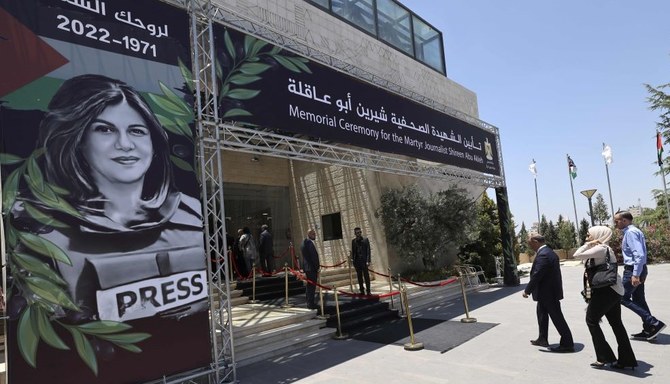
People arrive for a memorial ceremony for Shireen Abu Akleh, to mark the 40th day of the killing of the Al Jazeera journalist, in the West Bank city of Ramallah, June 19, 2022. (AFP)
Short Url
Updated 21 June 2022
Follow

New York Times traces source of bullet that killed Shireen Abu Akleh to Israeli convoy

  • An investigation by The New York Times found that the bullet that killed the reporter was fired from the approximate location of an Israeli military convoy
  • Israeli officials said a soldier might have shot Abu Akleh by mistake but also suggested the bullet might have come from a gun fired by a Palestinian

DUBAI: Veteran Palestinian American journalist Shireen Abu Akleh was most likely shot by an Israeli soldier from an elite army unit, a monthlong investigation by The New York Times has concluded.

The Al Jazeera reporter was killed on May 11 while covering an Israeli military operation in the occupied West Bank. Last week, the news network published an image of the bullet that it says killed its reporter, and identified it as a US-made 5.56mm round fired from an M4 rifle, a weapon commonly used by Israeli forces.

Israeli officials said a soldier might have shot Abu Akleh by mistake but also suggested the bullet might have come from a gun fired by a Palestinian. A preliminary investigation by the Israeli Army concluded it was “not possible to unequivocally determine the source of the gunfire.”

However, the investigation by The New York Times found that the bullet that killed the reporter was fired from the approximate location of an Israeli military convoy, most likely by a soldier from an elite unit.

It ruled out the Israeli suggestion that a Palestinian gunman might be responsible because there were no armed Palestinians near Abu Akleh when she was shot. The report also revealed that 16 shots were fired from the location of an Israeli convoy, contradicting Israeli claims that the soldier fired five bullets in the direction of the journalist.

The Times investigation did not find any evidence “that the person who fired recognized Ms. Abu Akleh and targeted her personally,” and was “unable to determine whether the shooter saw that she and her colleagues were wearing protective vests emblazoned with the word ‘Press.’”

The investigators pieced together the events of the day leading up to the shooting using videos collected from bystanders, journalists and security cameras; interviews with seven witnesses; the Israeli military’s accounts; audio analysis carried out by experts; and four visits to the site by Times reporters.

The killing of Abu Akleh and subsequent attacks by Israeli forces sparked an international outcry. A number of global media outlets, including CNN, The Washington Post, the Associated Press and investigative group Bellingcat, have conducted separate investigations into the reporter’s death, all of which concluded that Israeli forces were responsible.

Saudi Media Forum urges ethical coverage as crises redefine Arab journalism

Updated 04 February 2026
Follow

Saudi Media Forum urges ethical coverage as crises redefine Arab journalism

  • Raw news without context can mislead audiences and distort credibility, experts say

RIYADH: Arab media was born in crisis and shaped by conflict rather than stability, Malik Al-Rougi, general manager of Thaqafeyah Channel, said during the Saudi Media Forum in Riyadh on Wednesday.

Al-Rougi was speaking during a panel titled “Media and Crises: The Battle for Awareness and the Challenges of Responsible Coverage,” which examined how news organizations across the region navigated credibility and professional standards amid fast-moving regional developments.

“Today, when you build a media organization and invest in it for many years, a single crisis can destroy it,” he said.

Referring to recent events, Al-Rougi said that he had witnessed news channels whose credibility “collapsed overnight.”

“In journalistic and political terms, this is not a process of news production. It is a process of propaganda production,” he said. “The damage caused by such a post … is enormous for an institution in which millions, perhaps billions, have been invested.”

When a media outlet shifts from professionalism and credibility toward “propaganda,” he added, it moves away from its core role. 

Saudi media leaders, journalists, and experts gathered at the Saudi Media Forum in Riyadh to discuss credibility, ethics, and innovation. (AN photo by Huda Bashatah/Supplied)

“A crisis can work for you or against you,” Al-Rougi added. “When, in the heart of a crisis, you demonstrate high credibility and composure, you move light-years ahead. When you fail to adhere to ethical standards, you lose light-years as well.”

Abdullah Al-Assaf, professor of political media studies at Imam Muhammad bin Saud Islamic University, said that in many crises across the Arab world, agendas and directives had often prevailed over professionalism.

“Credibility was buried,” he added.

Hasan Al-Mustafa, writer and researcher at Al-Arabiya channel, said that raw information could be subject to multiple interpretations if not placed within a proper political, security, historical or geographical context.

He added that such an approach was urgently needed during periods of political and security volatility in the Middle East. 

When, in the heart of a crisis, you demonstrate high credibility and composure, you move light-years ahead. When you fail to adhere to ethical standards, you lose light-years as well.

Malik Al-Rougi Thaqafeyah, Channel general manager

“This objectivity, or this reliability, is a great responsibility,” Al-Mustafa said. “It is reflected not only in its impact on the audience, but also on the credibility of the content creator.”

Al-Mustafa warned against populism and haste in coverage, saying that they risked deepening crises rather than providing informed public perspectives.

He also said that competition with social media influencers had pushed some traditional outlets to imitate influencer-driven models instead of strengthening their own professional standards.

“Our media has been crisis-driven for decades,” he said, describing much of the region’s coverage as reactive rather than proactive.

During a separate panel titled “The Official Voice in the Digital Age: Strategies of Influence,” speakers discussed how rapid technological and social changes were reshaping the role of institutional spokespersons.

Abdulrahman Alhusain, official spokesperson of the Saudi Ministry of Commerce, said that the role was no longer limited to delivering statements or reacting to events.

“Today, the spokesperson must be the director of the scene — the director of the media narrative,” he said.

Audiences, he added, no longer accept isolated pieces of information unless they were presented within a clear narrative and structure.

“In the past, a spokesperson was expected to deliver formal presentations. Today, what is required is dialogue. The role may once required defense, but now it must involve discussion, the exchange of views, and open, candid conversation aimed at development — regardless of how harsh the criticism may be.”

He said that spokespersons must also be guided by data, digital indicators and artificial intelligence to understand public opinion before speaking.

“You must choose the right timing, the right method and the right vocabulary. You must anticipate a crisis before it happens. That is your role.”

Abdullah Aloraij, general manager of media at the Riyadh Region Municipality, said that the most important skill for a spokesperson today was the ability to analyze and monitor public discourse.

“The challenge is not in transferring words, but in transferring understanding and impact in the right way,” he said.