



ISLAMABAD: Pakistani prime minister Shehbaz Sharif on Monday called for a roadmap to enhance trade with Saudi Arabia and improve the kingdom’s investments in different sectors of Pakistan.
The prime minister was speaking at a meeting with a 15-member Saudi business delegation, led by Fahad Bin Muhammad Al-Bash, the chairman of the Saudi-Pak Business Council, which arrived in Pakistan on Monday to explore investments and joint ventures.
The delegation will visit Islamabad, Lahore, Sialkot, Faisalabad, and Karachi during a week-long trip and meet representatives from various chambers of commerce and the board of investment, as well as conduct business-to-business meetings in each city. The delegation will leave for the kingdom from Karachi on June 27.
On Monday, the delegation met members of the Islamabad Chamber of Commerce and Industry (ICCI) and held B2B meetings and delegation-level talks with officials of the Khyber Pakhtunkhwa Board of Investment.
Later in the evening, the Saudi businessmen also met with the Pakistani prime minister and key cabinet ministers.
“Now is the time that we should build a roadmap through which not only we can enhance our trade but also the Saudi investments in various sectors in Pakistan,” Sharif said while addressing the delegates, assuring them that their investments would be safe under Pakistani law.
“They [Saudi companies] can repatriate their profits and people of Pakistan can benefit from these investments in terms of empowerment, production, revenue generation, and so on,” he added.
Sharif said there were many potential areas of investment from Saudi companies, including agriculture-based industrial investments and natural resources.
“We have comparatively cheaper labor and Saudi investments in different areas could produce quality products and compete with other regional countries and [we could] export it back to the Kingdom and other countries.”
The PM said the people of Pakistan had always received “unconditional” material and diplomatic support from the people of Saudi Arabia: “In the recent past, the quantum of monetary support from the Saudi King Salman bin Abdulaziz runs into billions of dollars be it deposits in the State Bank of Pakistan, or deferred payment facility on the import of oil.”
In an interview with Arab News earlier in the day, the head of the delegation, Al-Bash, said the group aimed to search for joint ventures and investment opportunities in Pakistan and tap into support from the governments of both countries to grow business and trade.
“There is huge support from both governments for the business communities to work and there is a lot of potential in the economies to tap into for both countries,” Al-Bash said, adding that the Saudi business community saw a great opportunity for collaboration in the sectors of agriculture, livestock, information technology, human capital, mining, surgical goods, sportswear, and military.
“We are here for JVs (joint ventures) with Pakistani companies and have a plan to visit the China Pakistan Economic Corridor (CPEC) authority to check the opportunities for investment in the project,” Al-Bash said, adding that both countries would increase the number of bilateral business visits to enhance cooperation.
“We have scheduled two visits a year to Pakistan and there will be two visits from the Pakistani side to Saudi Arabia. We are also thinking of exhibiting Saudi products in Pakistan and Pakistani products in Saudi Arabia,” he added.
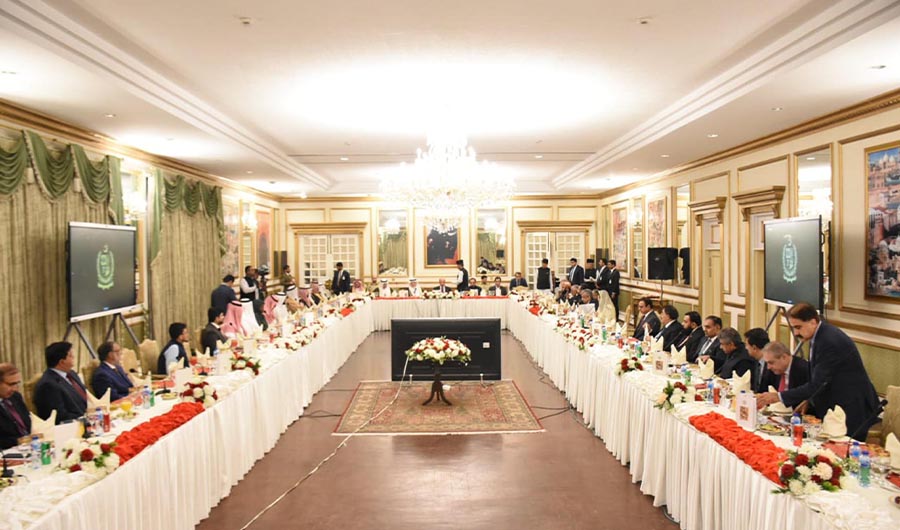
Saudi business delegation called on Pakistani Prime Minister Shehbaz Sharif in Islamabad on June 21, 2022. (PID)
ICCI President Muhammad Shakeel Munir said the chamber had organized specialized meetings of its members with Saudi businessmen to discuss collaborations.
“The Saudi delegation has businessmen from construction, infrastructure, energy, tourism, and pharmaceuticals and we have also invited businessmen from similar sectors so that they can find opportunities for collaboration and investment,” Munir told Arab News.
“We need some good joint ventures so I think this visit will be very fruitful and concrete results will come out,” he said.
“There is a huge potential to increase exports of rice, fruits and vegetables, halal meat, mangoes, pharmaceuticals, and different kinds of marble and granites [to Saudi Arabia],” Munir added.
Saudi businessman Faisal Khalid Alyahya said the Pakistan energy sector had immense potential and he was interested to explore possibilities for investment in the sector.
“We are well-known investors in Saudi Arabia, that’s why we are here in Pakistan to explore possibilities in the energy sector, both renewable and conventional,” Alyahya told Arab News.
He said after meeting Pakistani businessmen and authorities, he would present an investment proposal to his company, Al Gihaz Holding.
“Based on findings of our meetings,” he said, “we will decide how much to invest in Pakistan and will come back with a plan after a few months.”


