Iran fighter jet crashes after engine fails, pilots survive

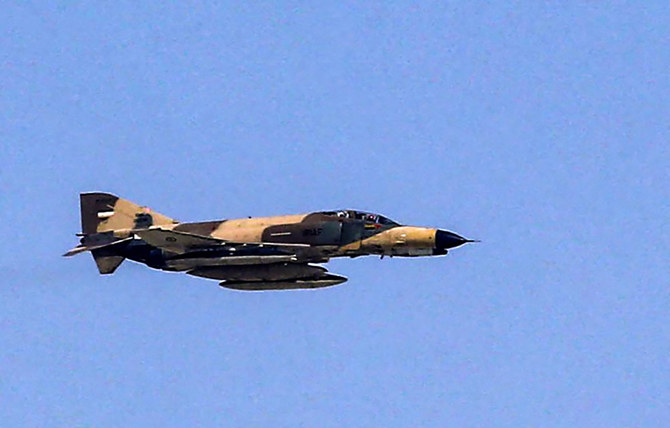
Iran’s air force has assortment of US-made military aircraft purchased before the 1979 Islamic Revolution and the Tomcat F-14 is American-made. (AFP)
Short Url
Updated 18 June 2022
Follow

Iran fighter jet crashes after engine fails, pilots survive

  • Technical failure in the engine of the Grumman F-14 Tomcat led to the crash

TEHRAN: An Iranian fighter plane crashed near the central city of Isfahan on Saturday after its engine failed, but both pilots survived, media reported.
The pilots were taken to a local hospital, the official IRNA news agency said. It said there was a technical failure in the engine of the Grumman F-14 Tomcat that led to the crash.
A clip by the agency showed columns of smoke billowing from the remains of the aircraft in a desert area.
Iran’s air force has an assortment of US-made military aircraft purchased before the 1979 Islamic Revolution and the Tomcat F-14 is American-made. It also has Russian-made MiG and Sukhoi planes. Decades of Western sanctions have made it hard to obtain spare parts and maintain the aging aircraft.
Iran has a history of similar crashes among its faltering fleet. In May a fighter jet crashed in the central desert of Iran, killing both pilots. In February, a fighter jet plunged into a soccer field in the country’s northwestern city of Tabriz, killing both pilots and a civilian.


UN Security Council sanctions four Sudan commanders over El-Fasher atrocities

Updated 3 sec ago
Follow

UN Security Council sanctions four Sudan commanders over El-Fasher atrocities

  • The UN Security Council has announced sanctions on four Sudanese paramilitary commanders for atrocities committed in the October takeover of the Darfur city of El-Fasher
UNITED NATIONS: The UN Security Council has announced sanctions on four Sudanese paramilitary commanders for atrocities committed in the October takeover of the Darfur city of El-Fasher.
The four are high-ranking members of the Rapid Support Forces, which a UN probe last week determined had committed acts of genocide in their 18-month siege and eventual capture of El-Fasher.
They are RSF deputy commanders Abdelrahim Hamdan Dagalo and Gedo Hamdan Ahmed, Brig. Gen. Al-Fateh Abdullah Idris and field commander Tijani Ibrahim.
Since April 2023, Sudan has been gripped by what the UN has called a “war of atrocities” between the RSF and Sudan’s regular army, killing tens of thousands and creating the world’s largest hunger and displacement crises.
For a year and a half, the RSF besieged North Darfur state capital El-Fasher — the region’s last major city to evade their control — before storming the city on October 26.
The campaign, which the UN fact-finding mission described as “three days of horror,” was marked by summary executions, systematic sexual violence and mass detention — primarily targeting the city’s ethnic Zaghawa population.
Abdelrahim, brother of RSF chief Mohamed Hamdan Dagalo, appears in footage “giving direct orders to his fighters to not take captives but to kill everyone,” according to the sanctions announcement.
He is already sanctioned by the United States, the United Kingdom and the European Union.
Idris, commonly referred to as Abu Lulu, became known as “the Butcher of El-Fasher” for graphic videos he himself posted of the takeover.
“Abu Lulu has filmed himself smiling and killing people while they begged for mercy, as well as videos where he makes ethnically targeted executions,” the Security Council said.
He, Ahmed and Ibrahim were slapped with US sanctions last week over their roles in the “ethnic killings, torture, starvation and sexual violence” committed in El-Fasher.
A special Security Council committee with representatives of all 15 member countries makes decisions on such sanctions.
Following the Darfur war of the early 2000s, where the RSF’s predecessor the Janjaweed committed similar atrocities at the behest of the Khartoum government, the Security Council in 2005 established a Sudan sanctions regime.
It includes an embargo on arms shipments to Darfur, as well as sanctions on individuals such as a freeze on assets and ban on foreign travel.