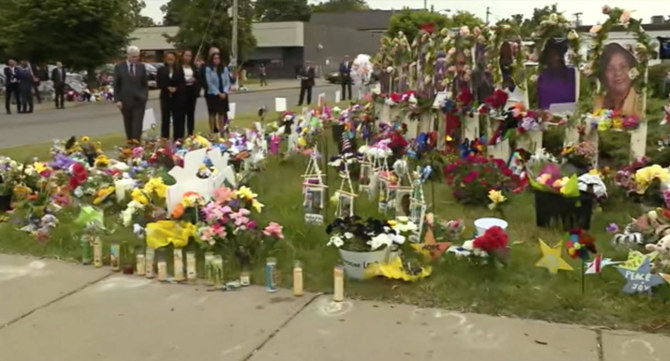
BUFFALO: The white man who killed 10 Black people at a Buffalo supermarket made his first appearance in federal court on hate crime charges Thursday, and the judge urged prosecutors to quickly decide whether to pursue the death penalty given the “substantial” cost of those cases.
In a brief proceeding, presiding Magistrate Judge H. Kenneth Schroeder said Payton Gendron was eligible to be represented by public defenders based on his financial situation. Fielding a series of questions from the judge mostly with “yes” or “no” responses, Gendron said he had not been employed in a year, had $16 dollars in a bank account, had no car and two shares of Disney stock.
Gendron has been held without bail since his arrest shortly after the May 14 attack at a Tops Friendly Supermarket, which also left three people wounded.
He appeared in U.S. District Court on a criminal complaint charging him with 10 counts each of hate crime resulting in death and using a firearm to commit murder. The complaint also includes three counts each of hate crime involving bodily injury and attempt to kill, and using a firearm in a violent crime.
Gendron wore an orange jump suit, shackles and a black mask covering a scruffy beard. He leaned forward slightly in his chair with his head down when the judge read the charges.
No plea was entered during the proceeding.
“It's hard being here. It's hard being in a courtroom with a terrorist," said Zeneta Everhart, one of about two dozen relatives of victims who were in the courtroom. "Seeing the man who tried to kill my son sitting there, sharing the same space with him, is hard.”
Everhart's 21-year-old son, Zaire Goodman, a Tops employee, was shot in the neck as he helped a customer in the parking lot but survived.
She called being in court “part of my healing process.”
Gendron's parents were not in the courtroom.
Attorney General Merrick Garland, who met with the victims’ families in Buffalo on Wednesday, has not ruled out seeking the death penalty against Gendron.
In calling for prosecutors to make a quick decision on the death penalty, Schroeder noted such cases typically require expert testimony from psychiatrists and medical examiners.
Federal prosecutor Joseph Tripi said the next step in the process involves an indictment. At that point, it will be the attorney general’s “sole decision” whether to seek the death penalty.
“I’m a Christian person, I don’t wish death on anyone,” a niece of 62-year-old victim Geraldine Talley said after the hearing, “but this right here I have to work with it, because I would rather see him dead.”
The niece, Tamika Harper, vowed to be at every court appearance “for my aunt and the other nine victims.”
“I'm angry, very, very angry,” said Harper, who wore pins on her top with the victims’ pictures. “He has not shown a lick of remorse.”
The federal hate crimes case is based partly on documents in which Gendron detailed his plans for the attack, including the semi-automatic rifle he would use, clothing and body armor he would wear and the portable camera that would allow him to stream the massacre live on the internet.
The writings included “statements that his motivation for the attack was to prevent Black people from replacing white people and eliminating the white race, and to inspire others to commit similar racially-motivated attacks,” according to the complaint.
Gendron was already facing a mandatory life sentence without parole if convicted on previously filed state charges, including hate-motivated domestic terrorism and murder. He has pleaded not guilty.
His lawyer in the state case declined to comment on the federal charges.
Gendron drove more than 200 miles (320 kilometers) from his home in Conklin to a predominantly Black part of Buffalo. There, authorities say, he fired approximately 60 shots at shoppers and workers.
The complaint details his path through the store's aisles in search of victims as customers and employees ran to take cover in a stock room, conference room, freezer and dairy cooler.
Gendron surrendered to police as he exited the supermarket.

Buffalo supermarket gunman in court on hate crime counts
https://arab.news/z3tz2
Buffalo supermarket gunman in court on hate crime counts
- Man who shot dead 10 people in Buffalo, New York has made his first court appearance on hate crime charges
UK cyclists to ride 550km in Saudi Arabia to save children with heart defects
- The H&K Cycle Club was the first team to take the Hejaz route, and their endeavour has since 2022 inspired hundreds of other cyclists to follow suit
- The cyclists expect to face scorching heat, brutal headwinds, sandstorms, and long no-U-turn stretches of roads, along with physical and mental exhaustion
LONDON: A cycling team from London set out on Sunday on a 550km journey from Makkah to Madinah in Saudi Arabia to raise funds for children in developing countries with congenital heart defects.
This is the fifth year that Shamsul Abdin, the head of the H&K Cycle Club, and 40 riders aged between 18 and 65, are taking on the challenge through the Hejaz region.
Abdin told Arab News that the “Hijrah Ride” was a replication of the journey made by Prophet Muhammad over 1,400 years ago, when he migrated from Makkah to Madinah, where he established the first city-state of Islam. This migration, known as Hijrah, also marked the beginning of the Islamic Hijri calendar.
The H&K Cycle Club has expanded from just six riders 14 years ago to more than 40 members from various cities across the UK, including London, Manchester, Oxford, and Birmingham. In November, they began their training in the freezing temperatures of the UK, aiming to cycle over 100 kilometers each day within 6 to 7 hours for a 4-day ride in Saudi Arabia. On Wednesday, they are expected to arrive in Madinah.
They have cycled throughout the UK and parts of Europe, riding from London to Istanbul to raise funds for various causes through Muntada Aid, a charity that works on projects in developing countries and organizes the “Hijrah Ride”.
They were also the first cycling team to take the Hejaz route, and their endeavour has since inspired hundreds of other cyclists to follow suit. Abdin has seen Saudi Arabia become more bike-friendly over the past five years, with cycling lanes integrated into city development, while drivers, locals, and authorities are now more aware of cyclists on the roads.
The cyclists expect to face scorching heat, brutal headwinds, sandstorms, and long no-U-turn stretches of roads, along with physical and mental exhaustion. For many riders, this will be their fifth ride in Hejaz. Some of them include Uber and bus drivers, business analysts, and even entrepreneurs, according to Abdin.
“The headwind feels like climbing a mountain; it’s a constant resistance. To overcome this challenge, we ride in a peloton, taking turns at the front. One person heads into the wind while the others line up behind, shielded from the gusts. After a while, we rotate, allowing everyone a chance to lead,” Abdin explained.
Almost £923,000 has been raised by the “Hijrah Ride” since its inception, to reach a target of one million pounds this year. Some of the money went into emergency aid programs in Gaza and Sudan. Muntada Aid aims to raise about £250,000 for its flagship project, “Little Hearts,” which will fund 150 surgeries for children with congenital heart defects in Pakistan and Bangladesh this year.
“I fell in love with this project, which gives children the opportunity to live up to their potential as adults, truly,” said Abdin, who was awarded the MBE (Member of the Order of the British Empire) in December for his contribution to charitable fundraising.
The riders will be escorted by two vehicles, one in front and one in the rear, carrying paramedics and media staff, along with food and water. They will split into two groups based on their cycling powers. Along the route, they will pass several locations, including Jeddah on the Red Sea, King Abdullah Economic City, Rabigh, Masturah, and Badr, before reaching the elevated roads of Madinah, where their journey, which started with performing Umrah in Makkah, will end.
Muntada Aid is a part of Al-Muntada Trust, which was founded in 1986 by a group of Middle Eastern students, including individuals from Qatar and Saudi Arabia, to address the famine crisis in Ethiopia. Since then, the organization has assisted children in 17 countries, including Somalia, Sudan, Chad, Kosovo, Bosnia, Bangladesh, Pakistan, Mali, and Niger. They focus on developing infrastructure in education, health, water and sanitation sectors.
Nasrun Mir, the marketing director of Muntada Aid, told Arab News that they support “Hijrah Ride” with financial backing and logistics, and that they have obtained permits through communication with the Saudi Ministry of Transport, the Ministry of Foreign Affairs, the Saudi embassy in London, and the British Consulate in Jeddah.
Mir, who is joining the journey as part of the media team this week, said that the reception in Saudi Arabia could not be friendlier.
“People offer us free food and drinks. They want to have conversations with us. They want to know what we do. In the Middle East, there is still no concept of using sports as a tool for charity. The general idea is that if I want to give money to the charity, I’ll give it to them. You don’t need to run. You don’t need to cycle,” Mir said.
In one incident, a local community prevented the riders from passing through their village unless they disembarked and sat down to eat with them. In particular sections of the road near Madinah, a Saudi police vehicle has escorted the riders for a few kilometers, he added.
“There have been incidents where people have stopped us from eating our own food during the break. They literally took our food and said, ‘No, you come to our village; you cannot eat your food. You have to have food, which we will prepare.’ This delayed ride for a couple of hours,” Mir said.


