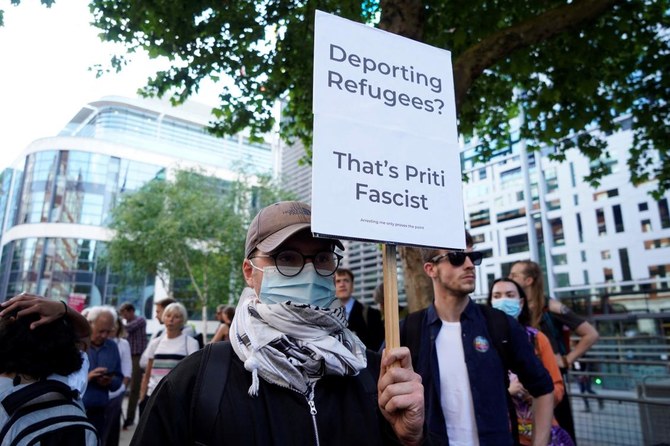
UK condemns court decision to block Rwanda deportation, will not leave convention

The government was thwarted in its attempt to send a handful of migrants on a charter plane to Rwanda on Tuesday after the European Court of Human Rights (ECHR) stepped in to issue injunctions, canceling the flight. (File/AFP)
Short Url
Updated 16 June 2022
Follow

UK condemns court decision to block Rwanda deportation, will not leave convention

  • Dominic Raab, who is also Britain’s justice secretary, criticized the Strasbourg-based court for essentially blocking the flight

LONDON: Britain has no plans to leave the European Convention on Human Rights, but the Strasbourg court which enforces it overstepped its powers in blocking the deportation of asylum seekers to Rwanda, deputy prime minister Dominic Raab said on Thursday.
The government was thwarted in its attempt to send a handful of migrants on a charter plane more than 4,000 miles (6,4000 km) to Rwanda on Tuesday after the European Court of Human Rights (ECHR) stepped in to issue injunctions, canceling the flight.
Raab, who is also Britain’s justice secretary, criticized the Strasbourg-based court for essentially blocking the flight, part of a policy which London says will stem the flow of migrants making dangerous trips across the English Channel from France.
Raab said the flights would take place despite criticism from the United Nations, the leadership of the Church of England and Prince Charles, the heir to the throne, who has privately described the plan as “appalling” according to media reports.
“Our plans involve staying within the Convention, the European Convention. It is also important the Strasbourg court reflects and stays faithful to its mandate as part of the convention,” he told BBC television.
“The Strasbourg court itself has said for many years that there’s no binding power of injunction. And then later on they said: ‘Well actually, we can issue such binding injunctions.’ It is not grounded in the Convention,” Raab told Sky News.
The European court’s late intervention had led some in Prime Minister Boris Johnson’s Conservative Party to call for Britain to pull out of the European Convention on Human Rights altogether.
Challenged over death threats on social media to human rights lawyers, Raab said they were unacceptable but Britain’s Human Rights Act had led to an “industry” of lawyers promoting “elastic interpretations” of the law on behalf of their clients.
He added that the government could not give a fixed date for when it would be able to send asylum seekers to Rwanda.


Venezuela to debate historic amnesty bill for political prisoners

Updated 3 sec ago
Follow

Venezuela to debate historic amnesty bill for political prisoners

  • Venezuela could pass a landmark bill on Thursday granting amnesty to political prisoners, marking an early milestone in the transition from the rule of toppled leader Nicolas Maduro
CARACAS:Venezuela could pass a landmark bill on Thursday granting amnesty to political prisoners, marking an early milestone in the transition from the rule of toppled leader Nicolas Maduro.
The legislation, which covers charges used to lock up dissidents under Maduro and his predecessor Hugo Chavez, aims to turn the page on nearly three decades of state repression.
It was spearheaded by interim president Delcy Rodriguez, who replaced Maduro after he was captured by US forces in Caracas last month and flown to New York to face trial.
Rodriguez took Maduro’s place with the consent of US President Donald Trump, provided she does Washington’s bidding on access to Venezuelan oil and expanding democratic freedoms.
She has already started releasing political prisoners ahead of the pending amnesty. More than 400 people have been released so far, according to rights group Foro Penal, but many more are still behind bars.
Rodriguez also ordered the closure of the notorious Helicoide prison in Caracas, which has been denounced as a torture center by the opposition and activists.
Lawmakers voted last week in favor of the amnesty bill in the first of two debates.
The second debate on Thursday coincides with Youth Day in Venezuela, which is traditionally marked by protests.
Students from the Central University of Venezuela, one of the country’s largest schools and home to criticism of Chavismo, called for a rally on campus.
Venezuela’s ruling party also announced a march in the capital Caracas.
’We deserve peace’
Venezuela’s attorney general said Wednesday that the amnesty — which is meant to clear the rap sheets of hundreds of people jailed for challenging the Maduro regime — must apply to both opposition and government figures.
He urged the United States to release Maduro and his wife, both in detention in New York.
“We deserve peace, and everything should be debated through dialogue,” Attorney General Tarek William Saab told AFP in an interview.
Delcy Rodriguez’s brother Jorge Rodriguez, who presides over the National Assembly, said last week that the law’s approval would trigger the release of all political prisoners.
“Once this law is approved, they will all be released the very same day,” he told prisoners’ families outside the notorious Zona 7 detention center in Caracas.
’We are all afraid’
Venezuelan opposition leader Juan Pablo Guanipa was one of the detainees granted early release.
But he was re-arrested less than 12 hours later and put under house arrest.
Authorities accused him of violating his parole after calling for elections during a visit to Helicoide prison, where he joined a demonstration with the families of political prisoners.
Guanipa is a close ally of Nobel Peace Prize laureate and opposition leader Maria Corina Machado, who was in hiding for over a year before she fled the country to travel to Oslo to receive the award.
“We are all afraid, but we have to keep fighting so we can speak and live in peace,” Guanipa’s son told reporters outside his home in Maracaibo.