

One step from glory: 5 things we learned as Saudi Arabia and Uzbekistan reach final of 2022 AFC U-23 Asian Cup

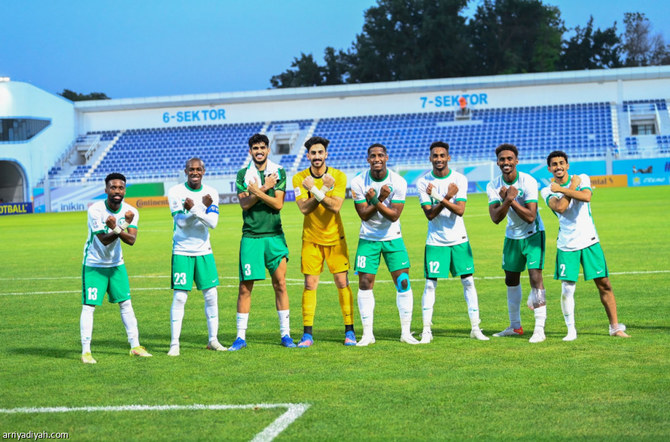
Saudi players celebrate beating Australia and reaching the final of the 2022 AFC U-23 Asian Cup. (SAFF)
Short Url
Updated 16 June 2022
Follow

One step from glory: 5 things we learned as Saudi Arabia and Uzbekistan reach final of 2022 AFC U-23 Asian Cup

  • Young Green Falcons hoping to win the competition for the first time on Sunday after two previous final losses
  • To concede no goals in five games is impressive and testament to the solid organization of the team

Saudi Arabia defeated Australia 2-0 in the semifinal of the 2022 AFC U-23 Asian Cup on Wednesday to book a huge showdown with the host nation Uzbekistan on Sunday.

Here are five things we learned from the last four clashes.

1. Al-Buraikan not just about goals

Firas Al-Buraikan may be among the top 10 goalscorers in the Saudi Arabian league, which is no mean feat given the foreign talent that plays there and the fact that he does not feature for one of the big clubs, but there is more to his game than finding the back of the net. The striker made both goals against Australia and showed great vision in doing so.

In the first half, there were two Australian defenders who were happy to maneuver the Al-Fateh forward into the corner but they didn’t expect an impressive and visionary pullback from the left side into the area for Hussain Al-Eisa to fire an unstoppable shot into the top corner.

Then came the all-important second that virtually killed the game as a contest. This time he was not quite as wide but still got to the byline of the left side, and pulled the ball back for Ayman Yahya to make no mistake and give the team the breathing space they were looking for.

2. Defense comes through again

Australia asked questions of the Saudi defense especially at set pieces. Tyrese Francois went very close in the first half as his shot came back firmly off the bar. A couple of other times, the West Asian team were relieved to see low shots roll just past the outside of the post.

The situation changed after the red card to Jay Rich-Baghuelou in the first half but that meant that there had to be more concentration from the team. Australia were always going to struggle to mount constant attacks but Saudi Arabia had to stay very vigilant.

The Olyroos were never going to give up even with a man removed and for a time did get balls in the area; and it took the second goal to remove the momentum that the Australians were building up. In the end though, it was another clean sheet, thanks to a late penalty save, and another win as the defense stayed focused. To concede no goals in five games is impressive and testament to the solid organization of the young Green Falcons.

3. Hamed Al-Ghamdi and others show strength in depth

The diminutive midfielder has had an excellent tournament, and was everywhere against Australia and full of energy and commitment. The Al-Ettifaq player is not the type to attract many headlines or score spectacular goals but he worked hard to deny the young Australians space or time. Al-Ghamdi was the embodiment of a real team performance. While the likes of Al-Buraikan and Ayman Yahya — the tournament’s top scorer with three — get the goals and the headlines, they can’t do it without the efforts of their teammates.

And then there was Haitham Asiri who has started every game at the Asian Cup but left the field after just nine minutes due to injury. Saudi Arabia didn’t miss a beat however and on came Al-Eisa who, just a few minutes later, scored the opener in ruthless fashion. In a tournament, it is not just about the starting 11 but the whole squad and for the team it is a case of so far, so good.

4. Strange ending offers a valuable lesson

There were five minutes added time awarded by the referee though the game already seemed over as a contest. Yet there were two penalties awarded. The first was given to Australia after a VAR review and Ramy Najjarine’s spot-kick was saved magnificently by goalkeeper Nawaf Al-Aqidi, adding another sheen of gloss to his burgeoning reputation. Very soon after, Saudi Arabia got a chance to make it 3-0 when they were given a penalty of their own. It was Abdullah Radif’s turn to see his effort saved.

It was an exciting end to what had looked like a regulation win. It was also an important lesson that even when it seems the game is won, or lost, you never know what can happen. As the 90-minute mark was passed, nobody could have predicted that there were about to be two penalties awarded. The game is not won until the final whistle goes.

5. Uzbekistan get past Japan to set up epic final

Japan had looked good in getting to the semifinal and really made the rest of the continent sit up by defeating defending champions South Korea 3-0 in the quarterfinals. That performance was one of potential champions and it looked as if the Samurai Blue were the team to beat.

Yet in the other semifinal Uzbekistan did the business with a 2-0 win. This wasn’t because of an intimidating atmosphere provided by the host nation as there were not 30,000 fans packed into the stadium. There were only a few hundred Japanese supporters with no home fans allowed due to incidents in the quarterfinal penalty shootout win over Iraq.

Even without their fans, Uzbekistan were aggressive in attack and defended with discipline. The memories they have of winning the 2018 title in China are still fresh and they would love nothing more than to lift the title in front of their own fans. It is possible that Saudi Arabia can use that expectation against the Central Asians and frustrate the hosts but it is going to be a real test. But then, that is what finals are all about.


A powerful rivalry: Sabalenka and Svitolina set for Australian Open semifinal showdown

Updated 2 sec ago
Follow

A powerful rivalry: Sabalenka and Svitolina set for Australian Open semifinal showdown

  • Top-ranked Sabalenka, who is seeking a third title in four years in Australia, is from Belarus
  • Players from Ukraine do not shake hands with players from Russia or Belarus at the net after matches
MELBOURNE: Naturally there’ll be attention on the backstory when Aryna Sabalenka and Elina Svitolina meet in the Australian Open women’s semifinals.
Top-ranked Sabalenka, who is seeking a third title in four years in Australia, is a 27-year-old from Belarus. She’s popular on TikTok for her humorous posts and dance routines.
Svitolina is a 31-year-old Ukrainian who will be returning to the Top 10 next week for the first time since returning from a maternity break she took in 2022. She reached her first Australian Open semifinal with a lopsided win over No. 3 Coco Gauff, needing only 59 minutes to end her run of three quarterfinal losses at Melbourne Park.
They’re both regularly asked questions relating to Russia’s war on Ukraine. Both have regularly said they want the focus to be on tennis. Svitolina is trying to bring joy to the people of Ukraine, of course. Sabalenka said she supports peace.
“It’s very close to my heart to see a lot of support from Ukrainians,” she said. “So I feel like (I) bring this light, a little light, you know, even just positive news to Ukrainian people, to my friends when they are watching.”
Players from Ukraine don’t shake hands with players from Russia or Belarus at the net after matches. It’s accepted on both sides.
They’re both on 10-match winning streaks so far in 2026 and entered the season’s first major with titles in warmup tournaments — Sabalenka in Brisbane, and Svitolina in Auckland, New Zealand, her 19th career title. That was Svitolina’s first foray back after an early end to the 2025 season for a mental health break.
Sabalenka, who has 22 career titles including back-to-back Australian championships in 2023 and ‘24 and back-to-back US Open triumphs in 2024 and last year, is 5-1 in career meetings with Svitolina. She is into the final 4 at a major for the 14th time, and has made the final seven times.
“It’s no secret that she’s a very powerful player. I watched a little bit of her (quarterfinal) match. She was playing great tennis, and I think, the power on all aspects of her game is her strengths,” Svitolina said of Sabalenka. “She’s very consistent. For me, I’ll have to ... try to find the ways and the little holes, little opportunities in her game.
“When you play the top players, you have to find these small opportunities and then be ready to take them.”
Svitolina is playing her fourth semifinal at a major — 2019 and 2023 at Wimbledon and the 2019 US Open — and aiming for her first final.
Sabalenka played her quarterfinal against 18-year-old Iva Jovic before the searing heat forced organizers to close the roof of the Rod Laver Arena stadium on Tuesday. She was long gone before Svitolina and Guaff played under the roof at night. At that stage, she didn’t know who she’d next be playing, but was sure “it’s going to be a battle.”
“Because whoever makes it there, it’s an incredible player,” she said. “I think my approach going to be the same. Doesn’t matter who I’m facing.
“I’ll just go, and I’ll be focused on myself and on my game.”
Rybakina-Pegula, 5 vs. 6
Sixth-seeded Jessica Pegula completed the final 4 when she held off fellow American Amanda Anisimova 6-2, 7-6 (1) to move into a semifinal against 2022 Wimbledon champion Elena Rybakina.
Pegula beat 2025 champion Madison Keys in the previous round before ending Anisimova’s run of back-to-back Grand Slam finals.
The sixth-seeded Pegula is hoping to emulate Keys’ run here last year and claim her maiden Grand Slam title in Australia.
“I’ve been waiting for the time when I can kind of break through,” Pegula said. “I feel like I really play some good tennis here and I like the conditions.”
With a 7-5, 6-1 victory in the center court opener Wednesday, Rybakina, the 2023 Australian Open runner-up, ended No. 2-ranked Iga Swiatek’s bid to complete a career Grand Slam — at least for this year.
Rybakina, who was born in Russia but represents Kazakhstan, said she’d focus on the lessons she’d taken from previous trips to the deciding end of the majors.
“Now I’m more calm. In the beginning, when it’s the first final and you go so far in the tournament, of course you are more emotional,” she said. “Now I feel like I’m just doing my job, trying to improve each day. So it’s kind of another day, another match.”