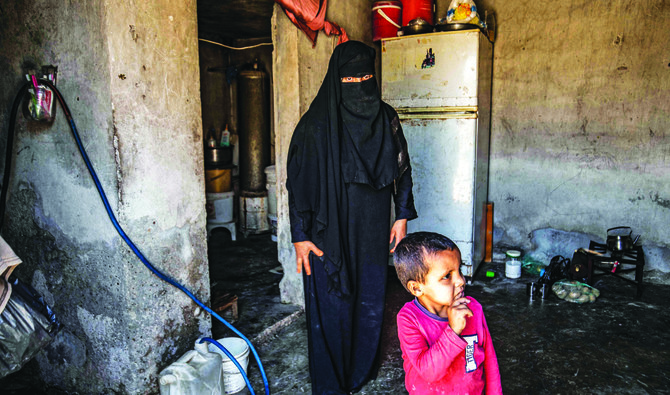

RAQQA, Syria: Noura Al-Khalif married a Daesh supporter and then wound up without her husband in a Syrian camp viewed by many as the last surviving pocket of the “caliphate.”
The 31-year-old woman has been back in her hometown outside the northern city of Raqqa for three years but she is struggling to shake off the stigma of having lived in the Al-Hol camp.
“Most of my neighbors call me a Daesh supporter,” she told AFP from her father’s house near Raqqa, where she now lives with her two children.
“I just want to forget but people insist on dragging me back, and ever since I left Al-Hol I haven’t felt either financial or emotional comfort.”
Al-Hol, in the Kurdish-controlled northeast, still houses about 56,000 people, mostly Syrians and Iraqis, some of whom maintain links with Daesh.
About 10,000 are foreigners, including relatives of Daesh fighters, and observers are increasingly worried what was meant as a temporary detention facility is turning into a jihadist breeding ground.
Most of Al-Hol’s residents are people who fled or surrendered during the dying days of IS’s self-proclaimed “caliphate” in early 2019.
For staying, whether by choice or not, until the very end, they are seen as fanatical Daesh supporters, although the camp’s population also includes civilians displaced by battles against the jihadists.
The stigma is a challenge for Khalif who arrived in Al-Hol from Baghouz, the riverside hamlet where Daesh was declared definitively defeated by US-backed Kurdish forces.
“Al-Hol camp was more merciful to us than Raqqa. I left the camp for my children and their education, but the situation here is not better,” she said.
In 2014, Khalif married a jihadist and lived with him across several Daesh-held regions before the two were separated by the fighting.
She hasn’t heard from her husband since she left for Al-Hol in 2019.
After a few months of living in the camp, Khalif was permitted to leave along with hundreds of other Syrians under an agreement between Syrian tribal chiefs and Kurdish authorities overseeing the facility. More than 9,000 Syrians have since been allowed to exit Al-Hol under such deals which aim to empty the camp of nationals, according to the Britain-based Syrian Observatory for Human Rights.
Khalif’s homecoming has been anything but sweet. She said she struggles to make a living by cleaning homes and faces constant suspicion.
“Some families won’t let me clean their homes because I wear the niqab (face veil) and because they think I’m a Daesh supporter,” she said.
Raqqa tribal elder Turki Al-Suaan has arranged for the release of 24 families from Al-Hol to facilitate their reintegration into their communities, but he acknowledged that it was no easy task.
“I know their families and they are from our region. But the intolerance that society has toward these people is a reaction to the abuses committed by Daesh against civilians in the area during their rule,” he said.
Raqqa resident Sara Ibrahim warned that there was a danger in stigmatizing people returning to Raqqa from Al-Hol, most of whom are women and children.
“A lot of families in Raqqa refuse to engage with these people and this ... could push them toward extremism in the future,” she said.
Fearing prejudice, Amal has kept a low profile since she arrived in Raqqa seven months ago from Al-Hol.
The 50-year-old grandmother and members of her family were among the last of those who flooded out of Baghouz, where the jihadists made their final stand.
“My neighbors in Raqqa do not know that I was in Al-Hol camp, and I fear people will have a bad idea if they know that I was living” there, she said, a niqab covering her face.