

NRG Matters: BP acquires 40% stake to lead $30bn Australian renewables project; UK ends EV subsidies program 

Short Url
Updated 15 June 2022
Follow

NRG Matters: BP acquires 40% stake to lead $30bn Australian renewables project; UK ends EV subsidies program 

RIYADH: On a macro level, Egypt, Israel and the EU have signed a gas export agreement as Europe seeks an alternative to Russian gas, while the UK has ended its electric cars $349 million subsidies program, as demand surged. 

Zooming in, the British oil giant BP has acquired a 40.5 percent stake in a massive Australian renewables project, that is valued at $30 billion. Saudi Aramco aims to ramp up blue ammonia production as it releases its first sustainability report. 

Looking at the bigger picture:

Egypt, Israel and the EU have signed a gas export agreement as Europe seeks to replace Russian supply of energy that it had depended on for years. 

The deal will allow Israel to increase its natural gas exports through existing pipelines to Egyptian ports in which it will be transported to Europe after being liquified. 


• As demand for electric cars surges, the UK closes its $349 million grant-funding program, according to Bloomberg.

The decision to end subsidies for EVs comes in a bid to free up cash to expand charging network and boost other battery-powered vehicles sales, such as vans, taxis and motorcycles. 

Through a micro lens: 

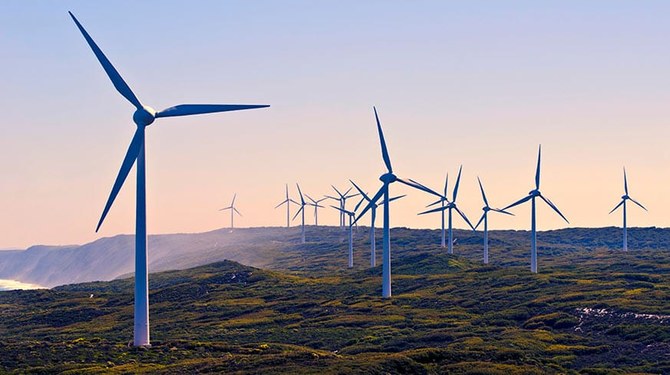
Oil giant BP acquired a 40.5 percent stake in a massive $30 billion Australian renewables and green hydrogen project, according to a statement. 

Following the acquisition, the British energy firm will lead and operate the 6,500 square kilometers project that is expected to develop up to 26 GW of combined solar and wind generating capacity.

Saudi Aramco aims to ramp up production of blue ammonia and hydrogen business, to produce up to 11 million metric tonnes of blue ammonia per year by 2030, according to a statement. 


Aramco rises nearly 3% as Gulf stocks fall on Middle East tensions

Updated 15 sec ago
Follow

Aramco rises nearly 3% as Gulf stocks fall on Middle East tensions

RIYADH: Saudi Arabian Oil Co. shares rose nearly 3 percent in intraday trading on March 1, outperforming regional markets as escalating tensions in the Middle East weighed on Gulf equities.

The stock climbed as much as 3.2 percent to SR25.76 ($6.87) before easing slightly to SR25.64, up 2.72 percent from the previous close of SR24.96, according to Tadawul data. More than 12 million shares were traded, with turnover exceeding SR306 million as of 12:20 p.m. Saudi time.

The gains came even as most Gulf markets declined after Israel and the US launched strikes on Iran, triggering retaliatory attacks and raising fears of a broader regional conflict.

The Kingdom’s benchmark Tadawul All Share Index dropped as much as 4.6 percent in early trading, putting it on track for its sharpest intraday fall since April, Reuters reported.

Elsewhere in the region, Boursa Kuwait suspended trading as a precautionary measure. Oman’s main index trimmed losses to 1.5 percent after falling more than 3 percent earlier, while Bahrain’s benchmark slipped 0.6 percent. Qatar’s market was closed for a bank holiday.

Investors are now closely watching oil markets, particularly the Strait of Hormuz, a key shipping route that carries about 15 million barrels of crude per day, nearly 30 percent of global seaborne oil trade.

“The most immediate and tangible development affecting oil markets is the effective halt of traffic through the Strait of Hormuz,” said Jorge Leon, senior vice president and head of geopolitical analysis at Rystad Energy.

“Unless de-escalation signals emerge swiftly, we expect a significant upward repricing of oil at the start of the week,” he added.

Leon said some supply could be rerouted through alternative pipelines, including Saudi Arabia’s East-West pipeline to the Red Sea, which has a capacity of about 5 million barrels per day, and the UAE’s Abu Dhabi pipeline, with a capacity of around 1.5 million barrels per day. Even so, he estimated the disruption could temporarily remove 8 million to 10 million barrels per day from global supply.

Barclays raised its Brent crude forecast to about $100 a barrel from $80 a day earlier, while analysts expect prices could jump by as much as $20 per barrel when trading resumes on March 2 if tensions escalate further, Reuters reported.

“Should the Strait remain effectively closed or energy infrastructure be confirmed as damaged, the upside risks to prices would increase further,” Leon said.

Even a short disruption in Hormuz traffic could lead to tanker delays, cargo rescheduling, and supply bottlenecks, keeping energy markets volatile in the near term.