Hilton to train Saudi youth amidst push to develop local hospitality talent

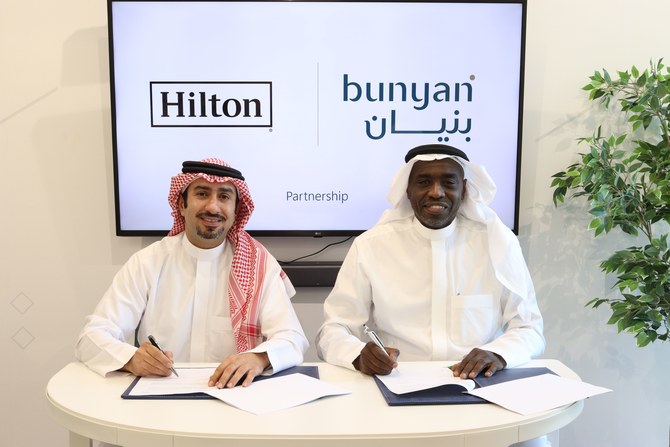
Fawaz Moumina, Sr Director of Human Resources, KSA, Egypt & Levant, Hilton and Nabil Tuker, CEO of Bunyan for Training signing the MoU of the hospitality training partnership. (Supplied)
Short Url
Updated 15 June 2022
Follow

Hilton to train Saudi youth amidst push to develop local hospitality talent

RIYADH: Hospitality major Hilton has partnered with Bunyan for Training, a local affiliate of Swiss hospitality management school Ecole Hôtelière de Lausanne, to train young Saudi talent willing to enter the industry. 

The training program, which will allow a number of select students to receive advanced theoretical and practical curricula, is accredited by the Saudi Technical and Vocational Training Corp. and certified by the Ecole Hôtelière de Lausanne, according to a statement. 

It will also allow students to pursue a Bachelor’s degree and expand their skill set across a variety of hospitality professions, including the culinary arts, food and beverage service, front office, and housekeeping. 

The program has been designed with the aim of providing job opportunities to young talent across Hilton hotels in Saudi following graduation.

“We’re delighted to collaborate with Hilton for this groundbreaking training program that we believe will provide a hugely beneficial start to a group of young students,” CEO of Bunyan for Training, Nabil Tuker said. 

Through expert coaching and real-life work experience, he said these students will have the best possible start in the hospitality industry with Hilton. 

A ‘golden era’ for Saudi hospitality sector 

This comes on the back of Saudi’s push to develop the hospitality sector as part of the strategy to diversify away from the fuel-based economy. 

With the Kingdom’s travel and tourism sector enjoying a dramatic rebound post-pandemic, the program is expected to play a part in developing local talent which Saudi would be in greater need of as more international hotels open their operation in the country.   

The Kingdom’s major cities such as Riyadh, Dammam and Jeddah witnessed their revenue per available room, or RevPAR, rising to 88 percent, 85 percent and 56 percent, respectively, in 2021, according to hospitality research company STR. 

The Jeddah hotel industry occupancy climbed to 64 percent in May, which is the highest since September 2019.

Furthermore, the pace of growth is set to gather steam as the Kingdom’s Vision 2030 reform program aims to attract 100 million annual visitors within eight years. 

In an exclusive interview with Arab News earlier, a top official of Knight Frank said the next 10 years will be a golden era for Saudi hospitality as the country has laid down the foundation of transformation in the sector.

“It will not happen again in the coming years and years to come. It will lay the foundation for hospitality in the long term,” Turab Saleem, head of hospitality, tourism and leisure consultancy at Knight Frank in the Middle East and North Africa, said on the sidelines of the Future Hospitality Summit held last month.


From 2 hours to 30 minutes: Qiddiya Bullet Train to cut Riyadh travel time by 75% 

Updated 6 sec ago
Follow

From 2 hours to 30 minutes: Qiddiya Bullet Train to cut Riyadh travel time by 75% 

RIYADH: Qiddiya is set to become significantly more accessible under plans to link the entertainment and tourism hub to King Salman International Airport and the King Abdullah Financial District through the new Qiddiya Bullet Train, Asharq Al Awsat reported

The project will reduce travel time to around 30 minutes, down from nearly two hours using other transport options, representing a 75 percent cut in commuting time. Operational speeds are expected to reach 250 km per hour, according to the Royal Commission for Riyadh City. 

The railway forms part of a broader transport strategy aimed at improving connectivity across the capital and enhancing mobility between key destinations, in line with population growth and urban expansion in western and southwestern Riyadh. 

In a related development, the commission announced the awarding of the Red Line extension of the Riyadh Metro to Diriyah. The expansion includes 7.1 km of tunnel and 1.3 km of elevated track, with stations at King Saud University and Diriyah. The latter is expected to serve as a future interchange with the planned Line 7. 

Officials estimate the project could remove around 150,000 cars from daily traffic, improving access to tourist destinations such as Bujairi Terrace and Wadi Safar, while supporting more sustainable mobility patterns. 

Bandar Al-Saadoun, vice chairman of Khaleejiah Holding, told Asharq Al-Awsat that the Diriyah development ranks among the largest projects under Vision 2030. He pointed to additional landmark initiatives in Wadi Safar, alongside the Opera House project and King Salman Grand Mosque. 

He said extending the Red Line along King Abdullah Road to Diriyah would generate strong real estate demand, particularly as the rail network integrates routes from King Salman International Airport through KAFD, Diriyah and the New Murabba development. 

Al-Saadoun added that roughly 30 projects have been announced in Qiddiya, raising the prospect of gradual real estate growth along corridors connected to the rail line. The project’s links to major developments — including Expo 2030 Riyadh, New Murabba and The Avenues — as well as the airport, which is expected to become one of the world’s largest by 2030, are likely to reinforce demand. 

Real estate analyst Khaled Almobid said large-scale transport projects such as the Qiddiya Bullet Train do more than lift prices; they reshape market structure and asset values over the medium and long term. 

Historically, properties within one to three km of transport stations see capital appreciation and rising investment demand, particularly for undeveloped “white land,” which often transitions into higher-density projects, he said. 

Almobid expects a dual impact: both redistribution of demand within Riyadh and genuine market expansion driven by what he called “manufactured demand” from Qiddiya, which is projected to attract 17 million visitors and generate 325,000 jobs. He also anticipates a population shift toward western Riyadh and areas surrounding the new stations. 

Land prices near Qiddiya have already risen between 30 percent and 40 percent since 2023, reflecting early market anticipation, he said, predicting more sustainable growth once operations begin and prices align with the tangible value of cutting travel time to 30 minutes between the airport, KAFD and Qiddiya. 

Residential and tourism-related real estate are likely to lead the next phase, supported by Saudi Arabia’s goal of raising homeownership to 70 percent and attracting 150 million annual visitors by 2030, with mixed-use locations along the rail corridor expected to draw the strongest investment interest.