

State Minister Khar to present Pakistan’s progress at FATF meeting in Germany

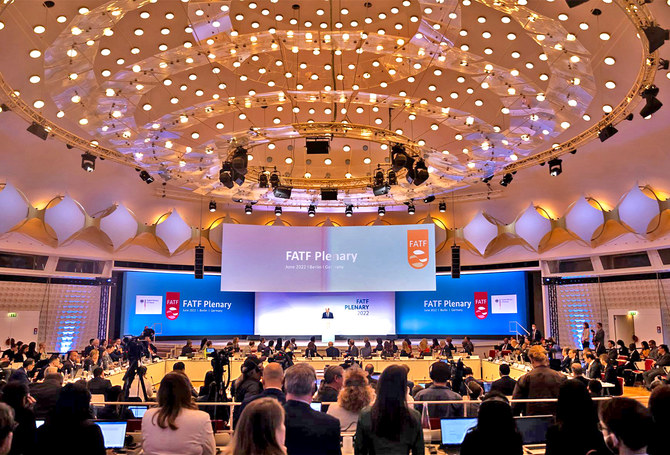
The picture shows FATF plenary meeting underway in Berlin, Germany, on June 14, 2022. (@FATFNews/Twitter)
Short Url
Updated 14 June 2022
Follow

State Minister Khar to present Pakistan’s progress at FATF meeting in Germany

  • Minister will underscore Pakistani’s commitment to further strengthen Anti-money laundering, terror financing regimes
  • Pakistan was placed on FATF ‘grey list’ of countries in 2018 for inadequate anti-terror funding, money laundering controls

ISLAMABAD: Pakistan’s State Minister for Foreign Affairs Hina Rabbani Khar will present the country’s progress at a plenary meeting of the global anti-money laundering watchdog, the Financial Action Task Force (FATF), in Germany this week, the Pakistani foreign office said on Tuesday. 

Germany is hosting the FATF plenary meeting in Berlin from June 13 to June 17. 

Pakistan was placed on the FATF grey list of countries in 2018 for inadequate anti-terror funding and money laundering controls. In June 2021, FATF President Marcus Pleyer said Islamabad had made “significant progress,” but there remained “serious deficiencies” in mechanisms to plug money laundering and “terrorism” financing. 

In March, the FATF announced retaining Pakistan on its “grey list,” but recognized the “swift steps” taken by Islamabad to improve its anti-money laundering (AML) and combating the financing of “terrorism” (CFT) regimes. 

“The Minister of State for Foreign Affairs, Ms. Hina Rabbani Khar, who is also the Chair of Pakistan’s National FATF Coordination Committee, will lead the Pakistan delegation in the FATF Plenary Meeting being held in Berlin, Germany,” the Pakistani foreign office said in a statement. 

“During the meeting, Pakistan’s progress under the 2018 and 2021 FATF Action Plans will be discussed. The Plenary will review the recommendations of FATF’s International Cooperation Review Group (ICRG).” 

Khar will hold meetings with the incoming and outgoing FATF presidents, executive secretary and heads of delegations of FATF member states to apprise them of the progress made by Pakistan on both FATF action plans. 

“The Minister of State will underscore the Government’s high-level political commitment to further strengthen Pakistan’s domestic AML-CFT regime,” the statement read. 

During the visit, the Pakistani state minister will also hold meetings with German dignitaries in the context of Pakistan-Germany bilateral relations. 

Pakistan was placed on the jurisdiction, subject to increased monitoring in 2018. Since then, Islamabad has taken measures to fulfill the FATF action plans and strengthen its AML and CFT programs. 

After its plenary meeting in March, the FATF said Pakistan had fulfilled six of the seven action items highlighted by the watchdog’s Asia Pacific Group (APG) in 2021. 

It recognized Pakistan’s continued political commitment led to “significant progress” across a comprehensive counter-terrorism financing action plan and that the South Asian country had fulfilled 26 of the 27 action items of its 2018 plan. 


Pakistan, global crypto exchange discuss modernizing digital payments, creating job prospects 

Updated 05 December 2025
Follow

Pakistan, global crypto exchange discuss modernizing digital payments, creating job prospects 

  • Pakistani officials, Binance team discuss coordination between Islamabad, local banks and global exchanges
  • Pakistan has attempted to tap into growing crypto market to curb illicit transactions, improve oversight

ISLAMABAD: Pakistan’s finance officials and the team of a global cryptocurrency exchange on Friday held discussions aimed at modernizing the country’s digital payments system and building local talent pipelines to meet rising demand for blockchain and Web3 skills, the finance ministry said.

The development took place during a high-level meeting between Finance Minister Muhammad Aurangzeb, Pakistan Virtual Assets Regulatory Authority (PVARA) Chairman Bilal bin Saqib, domestic bank presidents and a Binance team led by Global CEO Richard Teng. The meeting was held to advance work on Pakistan’s National Digital Asset Framework, a regulatory setup to govern Pakistan’s digital assets.

Pakistan has been moving to regulate its fast-growing crypto and digital assets market by bringing virtual asset service providers (VASPs) under a formal licensing regime. Officials say the push is aimed at curbing illicit transactions, improving oversight, and encouraging innovation in blockchain-based financial services.

“Participants reviewed opportunities to modernize Pakistan’s digital payments landscape, noting that blockchain-based systems could significantly reduce costs from the country’s $38 billion annual remittance flows,” the finance ministry said in a statement. 

“Discussions also emphasized building local talent pipelines to meet rising global demand for blockchain and Web3 skills, creating high-value employment prospects for Pakistani youth.”

Blockchain is a type of digital database that is shared, transparent and tamper-resistant. Instead of being stored on one computer, the data is kept on a distributed network of computers, making it very hard to alter or hack.

Web3 refers to the next generation of the Internet built using blockchain, focusing on giving users more control over their data, identity and digital assets rather than big tech companies controlling it.

Participants of the meeting also discussed sovereign debt tokenization, which is the process of converting a country’s debt such as government bonds, into digital tokens on a blockchain, the ministry said. 

Aurangzeb called for close coordination between the government, domestic banks and global exchanges to modernize Pakistan’s payment landscape.

Participants of the meeting also discussed considering a “time-bound amnesty” to encourage users to move assets onto regulated platforms, stressing the need for stronger verifications and a risk-mitigation system.

Pakistan has attempted in recent months to tap into the country’s growing crypto market, crack down on money laundering and terror financing, and promote responsible innovation — a move analysts say could bring an estimated $25 billion in virtual assets into the tax net.

In September, Islamabad invited international crypto exchanges and other VASPs to apply for licenses to operate in the country, a step aimed at formalizing and regulating its fast-growing digital market.