First of 10 ships carrying edible oil leaves for Pakistan from Indonesia

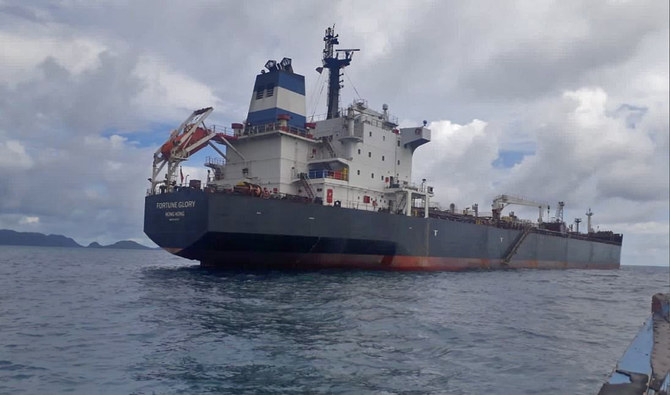
The picture released by Pakistan's state-run media APP on June 14, 2022 shows an Indonesian ship carrying edible oil to Pakistan. (APP/Twitter)
Short Url
Updated 14 June 2022
Follow

First of 10 ships carrying edible oil leaves for Pakistan from Indonesia

  • Indonesia has agreed to supply 2.5 million metric tons of edible oil to Pakistan
  • PM’s aide says import of oil will help reduce prices in Pakistan in a sustainable way

ISLAMABAD: The first of 10 cargo ships carrying 30,000 metric tons of edible oil will sail for Pakistan from Indonesia today, Pakistan prime minister’s office said on Tuesday, amid soaring oil and ghee prices in the South Asian country. 

The development comes days after a telephonic conversation between Pakistan PM Shehbaz Sharif and Indonesian President Joko Widodo, in which they agreed to closely coordinate on ensuring a steady supply of palm oil to Pakistan. 

Amid an increase in global commodity prices, the Pakistani government earlier this month jacked up the prices of ghee and cooking oil by an unprecedented Rs208 and Rs213 to an all-time high of Rs555 ($2.6) per kg and Rs605 ($2.9) per litre, respectively. 

On Tuesday, PM Sharif's office said Pakistan would receive 10 shipments of edible oil from Indonesia and Malaysia in the next two weeks. 

“A total of 2.5 million metric tons of edible oil will be supplied from Indonesia to Pakistan,” it said on Twitter. 

"The first ship carrying 30,000 metric tons of edible oil will leave for Pakistan today." 

The PM's office said the Indonesian Ministry of Commerce expedited matters on the request of a Pakistani delegation. 

Salman Sufi, PM Sharif's aide on strategic reforms, said Pakistan secured the immediate import of edible oil to bring the prices down in a sustainable way. 

Indonesia, the world's biggest palm oil exporter, allowed palm shipments to resume from May 23 following a three-week ban designed to boost cooking oil stocks and keep runaway local prices in check. Authorities have since launched an export acceleration programme and tweaked tax rules after shipments were slow to restart amid confusion over procedural issues. 

The removal of the ban has relieved pressure on the global vegetable oil market that witnessed peak prices because of the suspension, the invasion of Ukraine and global warming. 


Pakistan PM speaks to UAE president, calls for enhanced cooperation

Updated 13 February 2026
Follow

Pakistan PM speaks to UAE president, calls for enhanced cooperation

  • Shehbaz Sharif lauds UAE’s economic support in challenging times
  • Both leaders discuss a range of issues, agree to stay in close contact

ISLAMABAD: Prime Minister Shehbaz Sharif on Friday praised the United Arab Emirates for what he described as steadfast financial and political support during Islamabad’s recent economic crisis, as both sides signaled plans to deepen bilateral cooperation.

In a statement issued after Sharif spoke with UAE President Sheikh Mohamed bin Zayed Al Nahyan, the Prime Minister’s Office said the two leaders discussed matters of mutual interest and agreed to stay in close contact.

“The Prime Minister lauded the UAE’s consistent and unwavering support to Pakistan, that had helped the country navigate through difficult challenges,” the statement said, adding the two leaders “reaffirmed their shared desire to further enhance mutually beneficial cooperation between Pakistan and the UAE.”

The UAE, along with other friendly nations in the region, provided critical financial assistance to the South Asian country during a balance-of-payments crisis that strained Pakistan’s foreign exchange reserves and pressured its currency. Islamabad subsequently secured an International Monetary Fund program as part of broader stabilization efforts.

Sharif, in a post on X, described the exchange as positive.

“We fondly recalled our recent meetings and reaffirmed our shared resolve to further strengthen the historic, fraternal ties between Pakistan and the United Arab Emirates, and to expand mutually beneficial cooperation,” he wrote.

Millions of Pakistanis live and work in the UAE, forming one of the largest expatriate communities in the Gulf state.

Remittances from the UAE rank among Pakistan’s top sources of foreign currency inflows and play a significant role in supporting the country’s external accounts.

UAE-based companies are also investing in Pakistan, helping Islamabad develop its seaports to facilitate regional trade.