


RIYADH: Saudi Arabia’s reserves at the Kingdom’s national bank have fallen by 58 percent since 2016 as the government pushes ahead with funding its economic diversification plan, Vision 2030.
In April 2016 government funds at the Saudi Central Bank were SR957 billion ($255 billion), but now stand at SR402 billion.
Albara’a Al-Wazir, an economist at the US-Saudi Business Council, told Arab News the dipping into the reserve fund came as the money from oil fell over the period.
“The drop in the Kingdom’s oil revenues in light of the lower oil prices resulted in a budget deficit every year since 2013, which led the government to institute a dual pronged approach,” he said, adding: “The first was to draw down on its vast local and foreign reserves, and the second was to approach debt markets through issuing debt instruments to fund growing state expenditures.”
Reserves continued to decline in recent years despite oil prices rebounding to high levels.
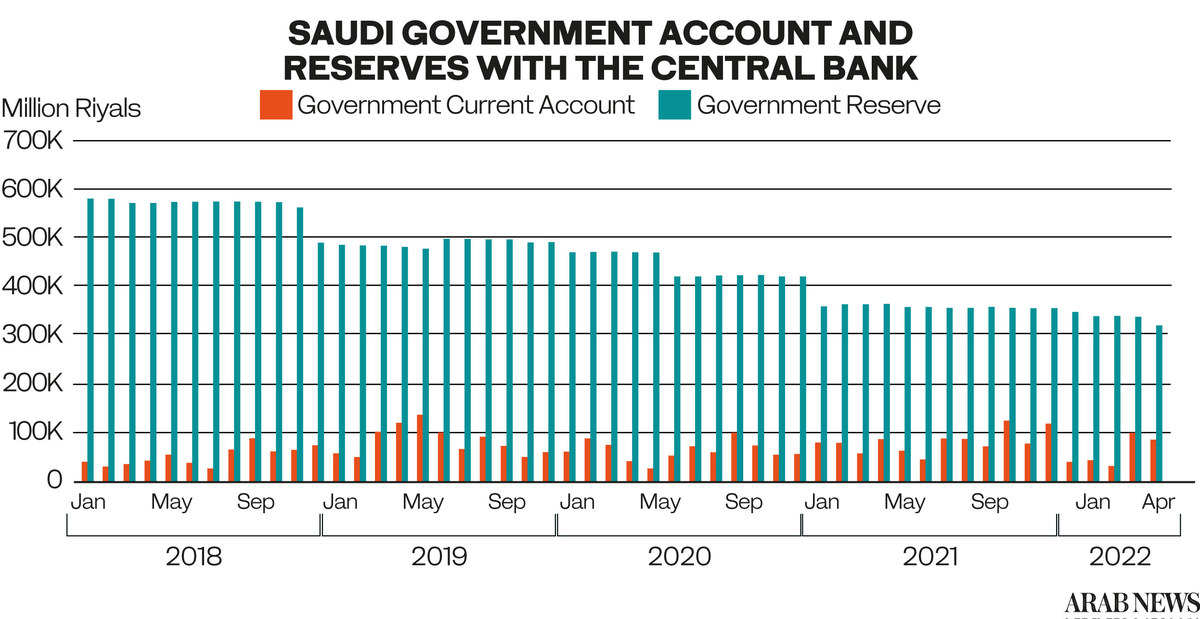
The government accounts with the central bank fell by SR35 billion and stood at SR402.4 billion in April compared to March, according to the latest data by Saudi Central Bank.
The monthly decrease came from the government’s current account and its reserves, which were down by SR16.3 billion and SR18.7 billion in April, respectively.
Government reserves that stood at SR319.1 billion in April witnessed a 10.8 percent year-on-year decline of SR38.8 billion. The current accounts totaled SR83.4 billion in April however recorded a year-on-year increase of 39 percent or SR23.3 billion.
In recent years, the central bank, which invested mainly in US bonds and similar low-risk assets, has been overshadowed by the Public Investment Fund, now the primary investment vehicle for sovereign money.
Al-Wazir said: “With the recent improvement in oil prices, the government aims to avoid the pro-cyclical spending of previous oil booms as it is initiating its Fiscal Sustainability Program, which seeks to decouple higher government spending from higher oil revenues.”
With the Vision 2030 development plan, the Kingdom wants to diversify its economy and end its dependence on oil in the long term.
The PIF was established in 1971 and reinstituted in 2015 when it was placed under the direction of the newly formed Council of Economic and Development Affairs.
Al-Wazir said: “The drawdown in government reserves is fueled partly by the need to service the Kingdom’s financing needs associated with the private sector stimulus packages.
“Furthermore, the Kingdom’s sizeable diversification plans necessitate capital injection into several Vision Realization Plans such as the PIF and national transformation programs.”
“Despite the drawdown in government reserves over the years, the current levels are still within an acceptable range, according to the Ministry of Finance,” added Al-Wazir.
Al-Wazir said that the Saudi government is likely to continue replenishing its reserves, as usually during oil booms.
However, the focus will shift toward developing the Kingdom’s non-oil economy through the PIF and National Development Fund, which will take precedence over previous periods.


