

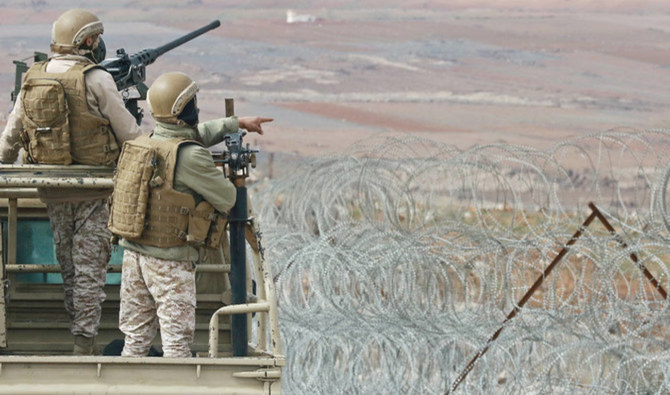

AMMAN: The Jordanian army has announced that its troops on the northeastern border with Syria foiled an attempt on Sunday at dawn to smuggle “large amounts” of drugs from the war-torn country into the kingdom.
The operation was the latest since the Jordanian army earlier this year announced an intensified campaign against drug smuggling from Syria which, it said, has been increasing dramatically.
A source from the Jordan Armed Forces-Arab Army said that rules of engagement were applied to the smugglers, leading to their escape back into Syria. Searching the area, the source said that troops found 900,000 Captagon pills and 154 palm palm-sized sheets of hashish.
The source reiterated that the army will apply “full force” to thwart any infiltration or smuggling attempts, protecting the kingdom’s borders and citizens.
On May 22, the JAF said that troops on Jordan’s eastern borders with Syria opened fire on people who attempted to infiltrate the kingdom, killing four of them and injuring others. The army said that the smugglers left behind 181 palm-sized sheets of hashish, 637,000 Captagon narcotic pills, and 39,600 tramadol pills.
The largest operation unveiled so far was on Jan. 27 when the Jordanian army announced that it had killed 27 infiltrators as they tried to smuggle “large amounts” of narcotics from Syria into the kingdom. The army said that the operation in late January came after the directives of the JAF chairman to change the rules of engagement. Jordan has been warning of Syria turning into a narco-state, posing cross-border threats to the kingdom, the region, and the rest of the world.
Jordan has also warned that narcotics had become an “established industry” in southern Syria under the sponsorship of Lebanon’s Shiite Hezbollah and other Iran-backed militias.
Director of JAF Military Media Department Col. Mustafa Hiyari recently accused Iran and Syria of sponsoring drug dealers operating in Syria, adding that the Jordanian army is waging a “drug war” on the northern borders. In remarks to the government-owned Al-Mamlaka TV, Hiyari also said that drug trafficking to Jordan is supported by “uncontrolled groups” within the Syrian army and pro-Iranian groups.
“We are facing a drugs war along the borders, led by organizations supported by foreign parties. These Iranian militias are the most dangerous because they target Jordan’s national security,” Hiyari said.
Fayez Dweiri, a retired major general and military analyst, has previously told Arab News that Hezbollah had resorted to the narcotics trade to secure funding after the US sanctions on Iran. He added Hezbollah has relocated some of its drug factories in Beirut’s Dahieh Al-Janubiya to Aleppo and other Syrian regime-controlled regions. Dweiri said that the US sanctions on Iran have hit Hezbollah hard, “obliging Tehran’s most funded proxy to look for other sources of revenues.”
According to a report by the Washington Institute for Near East Policy, Hezbollah has significantly expanded and institutionalized its drug trafficking enterprises, which now generate more money than its other funding streams. The think tank said that Hezbollah’s global narcotics industry began in Lebanon’s Bekaa Valley in the 1970s, using well-established smuggling routes across the Israel-Lebanon border.
Political analyst Amer Sabaileh voiced confidence in the Jordanian army’s ability to control drug trafficking from Syria, explaining that the narcotics industry has expanded in the southern parts of Syria, especially after the withdrawal of Russian forces from there. Jordan’s King Abdullah has recently warned that a Russian withdrawal from southern Syria due to the Ukraine war would allow Iran-backed militias to fill the void.
King Abdullah, in an interview in May for the Battlegrounds series by Stanford University’s Hoover Institution, said that the presence of the Russians in the south of Syria was a source of calm.
“That vacuum will be filled by the Iranians and their proxies, so, unfortunately, we are looking at maybe an escalation of problems on our borders,” the king said. The JAF has said that 361 smuggling attempts from Syria were foiled in 2021, leading to the seizure of about 15.5 million pills of narcotics of different types.
The army said that it prevented more than 130 smuggling attempts from Syria in 2020 and seized about 132 million Captagon pills and more than 15,000 sheets of hashish.


