Hajj registration closes for domestic pilgrims after exceeding 390,000, e-draw begins

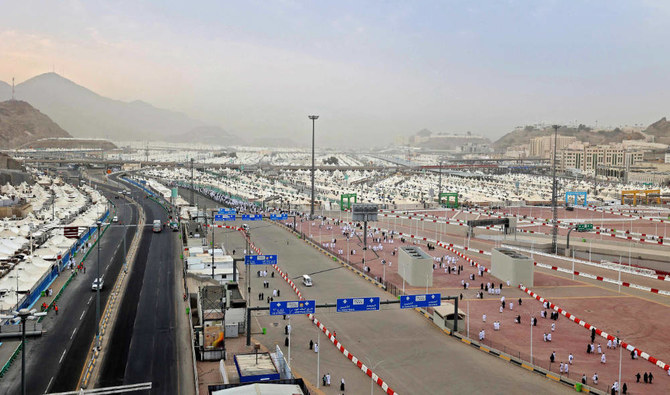
Muslim worshippers set out to perform a symbolic stoning of the devil ritual, as part of the Hajj pilgrimage in Mina, near Saudi Arabia's holy city of Makkah, on July 20, 2021. (AFP)
Short Url
Updated 13 June 2022
Follow

Hajj registration closes for domestic pilgrims after exceeding 390,000, e-draw begins

  • Registration closes for domestic pilgrims, e-draw begins

RIYADH: The Saudi Ministry of Hajj and Umrah has closed registration for domestic pilgrims for this year’s Hajj season, adding that the names would be announced later today following a draw.

The number of applicants for Hajj from inside Saudi Arabia had reached more than 390,000 requests, the ministry’s official spokesperson Hesham Saeed said. The selection of candidates will be done by e-lottery with priority given to those who have not performed Hajj previously, he said.

HIGHLIGHTS

• The number of applicants for Hajj from inside Saudi Arabia had reached more than 390,000 requests. The selection of candidates will be done by e-lottery with priority given to those who have not performed Hajj previously.

• Pilgrims successful in their request will receive a confirmation via text message on their registered devices.

“The sorting and the e-draw process will begin to select nominators from pilgrims who meet with the requirements that have been previously announced by the ministry,” said Saeed, who is also assistant deputy minister of Hajj and Umrah.

Pilgrims successful in their request will receive a confirmation via text message on their registered devices saying that they have been selected to perform Hajj, Islam’s fifth pillar.

“The nominators will be given 48 hours to complete the payment of the fees for the selected packages, after which the Hajj permits will be issued to them,” he said.

The ministry has also slashed prices for the three hospitality packages for the Hajj season this year.

The “Al-Abraj” package now costs SR13,943.75 ($3,716.33) per pilgrim, the “Developed Tents” package is SR11,970.35, and the “Undeveloped Tents” package cost SR9,098.80 per pilgrim. All prices are not inclusive of value-added tax and do not include land or air transportation to and from Makkah, the ministry said.

Registration opened for domestic pilgrims at the beginning of June through the “Eatmarna” application and via the ministry’s website.

The ministry stipulated that those who wished to register for Hajj, whether resident or citizen, should not exceed 65 years of age, and demonstrate complete immunization in the “Tawakkalna” application.

Earlier, the ministry confirmed that pilgrims from Europe, North America and Australia could also register electronically for this year’s Hajj.

Pilgrims from these countries were able to register their data and submit their official documents, including passports and necessary vaccination papers for COVID-19. They then were also entered into the lottery process for the appropriate packages, and if successful, should complete the online payment process. After that, the requests are sent to the Ministry of Foreign Affairs to issue visas in consultation with the ministry’s information center.

The ministry said that people should communicate by writing to [email protected], by phoning 920002814, or by using the official account on Twitter.

The likely date for Hajj this year will be during the first or second week of July, with the final date to be confirmed after the sighting of the new moon of Dhul Hijjah.


Riyadh takes shape at Tuwaiq Sculpture Symposium 2026

Updated 5 sec ago
Follow

Riyadh takes shape at Tuwaiq Sculpture Symposium 2026

RIYADH: This season, one of Riyadh’s busiest streets has taken on an unexpected role.

Under the theme “Traces of What Will Be,”sculptors are carving granite and shaping reclaimed metal at the seventh Tuwaiq Sculpture Symposium, running from Jan. 10 to Feb. 22.

The symposium is unfolding along Prince Mohammed bin Abdulaziz Road, known locally as Al‑Tahlia, a name that translates to desalination. The choice of location is deliberate.

The area is historically linked to Riyadh’s early desalination infrastructure, a turning point that helped to shift the city from water scarcity toward long‑term urban growth.

Twenty‑five artists from 18 countries are participating in this year’s event, producing large‑scale works in an open‑air setting embedded within the city.

The site serves as both workplace and eventual exhibition space, with sculptures remaining in progress throughout the symposium’s duration.

In her opening remarks, Sarah Al-Ruwayti, director of the Tuwaiq Sculpture Symposium, said that this year new materials had been introduced, including recycled iron, reflecting a focus on sustainability and renewal.

She added that the live-sculpting format allowed visitors to witness the transformation of raw stone and metal into finished artworks.

Working primarily with local stone and reclaimed metal, the participating artists are responding to both the material and the place.

For Saudi sculptor Wafaa Al‑Qunaibet, that relationship is central to her work, which draws on the physical and symbolic journey of water.

“My work … presents the connection from the salted water to sweet water,” Al‑Qunaibet told Arab News.

Using five pieces of granite and two bronze elements, she explained that the bronze components represented pipes, structures that carry saline water and allow it to be transformed into something usable.

The sculpture reflected movement through resistance, using stone to convey the difficulty of that transition, and water as a force that enables life to continue.

“I throw the stone through the difficult to show how life is easy with the water,” she said, pointing to water’s role in sustaining trees, environments and daily life.

Formally, the work relies on circular elements, a choice Al‑Qunaibet described as both technically demanding and socially resonant.

“The circle usually engages the people, engages the culture,” she said. Repeated circular forms extend through the work, linking together into a long, pipe‑like structure that reinforces the idea of connection.

Sculpting on site also shaped the scale of the piece. The space and materials provided during the symposium allowed Al‑Qunaibet to expand the work beyond her initial plans.

The openness of the site pushed the sculpture toward a six‑part configuration rather than a smaller arrangement.

Working across stone, steel, bronze and cement, American sculptor Carole Turner brings a public‑art perspective to the symposium, responding to the site’s historical and symbolic ties to desalination.

“My work is actually called New Future,” Turner told Arab News. “As the groundwater comes up, it meets at the top, where the desalination would take place, and fresh water comes down the other side.”

Her sculpture engages directly with the symposium’s theme by addressing systems that often go unseen. “Desalination does not leave a trace,” she said. “But it affects the future.”

Turner has been sculpting for more than two decades, though she describes making objects as something she has done since childhood. Over time, she transitioned into sculpture as a full‑time practice, drawn to its ability to communicate across age and background.

Public interaction remains central to her approach. “Curiosity is always something that makes you curious, and you want to explore it,” she said. Turner added that this sense of discovery is especially important for children encountering art in public spaces.

Saudi sculptor Mohammed Al‑Thagafi’s work for this year’s symposium reflects ideas of coexistence within Riyadh’s evolving urban landscape, focusing on the relationships between long‑standing traditions and a rapidly changing society.

The sculpture is composed of seven elements made from granite and stainless steel.

“Granite is a national material we are proud of. It represents authenticity, the foundation, and the roots of Saudi society,” Al‑Thagafi told Arab News.

“It talks about the openness happening in society, with other communities and other cultures.”

That dialogue between materials mirrors broader social shifts shaping the capital, particularly in how public space is shared and experienced.

Because the sculpture will be installed in parks and public squares, Al‑Thagafi emphasized the importance of creating multi‑part works that invite engagement.

Encountering art in everyday environments, he said, encouraged people to question meaning, placement, simplicity and abstraction, helping to build visual‑arts awareness across society.

For Al‑Thagafi, this year marked his fifth appearance at the symposium. “I have produced more than 2,600 sculptures, and here in Riyadh alone, I have more than 30 field works.”

Because the works are still underway, visitors can also view a small on‑site gallery displaying scaled models of the final sculptures.

These miniature models offer insight into each artist’s planning process, revealing how monumental forms are conceived before being executed at full scale.

As the symposium moves toward its conclusion, the completed sculptures will remain on site, allowing the public to encounter them in the environment that shaped their creation.