KYIV: The European Commission will provide a clear signal next week on Ukraine’s EU candidate status bid, its chief Ursula von der Leyen said Saturday, as fighting raged in the east and south of the country.
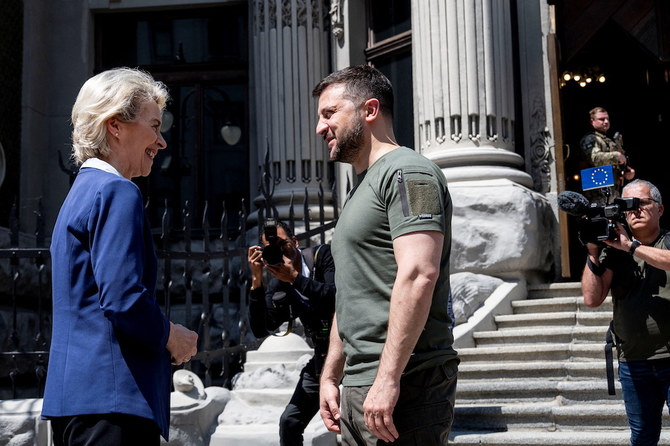
Making a surprise visit to Kyiv, von der Leyen said talks she held with Ukrainian President Volodymyr Zelensky “will enable us to finalize our assessment by the end of next week” — the first time the bloc has publicly given a timing.
Zelensky has been pressing for rapid admission into the European Union as a way of reducing Ukraine’s geopolitical vulnerability, which was brutally exposed by Russia’s February 24 invasion.
But officials and leaders in the bloc caution that, even with candidacy status, actual EU membership could take years or even decades.
All 27 EU governments would have to agree to grant Ukraine candidate status, after which there would be extensive talks on the reforms required before Kyiv could be considered for membership.
Von der Leyen, in her second trip to Kyiv since the start of the war in February, reminded Zelensky that, despite progress on administrative reforms and elsewhere, much still needed to be done.
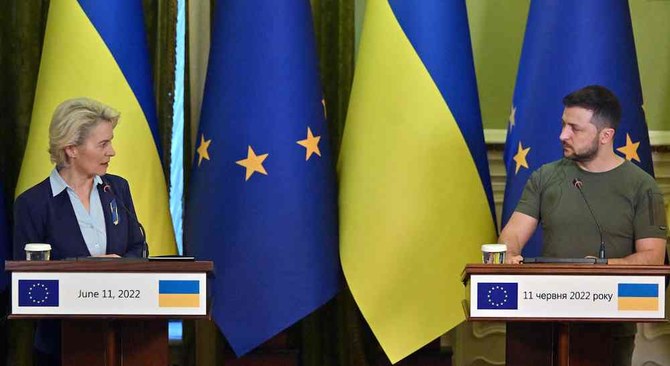
“You have done a lot in strengthening the rule of law but there is still need for reforms to be implemented, to fight corruption for example,” she told the joint news conference.
For his part, the Ukrainian president warned it was a “decisive time” for his country and the EU.
“Russia wants to ruin the European unity, wants to leave Europe divided and wants to leave it weak. The entire Europe is a target for Russia. Ukraine is only the first stage in this aggression, in these plans.”
Zelensky told the briefing: “All of Europe is a target for Russia, and Ukraine is just the first stage in this aggression.
“This is why a positive EU response to the Ukrainian application for membership can be a positive answer to the question of whether the European project has a future at all.”
Despite reservations among some member states, EU leaders are expected to approve Ukraine’s candidate status at a summit on June 23-24, though with stern conditions attached.
The EU and the US have strongly backed Ukraine, sending weapons and cash to help it see off Russian forces, and punishing Moscow with unprecedented economic sanctions.
Zelensky has urged them on during a continuous diplomatic offensive that has seen him appearing via video link at parliaments and summits around the world.
On Saturday, he warned the Shangri-La Dialogue security summit in Singapore of the dangers of a global food crisis posed by Russia’s blockade of Ukraine’s Black Sea ports.
He warned of “an acute and severe food crisis and famine,” adding that the “shortage of foodstuffs will inexorably lead to political chaos” — all of it “the direct consequence of the acts of the Russian state.”
Before the war, Ukraine was the world’s top producer of sunflower oil and a major wheat exporter, but millions of tons of grain exports remain trapped due to the blockade.
Speaking to delegates including Pentagon chief Lloyd Austin and China’s defense minister, Zelensky urged international pressure to end the blockade.
Kyiv is in discussion with the UN, Turkey and other countries to open a way to allow the grain exports, and Zelensky said the talks are focused on the “format” of the corridor.
After withdrawing from the capital Kyiv, Russian forces have concentrated their firepower on the eastern Donbas region and the south.
They continued their bombardment overnight Friday-Saturday of towns and villages around Kharkiv and in the Donbas regions of Lugansk and Donetsk, Zelensky’s office said.
“Russia wants to devastate every city in the Donbas, every single one, without exaggeration,” the president said in his nightly address Friday.
Moscow has particularly focused on the key eastern industrial city of Severodonetsk, which Lugansk regional governor Sergiy Gaiday said Saturday was “ruined” by Russian forces.
“This is their tactics — people are not needed, the infrastructure is not needed, houses are not needed, everything should be simply ruined,” he said in an interview posted on his Telegram channel.
He declined to estimate the number of civilian victims, but said he expected the figure would be “enormous and terrible.”
“Many people were buried in front of their houses’ entrances. A shell from heavy artillery is tearing people up into bits and pieces,” he said.
He added: “They lie like this for a day, three or four. It is impossible to take them out because there is constant shelling.”
In the Mykolaiv region near the front line in the south, regional governor Vitaliy Kim stressed the urgent need for international military assistance.
“Russia’s army is more powerful, they have a lot of artillery and ammo. For now, this is a war of artillery... and we are out of ammo,” he said.
British Defense Secretary Ben Wallace visited Ukraine on Friday, where Zelensky thanked London for its support.
Following Washington’s lead, Britain announced the delivery of multiple rocket launcher systems — with a range of about 80 kilometers (50 miles), slightly superior than the Russian systems.
It was not clear when Ukraine will be able to start using them.
In areas now controlled by its forces, Moscow has sought to impose its authority.
Authorities in the occupied city of Kherson in southern Ukraine handed out Russian passports to local residents for the first time on Saturday, news agencies reported.
Russia’s TASS agency said 23 Kherson residents received a Russian passport at a ceremony through a “simplified procedure” facilitated by a decree signed by Russian President Vladimir Putin in May.
Ukraine has denounced the move as a “flagrant violation” of its territorial integrity, saying Putin’s decree was “legally void.”
It follows the introduction last month in the Kherson region of the Russian ruble as an official currency alongside the Ukrainian hryvnia.
(With AFP and Reuters)


EU chief says to give signal on Ukraine’s hopes next week during Kyiv visit
https://arab.news/mrj64
EU chief says to give signal on Ukraine’s hopes next week during Kyiv visit

- Ursula von der Leyen visited Ukraine to discuss the country’s hopes of joining the bloc
- President Volodymyr Zelensky warned the world not to look away from the conflict devastating his country


Geoeconomic confrontation tops global risks in 2026: WEF report
- Also armed conflict, extreme climate, public polarization, AI
- None ‘a foregone conclusion,’ says WEF’s MD Saadia Zahidi
DUBAI: Geoeconomic confrontation has emerged as the top global risk this year, followed by state-based armed conflict, according to a new World Economic Forum report.
The Global Risks Report 2026, released on Wednesday, found that both risks climbed eight places year-on-year, underscoring a sharp deterioration in the global outlook amid increased international competition.
The top five risks are geoeconomic confrontation (18 percent of respondents), state-based armed conflict (14 percent), extreme weather events (8 percent), societal polarization (7 percent) and misinformation and disinformation (7 percent).
The WEF’s Managing Director Saadia Zahidi said the report “offers an early warning system as the age of competition compounds global risks — from geoeconomic confrontation to unchecked technology to rising debt — and changes our collective capacity to address them.
“But none of these risks are a foregone conclusion.”
The report assesses risks across three timeframes: immediate (2026); short-to-medium term (next two years); and long term (next 10 years).
Economic risks show the largest overall increase in the two-year outlook, with both economic downturn and inflation jumping eight positions.
Misinformation and disinformation rank fifth this year but rise to second place in the two-year outlook and fourth over the 10-year horizon.
The report suggests this reflects growing anxiety around the rapid adoption of artificial intelligence, with adverse outcomes linked to AI surging from 30th place in the two-year timeframe to fifth in the 10-year outlook.
Uncertainty dominates the global risk outlook, according to the report.
Surveyed leaders and experts view both the short- and long-term outlook negatively, with 50 percent expecting a turbulent or stormy global environment over the next two years, rising to 57 percent over the next decade.
A further 40 percent and 32 percent, respectively, describe the outlook as unsettled across the two- and 10-year timeframes, while just 1 percent anticipate a calm global outlook in either period.
Environmental risks ease slightly in the short-term rankings. Extreme weather fell from second to fourth place and pollution from sixth to ninth. Meanwhile, critical changes to Earth systems and biodiversity loss dropped seven and five positions, respectively.
However, over the next decade, environmental threats re-emerge as the most severe, with extreme weather, biodiversity loss, and critical changes to Earth systems topping the global risk rankings.
Looking ahead over the next decade, around 75 percent of respondents anticipate a turbulent or stormy environmental outlook, making it the most pessimistic assessment across all risk categories.
Zahidi said that “the challenges highlighted in the report underscore both the scale of the potential perils we face and our shared responsibility to shape what comes next.”
Despite the gloomy outlook, Zahidi signaled a positive shift in global cooperation.
“It is also clear that new forms of global cooperation are already unfolding even amid competition, and the global economy is demonstrating resilience in the face of uncertainty.”
Now in its 21st year, the Global Risks Report highlights a core message: global risks cannot be managed without cooperation.
As competition intensifies, rebuilding trust and new forms of collaboration will be critical, with the report stressing that today’s decisions will shape future outcomes.
The report was released ahead of WEF’s annual meeting, which will be held in Davos from Jan. 19 to 23.


