Highlights: Pakistan unveils 2022/23 budget, aims for 5% growth

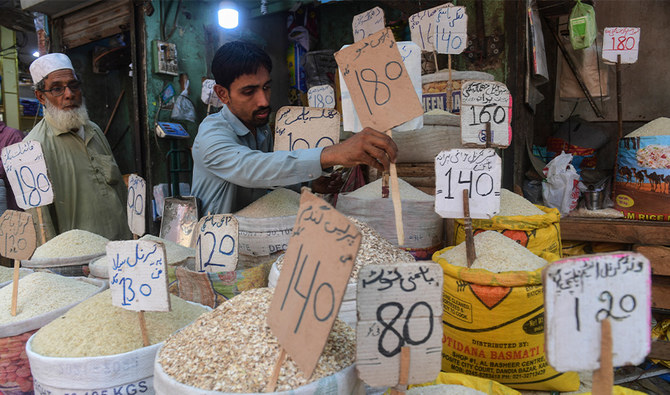
A shopkeeper place a price tag on rice at a shop in Karachi on June 10, 2022. (AFP)
Short Url
Updated 11 June 2022
Follow

Highlights: Pakistan unveils 2022/23 budget, aims for 5% growth

  • Budget aims for economic growth of 5% amid pressure to control the fiscal deficit and secure IMF bailout money
  • Targets 5% economic growth for 2022/23 fiscal year after an estimated annual growth of 5.97% for current fiscal year

ISLAMABAD: Pakistan Finance Minister Miftah Ismail on Friday unveiled the budget for the 2022/23 fiscal year starting July, aiming for economic growth of 5% amid pressure to control the fiscal deficit and secure International Monetary Fund bailout money.

These are the highlights from the 2022/23 budget:

GDP/DEFICIT

* Targets 5% economic growth for 2022/23 fiscal year, starting July, after an estimated annual growth of 5.97% for the current fiscal year

* Fiscal deficit target set at 4.9% of GDP for 2022/23 vs revised target of 7.1% in 2021/22

* Tax to GDP ratio set at 9.2% for 2022/23 vs 9% in 2021/22

RISKS TO ECONOMY

* Conflict between Russia and Ukraine poses a risk to Pakistan's economy

* Higher crude oil, food prices could stoke high inflation

* Monetary tightening and fiscal consolidation may slow down economic growth

EXPENDITURE

* Federal expenditure estimated at 9.5 trillion rupees for 2022/23

* Development expenditure set at 800 billion rupees for 2022/23

* Pakistan to spend 699 billion rupees on targeted subsidies in 2022/23

* Defence expenditure set at 1.52 trillion rupees for 2022/23 vs 1.48 trillion rupees in 2021/22

* Budget allocates 90.55 bln rupees for education in 2022/23 vs 90.86 bln in 2021/22

* Pakistan cuts health budget to 19.03 bln rupees for 2022/23 vs 154.49 bln rupees in 2021/22

REVENUE

* Revenue target set at 7 trillion rupees for 2022/23

* Aims to raise 96.41 billion rupees from privatisation in 2022/23

* To impose 2% additional tax on income taxpayers with 30 million rupees annual income

* Expects 300 bln rupees receipts from central bank in 2022/23 vs 474 bln rupees in 2021/22

INFLATION

* Budget forecasts average inflation of 11.5% in 2022/23 vs 11.7% in 2021/22

* Consumer-price-index based inflation rose in May to 13.8% year-on-year, the highest in two-and-half years.

* Pakistan raised petrol and diesel prices by around 20% earlier this month

INTERNATIONAL TRADE

* Pakistan's export target set at $35 billion for 2022/23

* Import target set at $70 billion for 2022/23

* Trade deficit target set at 2.2% of GDP in 2022/23

* Budget forecasts remittances of $33.2 billion in 2022/23

AUSTERITY MEASURES

* Ban on buying new cars for govt officials

* Aims cuts in fuel consumption by govt officials

* Funds for debt servicing estimated at 3.9 trillion rupees in 2022/23

OTHER INITIATIVES

* To raise tax exemption limit for salaried income taxpayers

* Announces to promote special economic zones to boost manufacturing

* Offers 5-year tax holiday for film production industry

* To set up 250 mini-stadiums to promote sports

* To exempt import of solar panels from tax

* Exempts 30 pharmaceutical products from customs duty

* Proposes 15% hike in govt employees' salaries

(This story corrects federal expenditure figure to 9.5 trillion rupees from 9.5 billion rupees)

($1 = 202.00 Pakistani rupees)


Pakistan to promote mineral sector at Saudi forum this month with 13 companies

Updated 5 sec ago
Follow

Pakistan to promote mineral sector at Saudi forum this month with 13 companies

  • Delegation will take part in the Future Minerals Forum in Riyadh from Jan. 13-15
  • Petroleum minister will lead Pakistan, participate in a 90-minute country session

ISLAMABAD: Around 13 Pakistani state-owned and private companies will attend the Future Minerals Forum (FMF) in Saudi Arabia from Jan. 13 to 15, an official statement said on Friday, as the country seeks to ramp up global engagement to develop its mineral resources.

The FMF is an international conference and investment platform for the mining sector, hosted by mineral-rich countries to attract global investors, companies and governments.

Petroleum Minister Ali Pervaiz Malik confirmed Pakistan’s participation in a meeting with the Saudi envoy, Nawaf bin Said Al-Malki.

Pakistan hosts one of the world’s largest copper-gold zones. The Reko Diq mine in southwestern Balochistan, with an estimated 5.9 billion tons of ore, is partly owned by Barrick Gold, which calls it one of the world’s largest underdeveloped copper-gold deposits. Its development is expected to boost Pakistan’s struggling economy.

“Upon an invitation of the Government of the Kingdom of Saudi Arabia, the Federal Minister informed the Ambassador that Pakistan will fully participate in the upcoming Future Minerals Forum (FMF), scheduled to be held in Riyadh later this month,” Pakistan’s Press Information Department (PID) said in an official statement.

The Pakistani minister will lead his country’s delegation at the FMF and take part in a 90-minute country showcase session titled “Unleashing Potential: Accelerating Pakistan’s Mineral Revolution” along with local and foreign investors.

Pakistan will also establish a dedicated pavilion to highlight the vast potential of its rich geological landscape to the global mineral community.

The Saudi envoy welcomed Pakistan’s decision to participate in the forum and discussed enhancing bilateral cooperation in the minerals and energy sectors during the meeting.

According to the statement, he highlighted the potential for cooperation between Saudi Arabia and Pakistan in the minerals and energy sectors, expressing confidence that the FMF would provide a platform to expand collaboration.
Pakistan’s mineral sector, despite its rich reserves of salt, copper, gold and coal, contributes only 3.2 percent to the country’s GDP and just 0.1 percent to global mineral exports.

However, many countries, including the United States, have shown interest in Pakistan’s underdeveloped mineral sector, particularly in copper, gold and other critical resources.

In October, Pakistan dispatched its first-ever shipment of rare earth and critical minerals to the United States, according to a Chicago-based US public relations firm’s report.