

Saudi Arabia’s TRSDC nursery to plant 2 million saplings this year as part of its green drive

Short Url
Updated 12 June 2022
Follow

Saudi Arabia’s TRSDC nursery to plant 2 million saplings this year as part of its green drive

  • Company to achieve its target of 15m plants by 2030, making it one of the most extensive nurseries in Mideast
  • The massive nursery spanning 1 million square meters propagates plants, trees, shrubs and other flora, which the company will eventually use for landscaping the two destinations, the Red Sea and AMAALA

RIYADH: The Red Sea Development Co. will plant 2 million saplings by the end of 2022 to achieve its ambitious target of 25 million plants by 2030, making it one of the most extensive nurseries in the Middle East and North Africa.

The massive nursery spanning 1 million square meters propagates plants, trees, shrubs, and other flora, which the company will eventually use for landscaping The Red Sea and AMAALA projects.
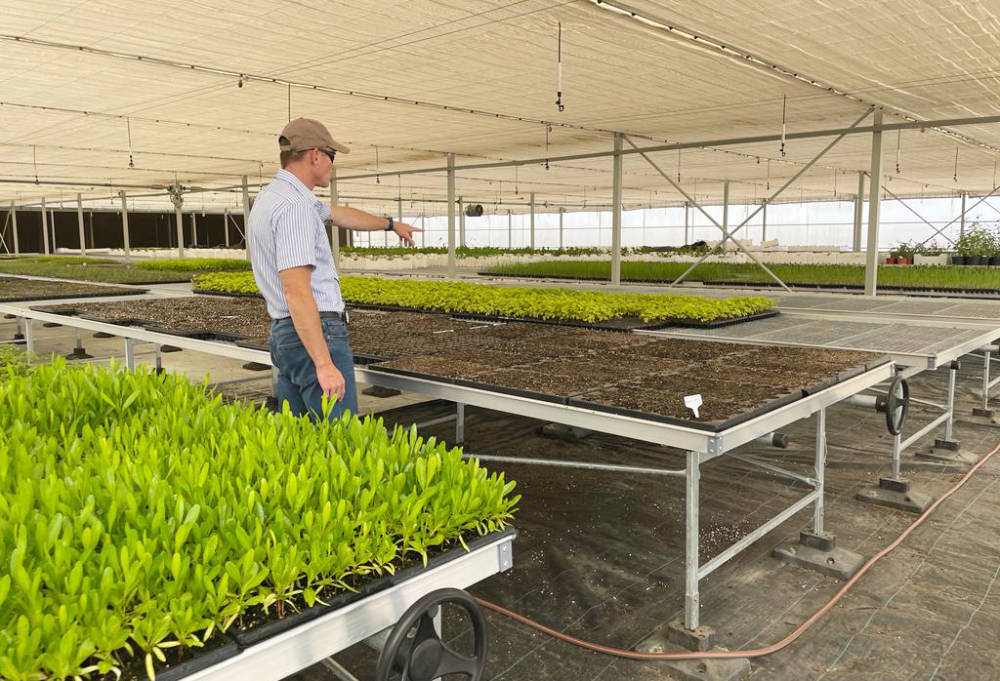
Though the nursery mainly comprises plants native to Saudi Arabia, the giga-project has also been sourcing desert plant species from across the world, including Australia, where the climate is similar to that of the Kingdom.

Saudi Arabia is pushing more project to plant trees and become green under its Saudi Green Initiative. The Kingdom will announce its complete strategic and executive plan for the initiative in November.

HIGHLIGHTS

• Though the nursery mainly comprises plants native to Saudi Arabia, the giga-project has also been sourcing desert plant species from across the world, including Australia.

• Though the nursery prefers to use native plant species, sometimes it is not feasible due to evolutionary pressures that make some plants more hazardous than their non-native equivalent.

“We’re very specific about the species we’re trying to breed,” said Grant Shaw, senior nursery director at TSRDC.



Grant Shaw - Senior nursery director at TSRDC

Before mixing nonnative and native species, the nursery does a “mock-up” to test how the plants react together to ensure they are compatible.

Though the nursery prefers to use native plant species, sometimes it is not feasible due to evolutionary pressures that make some plants more hazardous than their non-native equivalent.

“One of the biggest things we have to be conscious of is that many species in the Kingdom are thorny, which evolved as a defense mechanism to protect themselves from camels and giraffes common in the region,” said Shaw.

“This doesn’t work well for hotels because of the guests and their children,” he added.

He explained that the Australian version of the native Saudi plant is almost identical — even he had trouble telling them apart — except the Australian plant does not have thorns, making it more suited for a hotel environment.

Additionally, the nursery is conducting tests on native plants to see if they can germinate. Ninety-nine percent of the seeds planted in the greenhouse have germinated, pointed out Shaw.


Saudi Arabia launches skills framework to support mining, industrial growth 

Updated 6 sec ago
Follow

Saudi Arabia launches skills framework to support mining, industrial growth 

JEDDAH: Saudi Arabia has launched a new skills framework for the mining and industrial sectors to standardize job roles and support workforce development. 

The initiative was unveiled by Minister of Industry and Mineral Resources Bandar Alkhorayef on the sidelines of the Global Labor Market Conference 2026, according to Al-Eqtisadiah. 

The framework is intended to help employers, job seekers and training providers better navigate labor demand in mining and industry, as Saudi Arabia accelerates investment in manufacturing, minerals processing and related value chains under Vision 2030. 

“This is, in fact, a tool which ensures clear definitions of occupations and their required skills. It will cover more than 500 job roles, detailing the necessary skills, responsibilities, and titles,” Alkhorayef said during a discussion panel at the event. 

The Ministry of Industry and Mineral Resources said the initiative — known as the Industry & Mining Occupations & Skills Framework — will serve as a national reference for occupations and skills in mining and industry. 

The framework is designed to achieve a set of strategic objectives that support human capital development in the industrial and mining sectors. It aims to strengthen workforce planning, training programs, and career pathways, while supporting informed decision-making. 

Covering more than 500 industrial occupations, over 300 professional specialties, 600 skills, and 900 professional certifications, the framework sets standardized job titles, descriptions, and skill requirements to support recruitment, performance, and competitiveness. 

For each occupation, a profile is developed, outlining the code, job titles, and descriptions, as well as other information such as key tasks, educational qualifications, and required skills.

These profiles give employees clarity on roles, career pathways, and accredited credentials, while helping job seekers match their qualifications with suitable roles and focus on targeted skill development. 

The framework, published by the ministry, runs to nearly 3,200 pages and was developed through collaboration with the General Authority for Statistics, alongside government bodies, private sector organizations and academic institutions. 

The launch comes as Saudi Arabia’s mining push gains momentum after new surveys of the Arabian Shield showed the Kingdom’s mineral resources are larger than previously estimated. 

Official estimates have jumped by about 90 percent to roughly SR9.37 trillion ($2.5 trillion), up from around SR5 trillion in 2016, strengthening the case for further mining investment and skills development.