

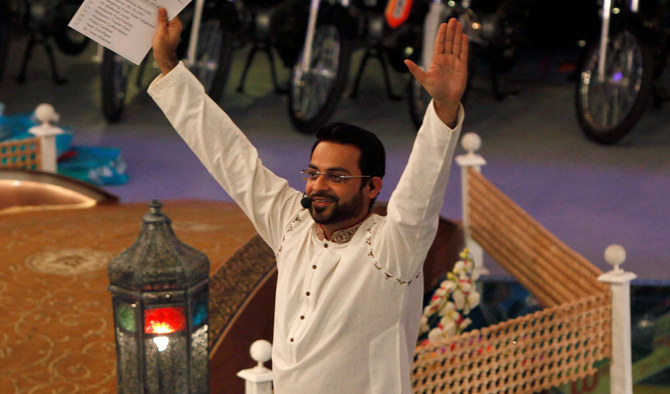

KARACHI: Pakistani lawmaker and TV host Dr. Aamir Liaquat Hussain was laid to rest in Karachi after a court allowed his family to receive his body without an autopsy examination.
Police on Thursday night stopped rescue service, the Chhipa Welfare Association, from handing Hussain’s body to his family, who had refused to allow the autopsy examination. Senior Superintendent Police Abdul Raheem Shirazi subsequently told media he was moving a local court for an order to allow an autopsy after police failed to convince the family.
After several unsuccessful rounds of talks between police and Hussain’s family on Friday, SSP Shirazi and his team eventually moved the court of a judicial magistrate for Hussain’s autopsy. Hussain’s ex-wife, Bushra Iqbal, and her children also appeared before the magistrate, and requested the body be handed over to them for burial without post-mortem.
“The court has decided to hand over the body without performing post-mortem, but after other legal formalities were completed,” said Ramzan Chhipa, the head of Chhipa Welfare Association.
Hussain, famous for combining religion and game shows, often courted controversy, most recently about his marriage to a minor girl. Aged 50, he was found dead at his Karachi home on Thursday.
Hussain’s ex-wife Iqbal said late Thursday his port-mortem would not be held as their children didn’t want it. Few hours later, Brigade Police Station SHO Khalid Rafique wrote a letter to the Chhipa Welfare Association, stopping it from handing over Hussain’s body to his family.
When Iqbal arrived at the morgue on Friday along with her son Ahmed Aamir and daughter Dua Aamir, the morgue administration refused to hand over the body.
Judicial Magistrate Naukar Abbas and Karachi Police Surgeon Dr. Summaiya Syed examined Hussain’s body at the morgue. The magistrate subsequently allowed the family to take the body without post-mortem.
Hussain was later laid to rest beside the graves of his parents within the compound of Sufi saint Abdullah Shah Ghazi’s shrine in Karachi’s Clifton area.
Ahead of the funeral, SHO Rafique told Arab News police wanted to fulfil formalities to put to rest any speculation about the circumstances of Hussain’s death.
A senior police official, who requested anonymity, said the police believed questions would be raised about the circumstances of Hussain’s death and a post-mortem was the only way to answer those questions.
“Aamir Liaquat has a third wife whose Khula (divorce) plea has yet to be accepted. He was one of the most popular personalities in Pakistan and questions can be raised about his death, which was not under normal circumstances,” the officer said, adding the autopsy could ascertain if he had a cardiac arrest or the fumes of the power generator at home caused his death.
Hussain’s death came weeks after he announced he would leave Pakistan following a controversy surrounding his third marriage that led to intense criticism of the premier televangelist on mainstream and social media. The girl, reportedly not of legal age, accused him of inflicting violence on her and regularly using drugs and alcohol during their brief relationship.
Hussain repeatedly denied the charges but the story was widely discussed in Pakistan and raised questions about his credentials as a religious expert, leading a teary-eyed Hussain to announce in a video last month that he had decided to leave Pakistan for good.


