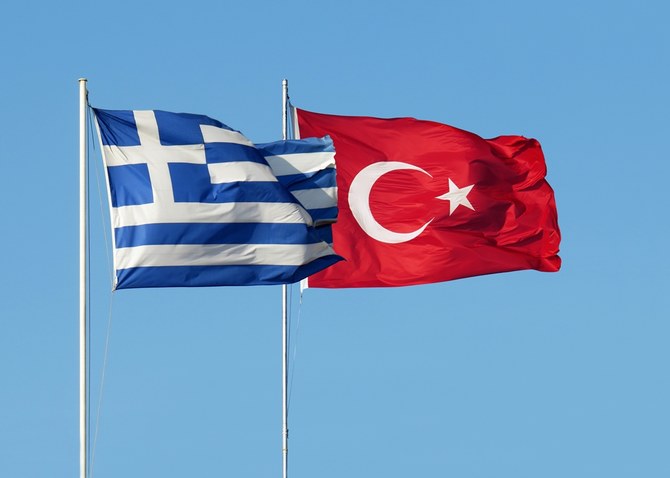
ATHENS: Greece on Thursday published a series of historical maps looking to refute Turkish accusations that Athens is violating peace treaties that followed World War I and World War II.
Turkish authorities say the Greeks have stationed troops on Aegean islands in violation of the peace treaties that followed the two 20th century conflicts.
Athens counters that the troops are stationed in response to the presence of Turkish military units, aircraft and landing craft on the opposite coast, in addition to Turkey’s invasion of Cyprus in 1974.
The Greek foreign ministry published maps going back to 1923 which it said depict “in a vivid and irrefutable way the Turkish illegal unilateral actions and claims.”
The maps “document the extent of Turkish revisionism in order to upend the status quo, violating international law... and threatening peace, security and stability in our region,” it said.
The two uneasy NATO neighbors have long feuded over maritime borders and energy exploration rights in disputed parts of the Aegean and eastern Mediterranean.
Facing re-election next year amid rampant inflation, Turkish President Recep Tayyip Erdogan has repeatedly attacked Greece over the islands and has said he would no longer meet Greek leaders.
“Come to your senses,” Erdogan said on Thursday in another shot at Greece.
“You should disarm the islands. I am not joking,” he said.
On Tuesday, Turkish Foreign Minister Mevlut Cavusoglu said Ankara would challenge Greece’s sovereignty over the islands if it continued to send troops there.

Greece hits back at Turkish claims in Aegean Sea
Short Url
https://arab.news/p6f5b
Greece hits back at Turkish claims in Aegean Sea
- Turkish authorities say the Greeks have stationed troops on Aegean islands
- Athens counters that the troops are stationed in response to the presence of Turkish military units
Algeria parliament to vote on law declaring French colonization ‘state crime’
ALGERIA: Algeria’s parliament is set to vote on Wednesday on a law declaring France’s colonization of the country a “state crime,” and demanding an apology and reparations.
The vote comes as the two countries are embroiled in a major diplomatic crisis, and analysts say that while Algeria’s move is largely symbolic, it could still be politically significant.
The bill states that France holds “legal responsibility for its colonial past in Algeria and the tragedies it caused,” according to a draft seen by AFP.
The proposed law “is a sovereign act,” parliament speaker Brahim Boughali was quoted by the APS state news agency as saying.
It represents “a clear message, both internally and externally, that Algeria’s national memory is neither erasable nor negotiable,” he added.
France’s colonization of Algeria from 1830 until 1962 remains a sore spot in relations between the two countries.
French rule over Algeria was marked by mass killings and large-scale deportations, all the way to the bloody war of independence from 1954-1962.
Algeria says the war killed 1.5 million people, while French historians put the death toll lower at 500,000 in total, 400,000 of them Algerian.
French President Emmanuel Macron has previously acknowledged the colonization of Algeria as a “crime against humanity,” but has stopped short of offering an apology.
Asked last week about the vote, French foreign ministry spokesman Pascal Confavreux said he would not comment on “political debates taking place in foreign countries.”
Hosni Kitouni, a researcher in colonial history at the University of Exeter in the UK, said that “legally, this law has no international scope and therefore is not binding for France.”
But “its political and symbolic significance is important: it marks a rupture in the relationship with France in terms of memory,” he said.
The vote comes as the two countries are embroiled in a major diplomatic crisis, and analysts say that while Algeria’s move is largely symbolic, it could still be politically significant.
The bill states that France holds “legal responsibility for its colonial past in Algeria and the tragedies it caused,” according to a draft seen by AFP.
The proposed law “is a sovereign act,” parliament speaker Brahim Boughali was quoted by the APS state news agency as saying.
It represents “a clear message, both internally and externally, that Algeria’s national memory is neither erasable nor negotiable,” he added.
France’s colonization of Algeria from 1830 until 1962 remains a sore spot in relations between the two countries.
French rule over Algeria was marked by mass killings and large-scale deportations, all the way to the bloody war of independence from 1954-1962.
Algeria says the war killed 1.5 million people, while French historians put the death toll lower at 500,000 in total, 400,000 of them Algerian.
French President Emmanuel Macron has previously acknowledged the colonization of Algeria as a “crime against humanity,” but has stopped short of offering an apology.
Asked last week about the vote, French foreign ministry spokesman Pascal Confavreux said he would not comment on “political debates taking place in foreign countries.”
Hosni Kitouni, a researcher in colonial history at the University of Exeter in the UK, said that “legally, this law has no international scope and therefore is not binding for France.”
But “its political and symbolic significance is important: it marks a rupture in the relationship with France in terms of memory,” he said.
© 2025 SAUDI RESEARCH & PUBLISHING COMPANY, All Rights Reserved And subject to Terms of Use Agreement.


