

At least four people perish as wildfires sweep Turkey’s Aegean and Mediterranean coasts

1 / 4
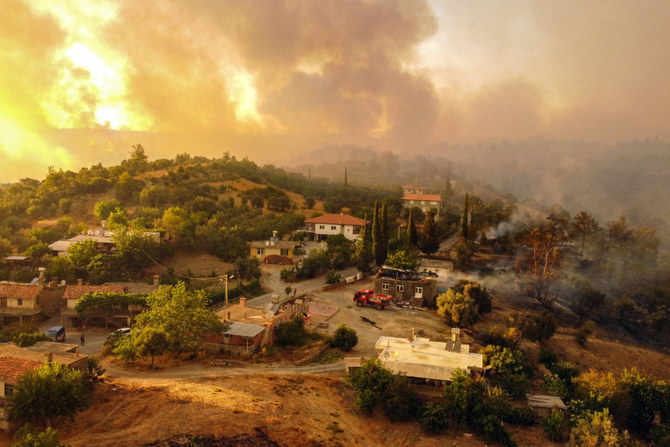
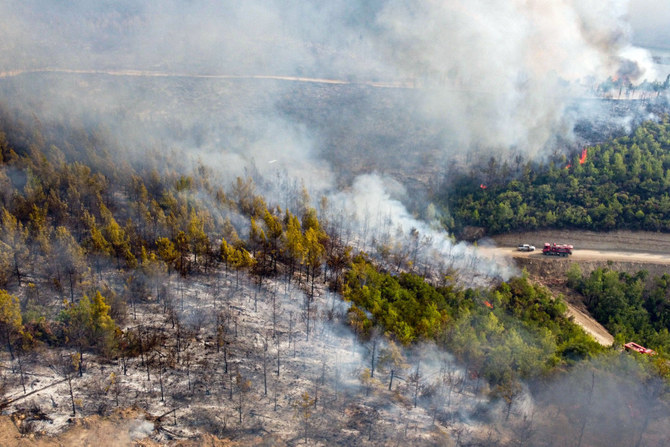
Wildfire engulfs a Mediterranean resort region on Turkey's southern coast near the town of Manavgat on July 30, 2021. (AFP)
2 / 4
Wildfire engulfs a Mediterranean resort region on Turkey's southern coast near the town of Manavgat on July 30, 2021. (AFP)
3 / 4
Wildfire engulfs a Mediterranean resort region on Turkey's southern coast near the town of Manavgat on July 30, 2021. (AFP)
4 / 4
In this image provided by Maxar, a satellite view of smoke rising from wildfires near Oymapinar Dam, southern Turkey, on Thursday July 29, 2021. (AP)
Short Url
Updated 31 July 2021
Follow

At least four people perish as wildfires sweep Turkey’s Aegean and Mediterranean coasts

  • More than 70 wildfires have broken out this week in provinces on Turkey’s Aegean and Mediterranean coasts
  • Countries including Azerbaijan, Russia, Ukraine, and Greece have offered emergency help

ANKARA: The death toll from wildfires on Turkey’s southern coast has risen to four and firefighters were battling blazes for the fourth day on Friday after the evacuation of dozens of villages and some hotels.

More than 70 wildfires have broken out this week in provinces on Turkey’s Aegean and Mediterranean coasts as well as inland areas.

At least four people are reported to have died and dozens have been hospitalized.

Forestry Minister Bekir Pakdemirli said fires raged on in six provinces and officials promised to bring to account anyone found responsible for starting them.

Villages and some hotels have been evacuated in tourist areas and television footage has shown people fleeing across fields as fires closed in on their homes.

Pakdemirli said fires were still blazing in the Mediterranean resort region of Antalya and the Aegean resort province of Mugla.

“We were hoping to contain some of the fires as of this morning but while we say cautiously that they are improving, we still cannot say they are under control,” he said.
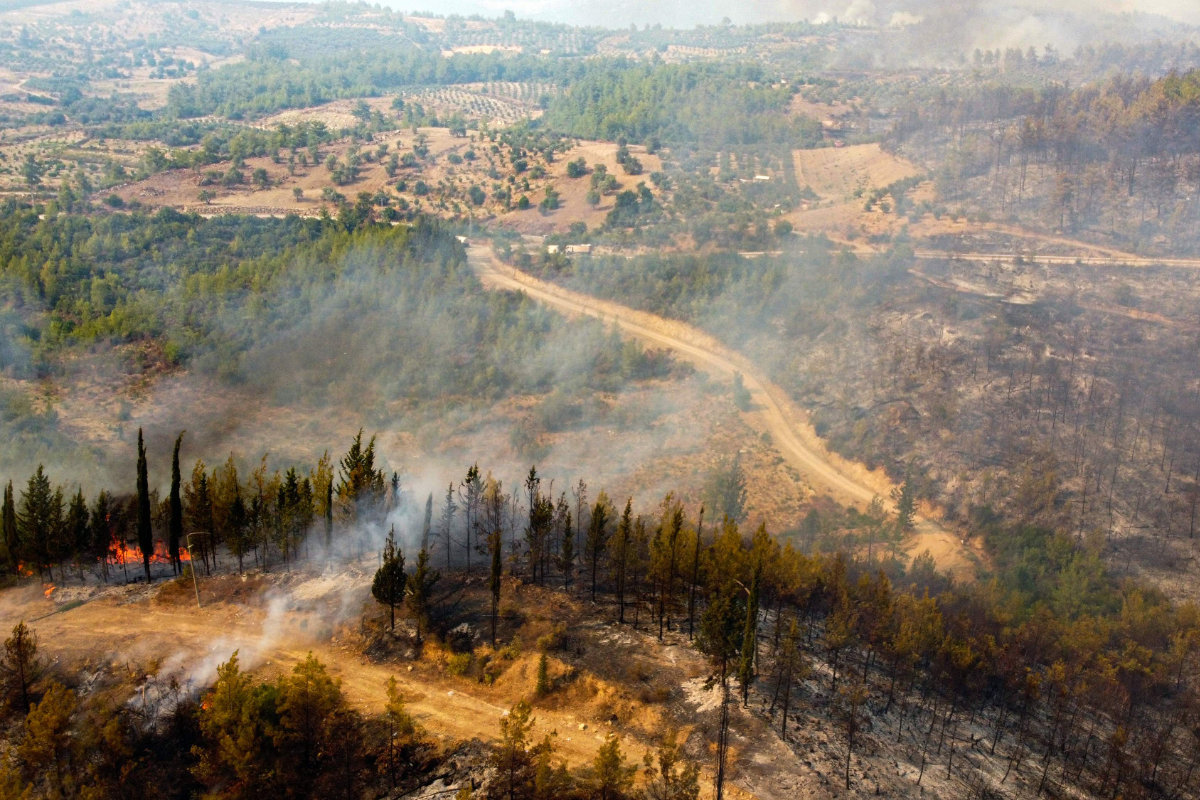


Wildfire engulfs a Mediterranean resort region on Turkey's southern coast near the town of Manavgat on July 30, 2021. (AFP)

Although wildfires during summertime are common in Turkey, this year the fires have reached an unprecedented level.

The mayor of the southern resort town of Marmaris blamed “sabotage” for the fires and said an investigation had been launched. A number of buildings and hotels in tourist zones of Marmaris and Bodrum were evacuated after separate fires.

Countries including Azerbaijan, Russia, Ukraine, and Greece have offered emergency help. Three planes, nine drones, 38 helicopters, 680 firefighting vehicles, and more than 4,000 personnel have been deployed to put out the fires.

Turkey has only three planes available to fight forest fires, but all are leased from Russia for 1.3 million liras ($154,350) per day.

Alpay Antmen, a lawmaker from the southern Mersin province and a member of the main opposition Republican Peoples’ Party (CHP), told Arab News: “We have been monitoring the situation on the ground since the beginning. Fortunately, they contained the fire from reaching the settlements. But this tragic case has shown once again the weakness of state apparatus in such emergency situations.”

He, along with other opposition parliamentarians, have been lobbying the Turkish government for a year to upgrade the country’s firefighting capacity.

“Nobody replied to our parliamentary inquiries, and we all witnessed the result of this incapacity. The Turkish president has 13 private planes in his possession, but why couldn’t they buy one single firefighting plane so far?” Antmen said.
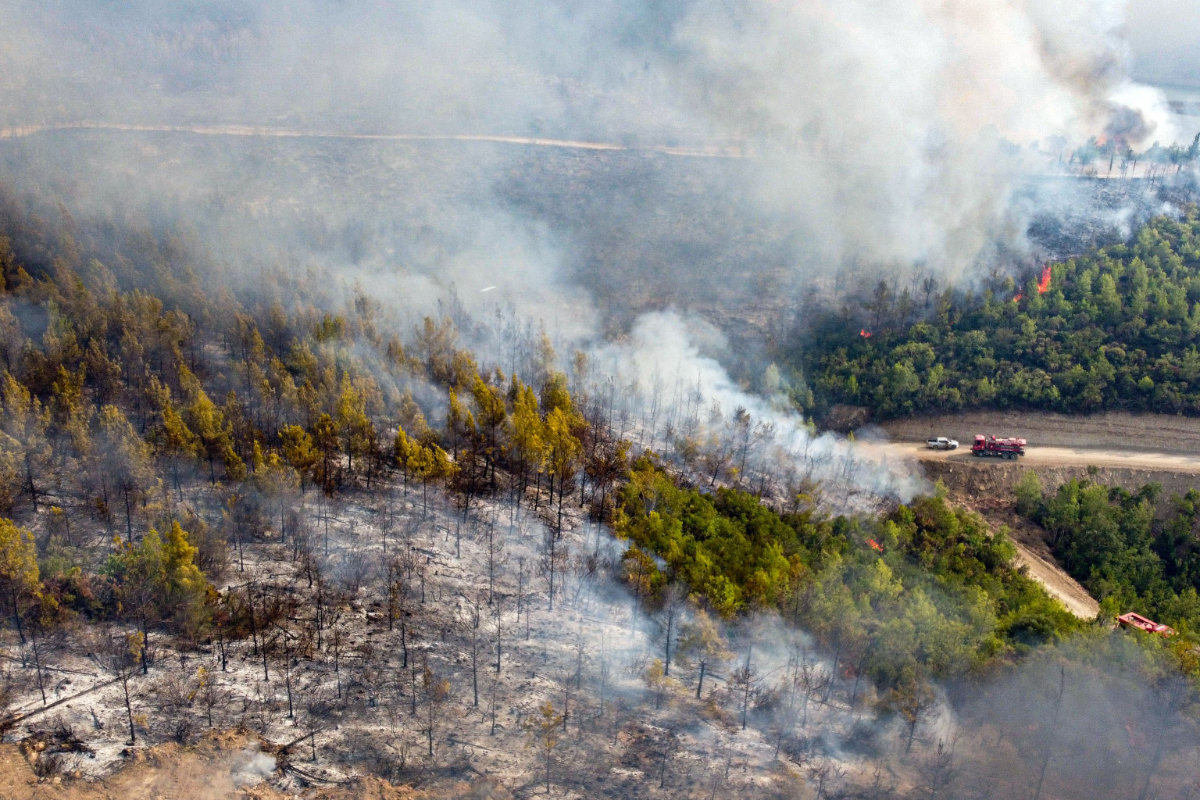


Wildfire engulfs a Mediterranean resort region on Turkey's southern coast near the town of Manavgat on July 30, 2021. (AFP)

Wildfires have broken out elsewhere in the region, with more than 40 in Greece in the last 24 hours, fanned by winds and soaring temperatures, authorities said. On Tuesday, a blaze tore through a pine forest north of Athens, damaging more than a dozen homes before it was brought under control.

Tolga Ozbek, an aviation expert, told Arab News that Turkey had increased its annual water carrying capacity to 148,000 tons this year from 80,000 tons in 2018.

“Fighting wildfires requires an integrated approach, using different types of planes and helicopters based on the geographical conditions. Turkey has been leasing its firefighting helicopters for the last 35 years. This has turned out to be costlier than buying some,” he said.

He pointed out that Turkey needed a permanent fleet of firefighting planes and should allocate a reasonable budget for such emergency situations.

“Whatever you invest in fighting fires, it always falls short because the fires can erupt anywhere anytime. While formulating specific policies in this regard, one should always consider the implications of global warming and the ongoing drought in the country,” Ozbek added.

Fires also burned large swathes of pine forest in the mountainous north of Lebanon this week, killing at least one firefighter and forcing some residents to flee.


Gaza hospital says receives fuel but only for about two days

Updated 2 sec ago
Follow

Gaza hospital says receives fuel but only for about two days

KHAN YUNIS: A major Gaza hospital that had suspended several services due to diesel shortages said it resumed some operations on Friday after receiving fuel but warned the supplies would only last about two days.
Ravaged by more than two years of war, the Al-Awda Hospital in central Gaza’s Nuseirat district cares for around 60 in-patients and receives nearly 1,000 people seeking medical treatment each day.
Earlier Friday, a senior official involved in managing the hospital, Ahmed Mehanna, said “most services have been temporarily stopped due to a shortage of the fuel needed for the generators.”
“Only essential departments remain operational: the emergency unit, maternity ward and paediatrics,” he had told AFP, adding that the hospital rented a small generator to keep those services running.
He had warned that a prolonged fuel shortage “would pose a direct threat to the hospital’s ability to deliver basic services.”
Under normal conditions, Al-Awda Hospital consumes between 1,000 and 1,200 liters of diesel per day, but it only had some 800 liters available.
Later Friday, Mehanna said that “this evening, 2,500 liters of fuel arrived from the World Health Organization, and we immediately resumed operations.”
“This quantity of fuel will last only two and a half days, but we have been promised an additional delivery next Sunday.”
Mohammed Salha, the hospital’s acting director, accused Israeli authorities of deliberately restricting fuel supplies to hospitals in Gaza.
“We are knocking on every door to continue providing services, but while the occupation allows fuel for international institutions, it restricts it for local health facilities such as Al-Awda,” Salha told AFP.
Health hard hit
Despite a fragile truce observed since October 10, the Gaza Strip remains engulfed in a severe humanitarian crisis.
While the ceasefire agreement stipulated the entry of 600 aid trucks per day, only 100 to 300 carrying humanitarian assistance can currently enter, according to the United Nations and non-governmental organizations.
The remaining convoys largely transport commercial goods that remain inaccessible to most of Gaza’s 2.2 million people.
Earlier Friday, Khitam Ayada, 30, who has taken refuge in Nuseirat, said she had gone to Al-Awda hospital after days of kidney pain.
But “they told me they didn’t have electricity to perform an X-ray... and that they couldn’t treat me,” the displaced woman said.
“We lack everything in our lives, even the most basic medical services,” she told AFP.
Gaza’s health sector has been among the hardest hit by the war.
During the fighting, the Israeli miliary repeatedly struck hospitals across Gaza, accusing Hamas of operating command centers there, an allegation the group denied.
International medical charity Doctors Without Borders now manages roughly one-third of Gaza’s 2,300 hospital beds, while all five stabilization centers for children suffering from severe malnutrition are supported by international NGOs.
The war in Gaza was sparked by an unprecedented Hamas attack on Israel on October 7, 2023 that resulted in the deaths of 1,221 people, most of them civilians, according to an AFP tally based on official Israeli figures.
In Israel’s ensuing military campaign in Gaza, at least 70,942 people — also mostly civilians — have been killed, according to the health ministry in the Hamas-run territory.
These figures are considered reliable by the United Nations.