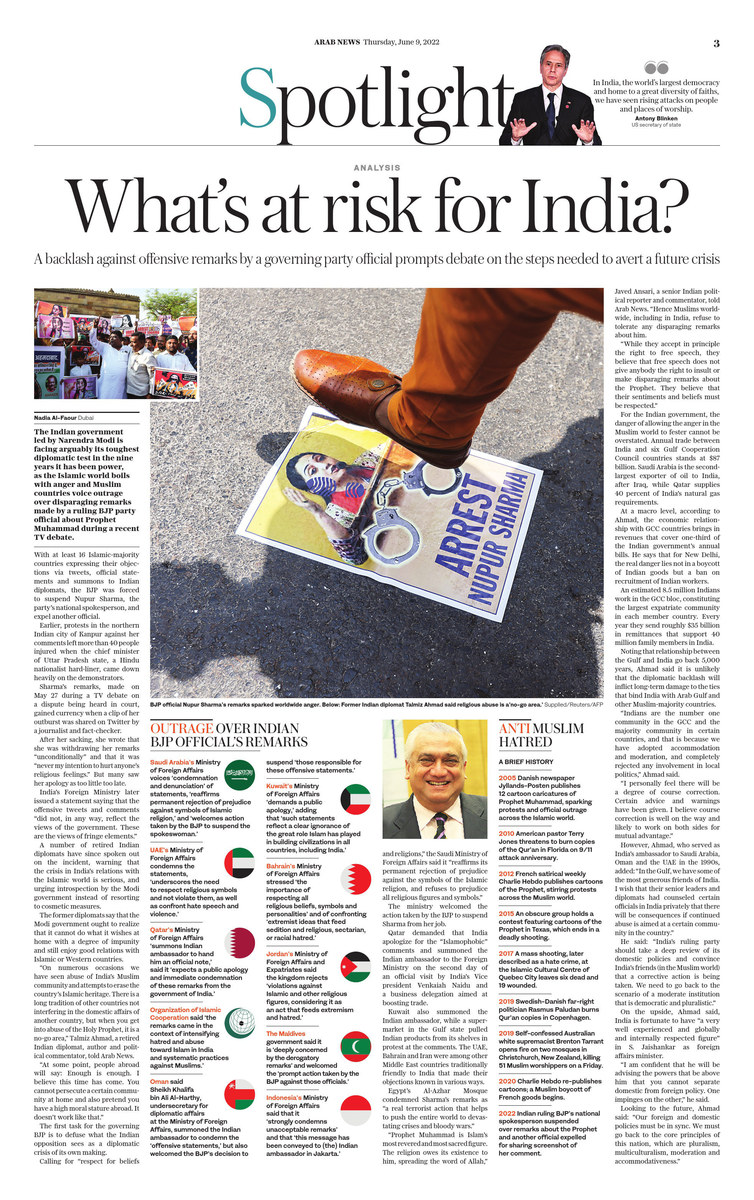
DUBAI: The Indian government led by Narendra Modi is facing arguably its toughest diplomatic test in the nine years it has been power, as the Islamic world boils with anger and Muslim countries voice outrage over disparaging remarks made by a ruling BJP party official about the Prophet Muhammad during a recent TV debate.
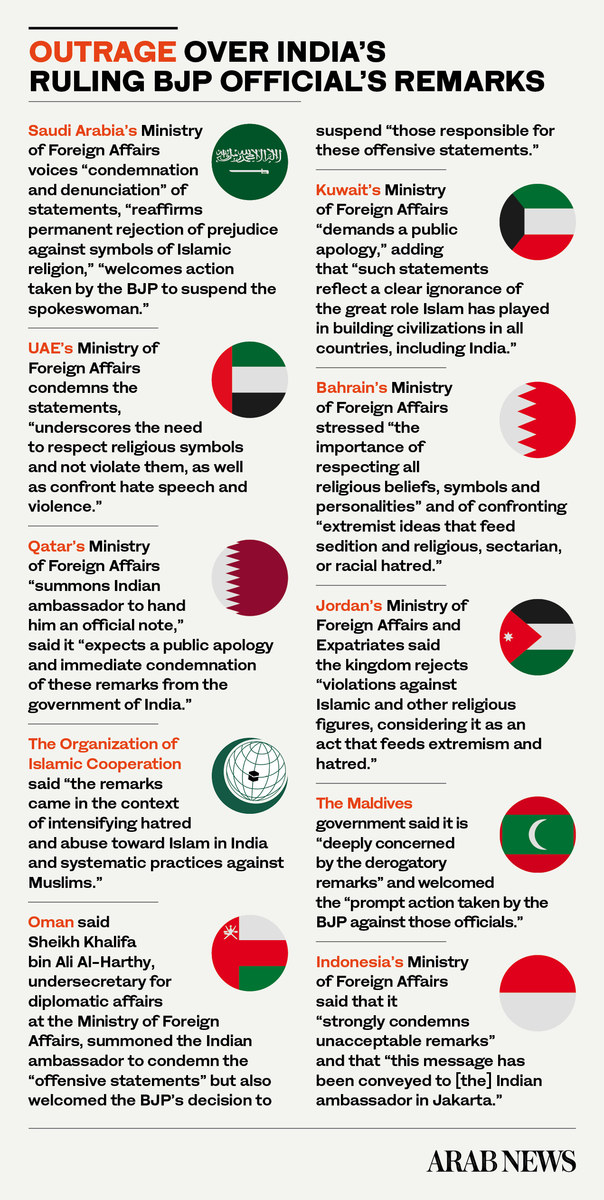
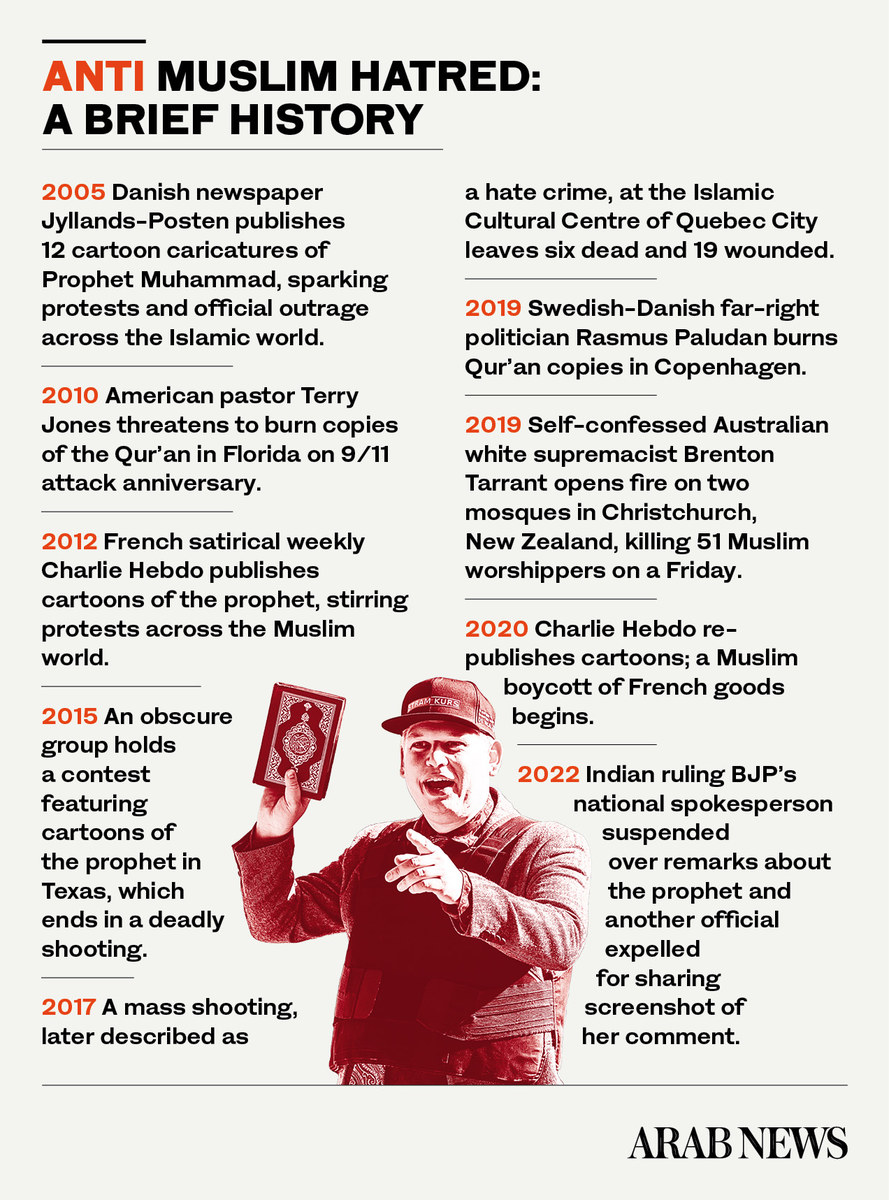
With at least 16 Islamic-majority countries expressing their objections via tweets, official statements and summons to Indian diplomats, the BJP was forced to suspend Nupur Sharma, the party’s national spokesperson, and expel another official for screenshot of her offensive comment in a tweet.
Earlier, protests in the northern Indian city of Kanpur against her comments left more than 40 people injured when the chief minister of Uttar Pradesh state, a Hindu nationalist hard-liner, came down heavily on the demonstrators.

Nupur Sharma, the BJP national spokesperson whose hate speech has caused clashes in India and protests by Muslim nations worldwide. (Photo courtesy: Nupur Sharma's Twitter)
Sharma’s remarks, made on May 27 during a TV debate on a dispute being heard in court, gained currency when a clip of her outburst was shared on Twitter by a journalist and fact-checker.
After her sacking, she wrote that she was withdrawing her remarks “unconditionally” and that it was “never my intention to hurt anyone’s religious feelings.” But many saw her apology as too little too late.
A number of retired Indian diplomats have since spoken out on the incident, warning that the crisis in India’s relations with the Islamic world is serious, and urging introspection by the Modi government instead of resorting to cosmetic measures.
The former diplomats say that the Modi government ought to realize that it cannot continue to do what it wishes at home with impunity and still enjoy good relations with Islamic or Western countries.
“On numerous occasions we have seen abuse of India’s Muslim community and attempts to erase the country’s Islamic heritage. There is a long tradition of other countries not interfering in the domestic affairs of another country, but when you get into abuse of the holy prophet, it is a no-go area,” Talmiz Ahmad, a retired Indian diplomat, author and political commentator, told Arab News.
“At some point, people abroad will say: Enough is enough. I believe this time has come. You cannot persecute a certain community at home and also pretend you have a high moral stature abroad. It doesn’t work like that.”
India’s foreign ministry has issued a statement saying that the offensive tweets and comments “did not, in any way, reflect the views of the government. These are the views of fringe elements.”
The first task for the governing BJP is to defuse what the Indian opposition sees as a diplomatic crisis of its own making.
Calling for “respect for beliefs and religions,” the Saudi Ministry of Foreign Affairs said it “reaffirms its permanent rejection of prejudice against the symbols of the Islamic religion, and refuses to prejudice all religious figures and symbols.”
The ministry welcomed the action taken by the BJP to suspend Sharma from her job.
Qatar demanded that India apologize for the “Islamophobic” comments and summoned the Indian ambassador to the foreign ministry on the second day of an official visit by India’s Vice president Venkaiah Naidu and a business delegation aimed at boosting trade.
Kuwait also summoned the Indian ambassador, while a supermarket in the Gulf state pulled Indian products from its shelves in protest at the comments. The UAE, Bahrain and Iran were among other Middle East countries traditionally friendly to India that made their objections known in various ways.
Egypt’s Al-Azhar Mosque condemned Sharma’s remarks as “a real terrorist action that helps to push the entire world to devastating crises and bloody wars,” and urged the UN to take action to protect minority rights in India amid what it described as “intensifying hatred and abuse toward Islam in India and against Muslims.”
Putting the official condemnations into context, Javed Ansari, a senior Indian political reporter and commentator, told Arab News: “Prophet Muhammad is Islam’s most revered and most sacred figure. The religion owes its existence to him, spreading the word of Allah.
“Hence Muslims worldwide, including in India, refuse to tolerate any disparaging remarks about him.
“While they accept in principle the right to free speech, they believe that free speech does not give anybody the right to insult or make disparaging remarks about the prophet. They believe that their sentiments and beliefs must be respected.”
For the Indian government, the danger of allowing the anger in the Muslim world to fester cannot be overstated. Annual trade between India and six Gulf Cooperation Council countries stands at $87 billion. Saudi Arabia is the second-largest exporter of oil to India, after Iraq, while Qatar supplies 40 percent of India’s natural gas requirements.
At a macro level, according to Ahmad, remittances from the Indian community in the GCC countries bring in revenues that cover over a third of the Indian government’s annual oil import bills. He describes India’s ties with the bloc encompassing trade, logistics, energy and investment as substantial, adding that for New Delhi the real danger lies not in a boycott of Indian goods but a possible adverse impact on the recruitment of Indian workers.
An estimated 8.5 million Indians work in the GCC bloc, constituting the largest expatriate community in each member country. Every year they send roughly $35 billion in remittances that support 40 million family members in India. It is said that each employed Indian in the Gulf has at least four or five individuals relying on their earnings abroad.
Noting that the relationship between the Gulf and India go back 5,000 years, Ahmad said it is unlikely that the diplomatic backlash will inflict long-term damage to the ties that bind India with Arab Gulf and other Muslim-majority countries.
“Indians are the number one community in the GCC and the majority community in certain countries, and that is because we have adopted accommodation and moderation, and completely rejected any involvement in local politics. This is the community’s strength,” Ahmad said.
“I personally feel there will be a degree of course correction. Certain advice and warnings have been given. I believe course correction is well on the way and likely to work on both sides for mutual advantage.”
Having said that, Ahmad, who served as India’s ambassador to Saudi Arabia, Oman and the UAE during 2000-11, added: “In the Gulf, we have some of the most cherished friends of India. I wish that their senior leaders and diplomats had quietly counseled certain officials in India that there will be negative consequences for bilateral relations if continued abuse is directed at a certain community in the country.”
For its part, he said, “India’s ruling party should take a deep review of its domestic policies and convince India’s friends (in the Muslim world) that corrective action is being taken. We need to go back to the scenario of India as a pluralistic, multi-cultural and moderate nation that is democratic and accommodative."
On the upside, Ahmad says, India is fortunate to have “a towering intellectual and a very well experienced diplomat who is highly respected globally and at home” like Dr. S Jaishankar as the foreign affairs minister.
“I am confident that he will be advising the powers that be that you cannot separate domestic from foreign policy. One impinges on the other,” he said.
Looking to the future, Ahmad said: “Our foreign and domestic policies must be in sync. We must go back to the core principles of this nation, which are pluralism, multiculturalism, moderation and accommodativeness.”