

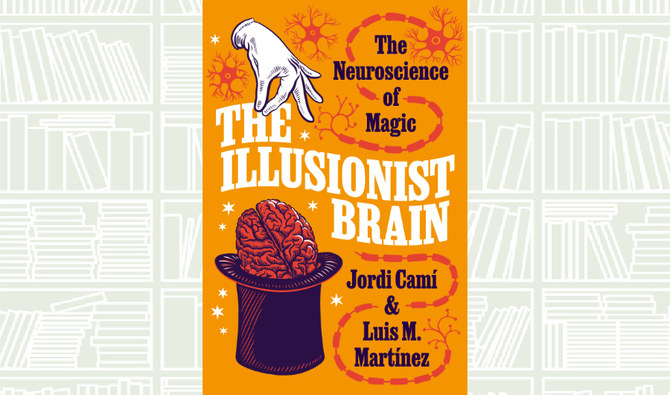
What We Are Reading Today: The Illusionist Brain: The Neuroscience of Magic

Short Url
Updated 09 June 2022
Follow

What We Are Reading Today: The Illusionist Brain: The Neuroscience of Magic

Authors: Jordi Cami and Luis M. Martinez

How do magicians make us see the impossible? The Illusionist Brain takes you on an unforgettable journey through the inner workings of the human mind, revealing how magicians achieve their spectacular and seemingly impossible effects by interfering with your cognitive processes.

Along the way, this lively and informative book provides a guided tour of modern neuroscience, using magic as a lens for understanding the unconscious and automatic functioning of our brains.

We construct reality from the information stored in our memories and received through our senses, and our brains are remarkably adept at tricking us into believing that our experience is continuous.


Book Review: Things We Do Not Tell the People We Love

Updated 20 February 2026
Follow

Book Review: Things We Do Not Tell the People We Love

It is always a pleasure to encounter a short story collection that delivers on every page, and British Muslim writer Huma Qureshi’s “Things We Do Not Tell the People We Love,” does exactly that.

Deliciously complex and devastating, the stories in this collection, published in paperback in 2022, are told mostly from the female perspective, capturing the intimate textures of everyday life, from love, loss and loneliness to the endlessly fraught relationships between mothers and daughters, friends and lovers.

Qureshi’s prose is understated yet razor-sharp, approaching her characters from close quarters with poignant precision. 

I found it particularly impressive that none of the stories in the collection fall short or leave you confused or underwhelmed, and they work together to deliver the title’s promise.

Even the stories that leave you with burning, unanswered questions feel entirely satisfying in their ambiguity.

Several pieces stand out. “Firecracker” is a melancholy study of how some friendships simply age out of existence; “Too Much” lays bare the failures of communication that so often run between mothers and daughters; “Foreign Parts,” told from a British man’s perspective as he accompanies his fiancee to Lahore, handles questions of class and hidden identity with admirable delicacy; and “The Jam Maker,” an award-winning story, builds to a genuinely thrilling twist.

Throughout, Qureshi’s characters carry South Asian and Muslim identities worn naturally, as one thread among many in the fabric of who they are. They are never reduced to stereotypes or a single defining characteristic. 

Reading this collection, I found myself thinking of early Jhumpa Lahiri, of “Interpreter of Maladies,” and that feeling of discovering a writer who seems destined to endure. 

Huma Qureshi tells the stories of our times— mundane and extraordinary in equal measure— and she tells them beautifully.