

Ton-up Hope leads West Indies to 305-8 in first Pakistan ODI

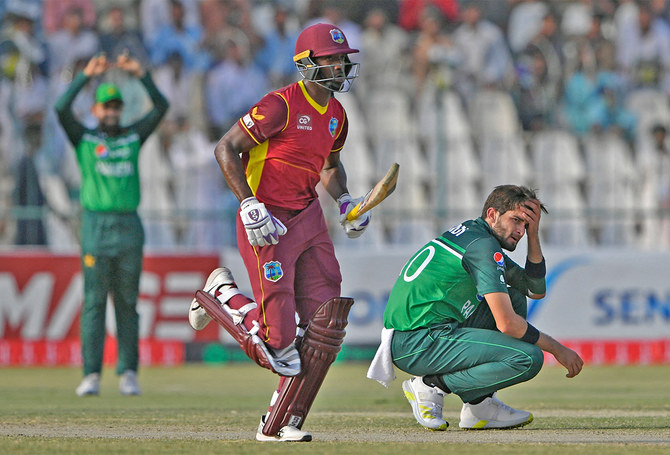
Pakistan's Shaheen Shah Afridi (R) reacts as West Indies' Shamarh Brooks (C) runs between the wickets during the first one-day ODI cricket match in Multan, Pakistan, on June 8, 2022. (AFp)
Short Url
Updated 08 June 2022
Follow

Ton-up Hope leads West Indies to 305-8 in first Pakistan ODI

  • 28-year-old Barbadian knocked 134-ball for his 12th one-day international century 
  • Fast bowler Haris Rauf, best of home bowlers with 4-77, ended Hope’s knock 

Multan, Pakistan: Opener Shai Hope defied Pakistan’s much vaunted bowling attack and sweltering Multan heat to lift the West Indies to a solid 305-8 in the first day-night international on Wednesday.

The 28-year-old Barbadian knocked 134-ball 127 for his 12th one-day international century after West Indies won the toss and opted to bat on a flat Multan stadium pitch.

Hope, who cracked 15 boundaries and a six, added an innings-building 154 with Shamarh Brooks after the visitors lost opener Kyle Mayers for three in the third over, caught and bowled by pacer Shaheen Shah Afridi.

Brooks scored a polished 83-ball 70 with seven boundaries.

Fast bowler Haris Rauf, best of home bowlers with 4-77, ended Hope’s knock when he bowled him with a slower delivery in the 44th over.

The scorching Multan heat — with temperatures soaring to between 40 to 42 degrees Celsius (104 to 107 degrees Fahrenheit — did not stop Hope and Brooks, who both batted with guts and power.

Hope drove pacer Hasan Ali to cover boundary to reach three-figures off 118 balls, also completing 4,000 ODI runs in his 93rd match.

He is the 11th West Indies batsman to reach the milestone in ODI cricket.

It was a brilliant one-handed diving catch by Shadab Khan off Mohammad Nawaz at short third man that dismissed Brooks, but only after he helped Hope in recovery.

Skipper Nicholas Pooran hit three towering sixes in his 16-ball 21 while Rovman Powell made 32 off 23 balls and Romario Shepherd took 25 off 18 as West Indies added 87 in the last ten overs.

The three-match series is part of the World Cup Super League, a qualification round for the 2023 World Cup. 


Rating firm S&P says it won’t rush Iran war downgrades, sees risks for countries like Pakistan

Updated 12 March 2026
Follow

Rating firm S&P says it won’t rush Iran war downgrades, sees risks for countries like Pakistan

  • Agency says it is monitoring indebted energy importers as higher oil prices strain finances
  • Gulf economies seen better placed to weather shock, though Bahrain flagged as vulnerable

LONDON: S&P Global ‌said it would not make any knee-jerk sovereign rating cuts following the outbreak of war in the ​Middle East, but warned on Thursday that soaring oil and gas prices were putting a number of already cash-strapped countries at risk.

The firm’s top analysts said in a webinar that the conflict, which has involved US and Israeli strikes ‌against Iran and Iranian ‌strikes against Israel, ​US ‌bases ⁠and Gulf ​states, ⁠was now moving from a low- to moderate-risk scenario.

Most Gulf countries had enough fiscal buffers, however, to weather the crisis for a while, with more lowly rated Bahrain the only clear exception.

Qatar’s banking sector could ⁠also struggle if there were significant ‌deposit outflows in ‌reaction to the conflict, although there ​was no evidence ‌of such strains at the moment, they ‌said.

“We don’t want to jump the gun and just say things are bad,” S&P’s head global sovereign analyst, Roberto Sifon-Arevalo, said.

The longer the crisis ‌was prolonged, though, “the more difficult it is going to be,” he ⁠added.

Sifon-Arevalo ⁠said Asia was the second-most exposed region, due to many of its countries being significant Gulf oil and gas importers.

India, Thailand and Indonesia have relatively lower reserves of oil, while the region also had already heavily indebted countries such as Pakistan, Bangladesh and Sri Lanka whose finances would be further hurt by rising energy prices.

“We ​are closely monitoring ​these (countries) to see how the credit stories evolve,” Sifon-Arevalo said.