‘No choice’: The Ukrainians forced to flee to Russia

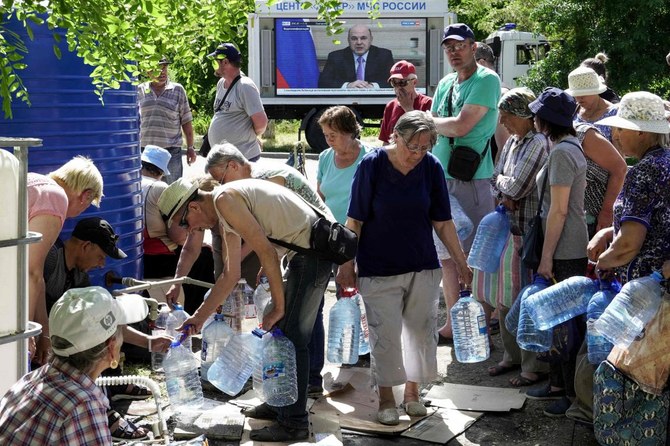
Local residents get some water as Russian Prime minister Mikhail Mishustin appears on a screen in Mariupol on June 3, on the 100th day of the Russian invasion of Ukraine. (AFP)
Short Url
Updated 07 June 2022
Follow

‘No choice’: The Ukrainians forced to flee to Russia

  • Ukrainian authorities have been accusing Moscow of "illegally transferring" more than a million Ukrainians to Russia
  • A Russian defence ministry official said the transfers of civilians was only being done to "evacuate" them away from "dangerous areas"

WARSAW: Some residents of the devastated Ukrainian city of Mariupol who managed to escape are saying they were given no choice but to travel to Russia in what the Kyiv government regards as “deportations.”
After spending weeks in a Mariupol basement and following the death of her father, who was killed in a rocket attack, Tetiana decided to leave her city to try to save her nine-year-old daughter.
With no mobile network or any possibility of communicating, she took advantage of a lull in the shelling to go to an assembly point arranged by pro-Russian authorities to find out about ways out.
There, she was told going to Russia was the only option.
“We were in shock. We did not want to go to Russia,” the 38-year-old accountant said on the phone from Riga in Latvia where she has since sought refuge with her family.
“How can you go to a country that wants to kill you?“
For several weeks, Ukrainian authorities have been accusing Moscow of “illegally transferring” more than a million Ukrainians to Russia or to the parts of Ukraine currently controlled by Russian forces.
A Russian defense ministry official, Mikhail Mizintsev, confirmed the one million number but said the transfers of civilians was only being done to “evacuate” them away from “dangerous areas.”
Some civilians have indeed been forced to go toward Russia because travel to Ukrainian-held areas was blocked by fighting.
Speaking to AFP after crossing from Russia into Estonia, Yelyzaveta, originally from Izyum, a city in the east currently held by Russian forces, said this was the case for her.
“It was impossible to go toward Ukraine,” Tetiana, who asked not to be identified, told AFP.
Like Tetiana, two other families from Mariupol — where the Ukrainian government says 20,000 people were killed, said they too were forced to go to Russia.
Svitlana, an employee in a large industrial concern, also hid in a basement with her husband and parents in-law in Mariupol until some Russian soldiers ordered them to a part of the city fully in Russian hands.
“When an armed man tells you that, you can’t really say no,” said the 46-year-old, who has since been able to travel to Lviv in western Ukraine.
Her family was initially taken to Novoazovsk, a small town near Mariupol that is in the hands of Russia-backed separatists.
There they stayed for four days in a school.
They were then transferred to Starobesheve, where they were put up in a crowded community center where people slept on the floor.
“The worst was the smell of dirty feet, dirty bodies. It stayed on our things even after we washed them many times,” Svitlana said.
Three days later, the family was interrogated in a building occupied by separatist police.
They had to answer written questions about whether they had relatives in the Ukrainian army, their fingerprints were taken and they had to hand over their phones for checks.
In a separate room, the men had to undress to show they did not have any Ukrainian patriotic tattoos or combat wounds — a sign that they might be in the military.
“My husband had to take off everything except his underwear and his socks,” Svitlana said.
“We also deleted all photos and social media from our phones,” she said, fearing possible repercussions because of her “pro-Ukrainian position.”
Ivan Druz, 23, who left Mariupol with his half-brother in April, suffered the same treatment in Starobesheve.
He was then hoping to go to territory controlled by Ukraine but after a lot of moving around within Russian-occupied areas, Druz, who is now in Riga, was told it was not possible.
“At first they tire you out and then they tell you that you can only leave in one direction,” he said.
After arriving at the Russian border, he had to undress and answer questions about chats with his aunt in Ukrainian.
“They asked me why she was writing to me in Ukrainian” and “wanted to check that I was not a Nazi,” he said.
Once in Russia, the families of Tetiana and Druz were sent to Taganrog, around 100 kilometers (62 miles) from Mariupol.
Just after arriving, they were told by officials that they had to travel by train to Vladimir — around 1,000 kilometers further north.
From there, Ivan and his half-brother had to leave again, this time to the city of Murom, 130 kilometers to the southeast, where they were put up in a hostel for refugees.
Thanks to Russian friends, the families of Ivan, Tetyana and Svitlana eventually traveled to Moscow and took buses for Latvia or Estonia where Ukrainian refugees are being welcomed.
“Once in Latvia, we finally felt free,” Tetyana said.


Trump taking steps toward installing a Columbus statue near the White House

Updated 6 sec ago
Follow

Trump taking steps toward installing a Columbus statue near the White House

  • Trump endorses a traditional view of Columbus as leader of the 1492 mission that marked the unofficial beginning of European colonization in the Americas

ANNAPOLIS, Maryland: President Donald Trump is taking steps toward installing near the White House a replica of a statue of famed explorer Christopher Columbus that had been tossed into Baltimore’s harbor during his first term amid protests against institutional racism.
John Pica, a Maryland lobbyist and president of the Italian American Organizations United, said his group owns the statue and agreed to loan it to the federal government for placement at or near the White House.
Pica told The Associated Press in an interview that he was contacted about the statue around Columbus Day last year by an intermediary who said the White House was looking for a statue of the explorer. Pica says his organization took a straw vote and unanimously decided to send the statue to the White House. They signed the loan agreement Wednesday.
Asked if he was optimistic the statue would make it to the White House, Pica said, “Cautiously optimistic, yes.” The exact timing for any planned installation was unclear, he said, though he added, “possibly within two weeks.”
Maryland state Delaware Nino Mangione, a Republican who has worked with the Italian American group to find the statue a new home after it was pulled from the harbor, also confirmed the plans for the statue, which were first reported earlier Wednesday by The Washington Post.
The White House declined to comment to the AP on plans for the statue but reaffirmed Trump’s affinity for Columbus, whose legacy has shifted as historians and educators amplify how white European figures and their descendants treated Native Americans and enslaved Africans to develop the New World.
“In this White House, Christopher Columbus is a hero,” said Trump spokesman David Ingle. “And he will continue to be honored as such by President Trump.”
Trump wants to put his own stamp on American history ahead of big anniversary celebration
For Pica and his group, the statue’s Washington placement would celebrate a famous Italian who holds iconic status among Italian Americans. For Trump, it would be another move to reshape the telling of US history as the nation marks the 250th anniversary of the signing of the Declaration of Independence.
Trump endorses a traditional view of Columbus as leader of the 1492 mission that marked the unofficial beginning of European colonization in the Americas and the development of the modern economic and political order. But in recent years, Columbus also been recognized as a primary example of Western Europe’s conquest of the New World, its resources and its native people.
The statue now headed to Washington is a replica of one toppled by protesters on July 4, 2020, and thrown into Baltimore’s Inner Harbor after anger boiled over following the death of George Floyd at the hands of police. It was one of many statues of Columbus that were vandalized around the same time, with protesters saying the Italian explorer was responsible for the genocide and exploitation of native peoples in the Americas.
“I was there when we got it out of the harbor,” Mangione said, adding that artist Will Hemsley used parts of the old statue, first unveiled during Ronald Reagan’s presidency, “to build and restore a beautiful, brand new statue.”
In recent years, some individuals, institutions and government entities have displaced Columbus Day with recognition of Indigenous Peoples Day. President Joe Biden in 2021 became the first US president to mark Indigenous Peoples Day with a proclamation.
The statue may not be permanent
Pica emphasized that his group is lending the statue and would reclaim it if a future administration wanted it taken down.
Trump dismisses the shift on Columbus as “left-wing arsonists” bending history and twisting Americans’ collective memory. “I’m bringing Columbus Day back from the ashes.,” he declared last April. Echoing his 2024 campaign rhetoric, he complained that “Democrats did everything possible to destroy Christopher Columbus, his reputation, and all of the Italians that love him so much.”
Trump issued a Columbus Day proclamation last October and ignored Indigenous Peoples Day. He praised Columbus as “the original American hero, a giant of Western civilization, and one of the most gallant and visionary men to ever walk the face of the earth.”
That tribute reflected Trump’s broader take on history. Last spring, he signed an executive order titled “Restoring Truth and Sanity to American History,” which bemoaned “a concerted and widespread effort to rewrite our Nation’s history” in a way that misrepresents the US “as inherently racist, sexist, oppressive, or otherwise irredeemably flawed.”
Since the order, the administration has demanded a comprehensive review of exhibits across all Smithsonian museums and pushed Executive Branch agencies and state and local entities — especially colleges, universities and schools — that receive federal funding to roll back their diversity initiatives.