

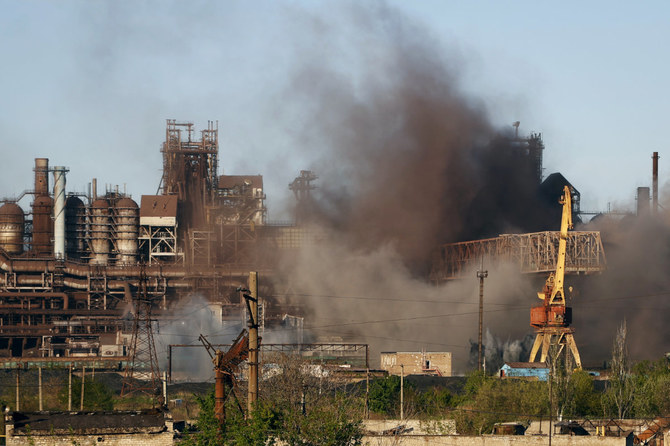
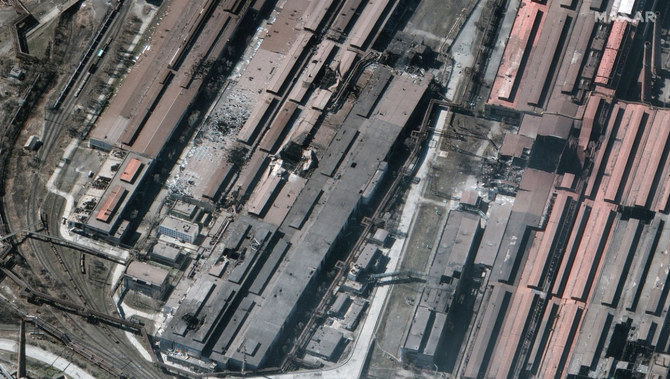
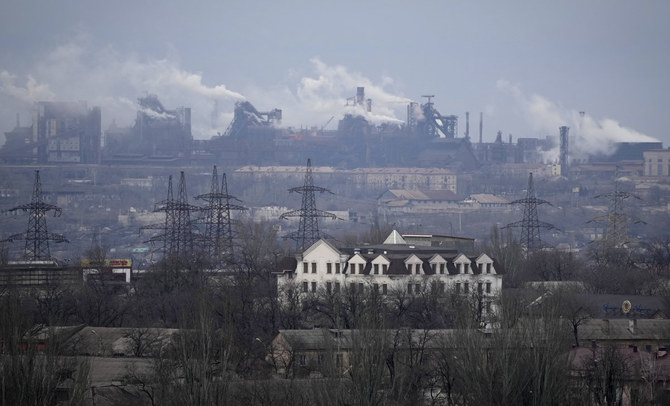

POKROVSK, Ukraine: Russia claimed to have captured Mariupol on Friday in what would be its biggest victory yet in its war with Ukraine, after a nearly three-month siege that reduced much of the strategic port city to a smoking ruin, with over 20,000 civilians feared dead.
Russian Defense Minister Sergei Shoigu reported to President Vladimir Putin the “complete liberation” of the Azovstal steel plant in Mariupol — the last stronghold of Ukrainian resistance — and the city as a whole, spokesman Igor Konashenkov said.
There was no immediate confirmation from Ukraine.
Russia’s state news agency RIA Novosti quoted the ministry as saying a total of 2,439 Ukrainian fighters who had been holed up at the steelworks had surrendered since Monday, including over 500 on Friday.
As they surrendered, the troops were taken prisoner by the Russians, and at least some were taken to a former penal colony. Others were said to be hospitalized.
The defense of the steel mill had been led by Ukraine’s Azov Regiment, whose far-right origins have been seized on by the Kremlin as part of an effort to cast its invasion as a battle against Nazi influence in Ukraine. Russia said the Azov commander was taken away from the plant in an armored vehicle.
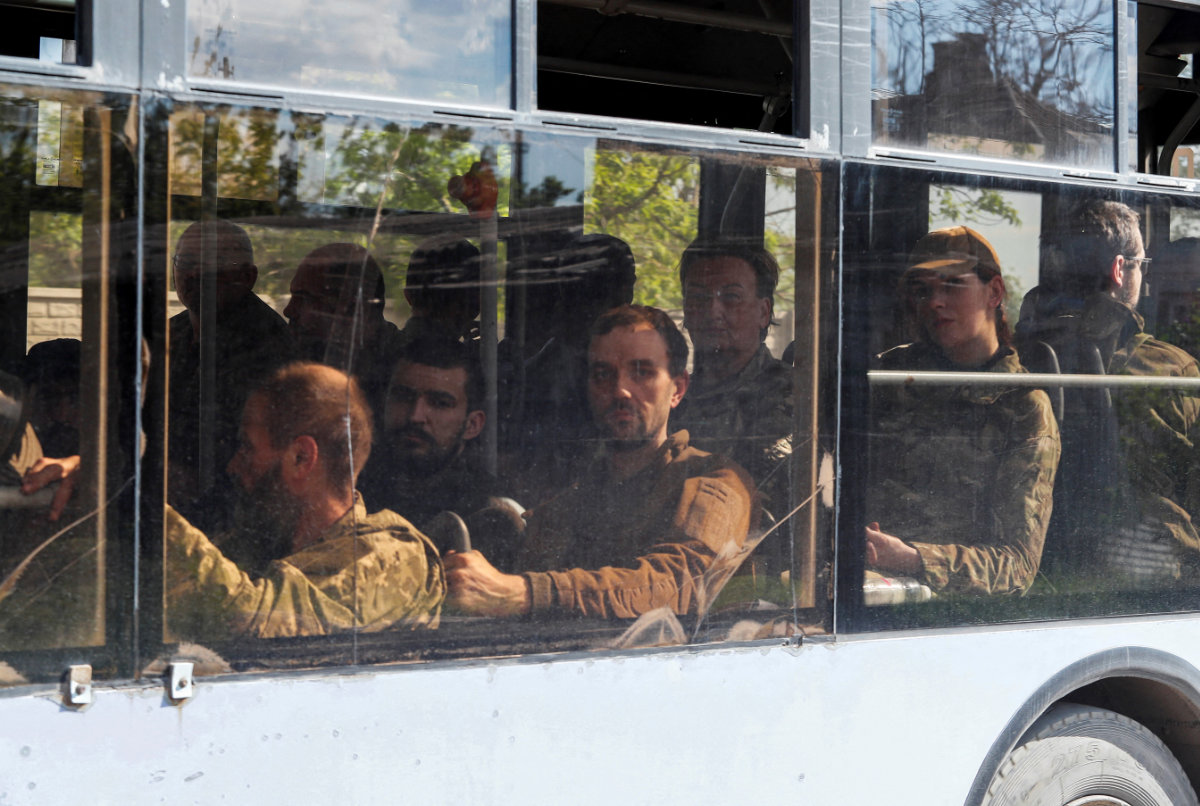
A bus carries captured Ukrainian defenders of the besieged Azovstal steel mill in Mariupol on May 20, 2022, to an undisclosed location. (REUTERS)
Russian authorities have threatened to investigate some of the steel mill’s defenders for war crimes and put them on trial, branding them “Nazis” and criminals. That has stirred international fears about their fate.
The steelworks, which sprawled across 11 square kilometers (4 square miles), had been the site of fierce fighting for weeks. The dwindling group of outgunned fighters had held out, drawing Russian airstrikes, artillery and tank fire, before their government ordered them to abandon the plant’s defense and save themselves.
The complete takeover of Mariupol gives Putin a badly needed victory in the war he began on Feb. 24 — a conflict that was supposed to have been a lightning conquest for the Kremlin but instead has seen the failure to take the capital of Kyiv, a pullback of forces to refocus on eastern Ukraine, and the sinking of the flagship of Russia’s Black Sea fleet.
Military analysts said Mariupol’s capture at this point is of mostly symbolic importance, since the city was already effectively under Moscow’s control and most of the Russian forces that were tied down by the fighting there had already left.
In other developments Friday, the West moved to pour billions more in aid into Ukraine and fighting raged in the Donbas, the industrial heartland in eastern Ukraine that Putin is bent on capturing.
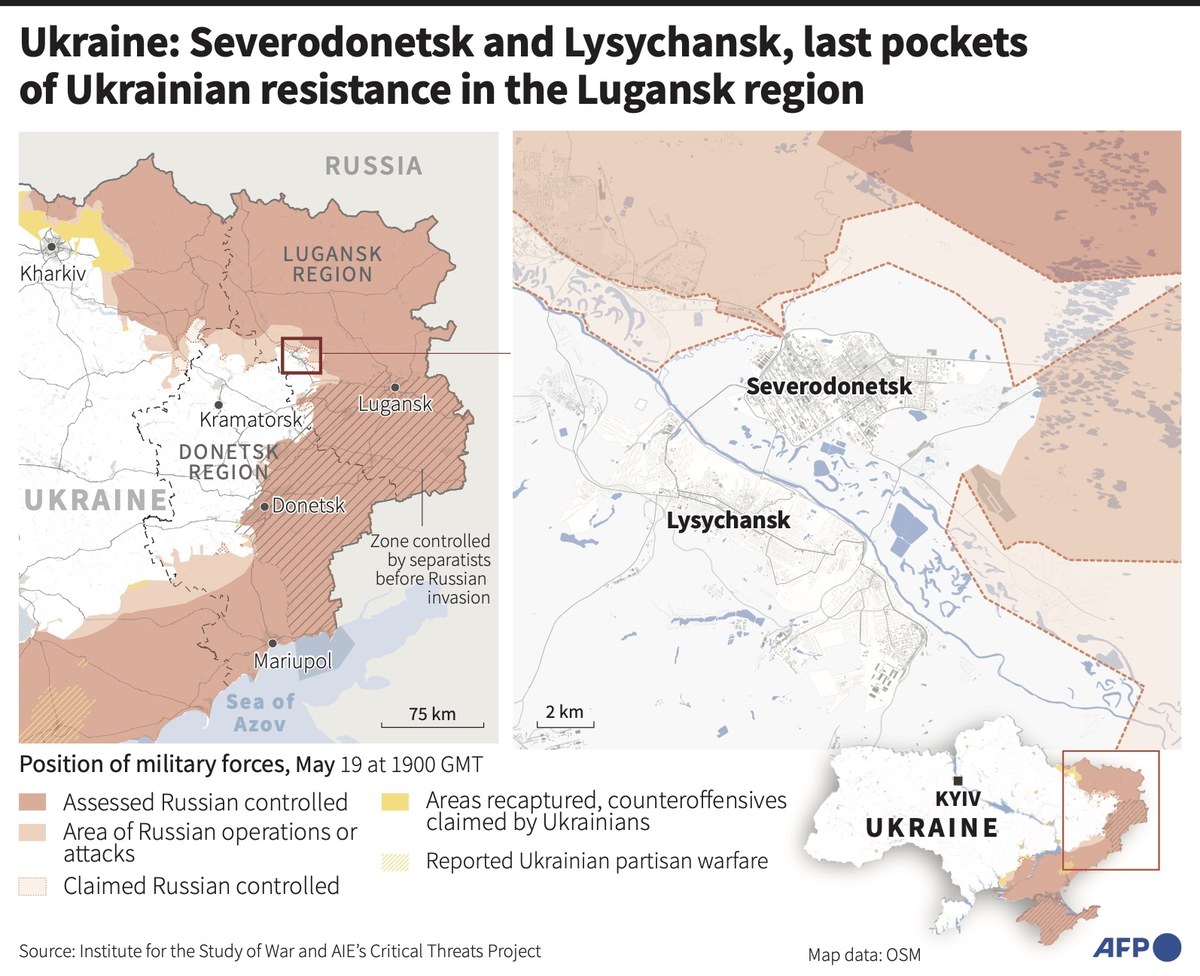
Russian forces shelled a vital highway and kept up attacks on a key city in the Luhansk region, hitting a school among other sites, Ukrainian authorities said. Luhansk is part of the Donbas.
The Kremlin had sought control of Mariupol to complete a land corridor between Russia and the Crimean Peninsula, which it seized from Ukraine in 2014, and free up troops to join the larger battle for the Donbas. The city’s loss also deprives Ukraine of a vital seaport.
Mariupol endured some of the worst suffering of the war and became a worldwide symbol of defiance. An estimated 100,000 people remained out a prewar population of 450,000, many trapped without food, water, heat or electricity. Relentless bombardment left rows upon rows of shattered or hollowed-out buildings.
A maternity hospital was hit with a lethal Russian airstrike on March 9, producing searing images of pregnant women being evacuated from the place. A week later, about 300 people were reported killed in a bombing of a theater where civilians were taking shelter, although the real death toll could be closer to 600.
Satellite images in April showed what appeared to be mass graves just outside Mariupol, where local officials accused Russia of concealing the slaughter by burying up to 9,000 civilians.
Ukrainian President Volodymyr Zelensky said Monday the evacuation of his forces from the miles of tunnels and bunkers beneath Azovstal was done to save the lives of the fighters.
Earlier this month, hundreds of civilians were evacuated from the plant during humanitarian cease-fires and spoke of the terror of ceaseless bombardment, the dank conditions underground and the fear that they wouldn’t make it out alive.
As the end drew near at Azovstal, wives of fighters who held out at the steelworks told of what they feared would be their last contact with their husbands.
Olga Boiko, wife of a marine, wiped away tears as she said that her husband had written her on Thursday: “Hello. We surrender, I don’t know when I will get in touch with you and if I will at all. Love you. Kiss you. Bye.”
Natalia Zaritskaya, wife of another fighter at Azovstal, said that based on the messages she had seen over the past two days, “Now they are on the path from hell to hell. Every inch of this path is deadly.”
She said that two days ago, her husband reported that of the 32 soldiers with whom he had served, only eight survived, most of them seriously wounded.
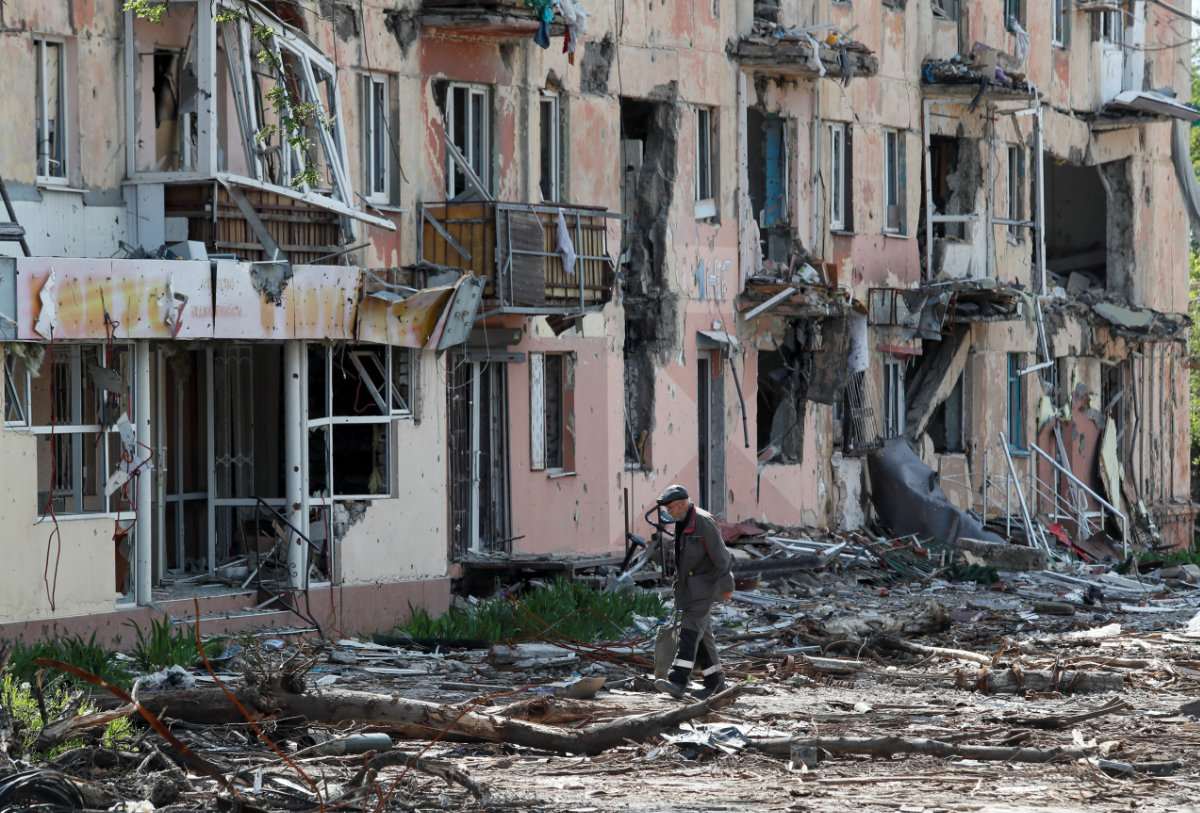
A resident walks near a building heavily damaged during Ukraine-Russia conflict in the southern port city of Mariupol, Ukraine, on May 20, 2022. (REUTERS)
While Russia described the troops leaving the steel plant as a mass surrender, the Ukrainians called it a mission fulfilled. They said the fighters had tied down Moscow’s forces and hindered their bid to seize the east.
Mykhailo Podolyak, an adviser to Zelensky, described the defense of Mariupol as “the Thermopylae of the 21st century” — a reference to one of history’s most glorious defeats, in which 300 Spartans held off a much larger Persian force in 480 B.C. before finally succumbing.
In other developments Friday:
• Zelensky said Russia should be made to pay for every home, school, hospital and business it destroys. He called on Ukraine’s partners to seize Russian funds and property under their jurisdiction and use them to create a fund to compensate those who suffered.
Russia “would feel the true weight of every missile, every bomb, every shell that it has fired at us,” he said in his nightly video address.
• The Group of Seven major economies and global financial institutions agreed to provide more money to bolster Ukraine’s finances, bringing the total to $19.8 billion. In the US, President Joe Biden was expected to sign a $40 billion package of military and economic aid to Ukraine and its allies.
• Russia will cut off natural gas to Finland on Saturday, the Finnish state energy company said, just days after Finland applied to join NATO. Finland had refused Moscow’s demand that it pay for gas in rubles. The cutoff is not expected to have any major immediate effect. Natural gas accounted for just 6 percent of Finland’s total energy consumption in 2020, Finnish broadcaster YLE said.
• A captured Russian soldier accused of killing a civilian awaited his fate in Ukraine’s first war crimes trial. Sgt. Vadim Shishimarin, 21, could get life in prison.
• Russian lawmakers proposed a bill to lift the age limit of 40 for Russians volunteering for military service. Currently, all Russian men 18 to 27 must undergo a year of service, though many get college deferments and other exemptions.
Heavy fighting was reported Friday in the Donbas, a mostly Russian-speaking expanse of coal mines and factories.
Serhiy Haidai, the governor of Luhansk, said Russian forces shelled the Lysychansk-Bakhmut highway from multiple directions, taking aim at the only road for evacuating people and delivering humanitarian supplies.
“The Russians are trying to cut us off from it, to encircle the Luhansk region,” he said via email.
Moscow’s troops have also been trying for weeks to seize Severodonetsk, a key city in the Donbas, and at least 12 people were killed there on Friday, Haidai said. A school that was sheltering more than 200 people, many of them children, was hit, and more than 60 houses were destroyed across the region, he added.
But he said the Russians took losses in the attack on Severodonetsk and were forced to retreat. His account could not be independently verified.
Another city, Rubizhne, has been “completely destroyed,” Haidai said. “Its fate can be compared to that of Mariupol.”

keywords


