



GWADAR: When Hindus gathered at a temple last month in the port city of Gwadar to pray for the victory of a Muslim religious political party in local elections, it was not unusual: different faiths have for centuries lived in harmony in the remote fishing town by the azure waters of the Arabian Sea.
China’s Belt and Road Initiative is developing a Chinese-operated deepwater port in Gwadar in the southwestern Balochistan province, and a transportation network linking Gwadar to China. Pakistan’s government views such foreign investment as vital, and is eager to strengthen ties with China as a counterweight to Pakistan’s archrival, India.
But Balochistan is more often in the news for sectarian and separatist attacks than as an example of development — or interfaith harmony.
The temple where the prayers for the Muslim party were held late May lies in Shahi Bazaar, one of the oldest neighborhoods of the port town. Marked by orange banners and a portrait of Ganesh, the elephant-headed Hindu deity, the small two-room structure of Shri Krishna Mandir, or Om Mandir as locals call it, stands between a jamatkhana — a congregational place of Ismailis — and a Sunni mosque.
According to Bhimraj Mal, the temple’s caretaker, it was built during the time the area was governed by the Sultanate of Oman, when Hindus were one of the city’s main communities.
In 2002, Bhimraj Mal, the temple’s caretaker, said he went to meet the local leaders of Jamiat Ulema-e-Islam (JUI-F), which was then part of Balochistan’s ruling coalition.
“Your party has won and the provincial minister for minorities also belongs to your party, so we have come here to seek your support,” Mal told Arab News, narrating his words to the then district chief of JUI-F, Maulana Abdul Hameed Inquilabi.
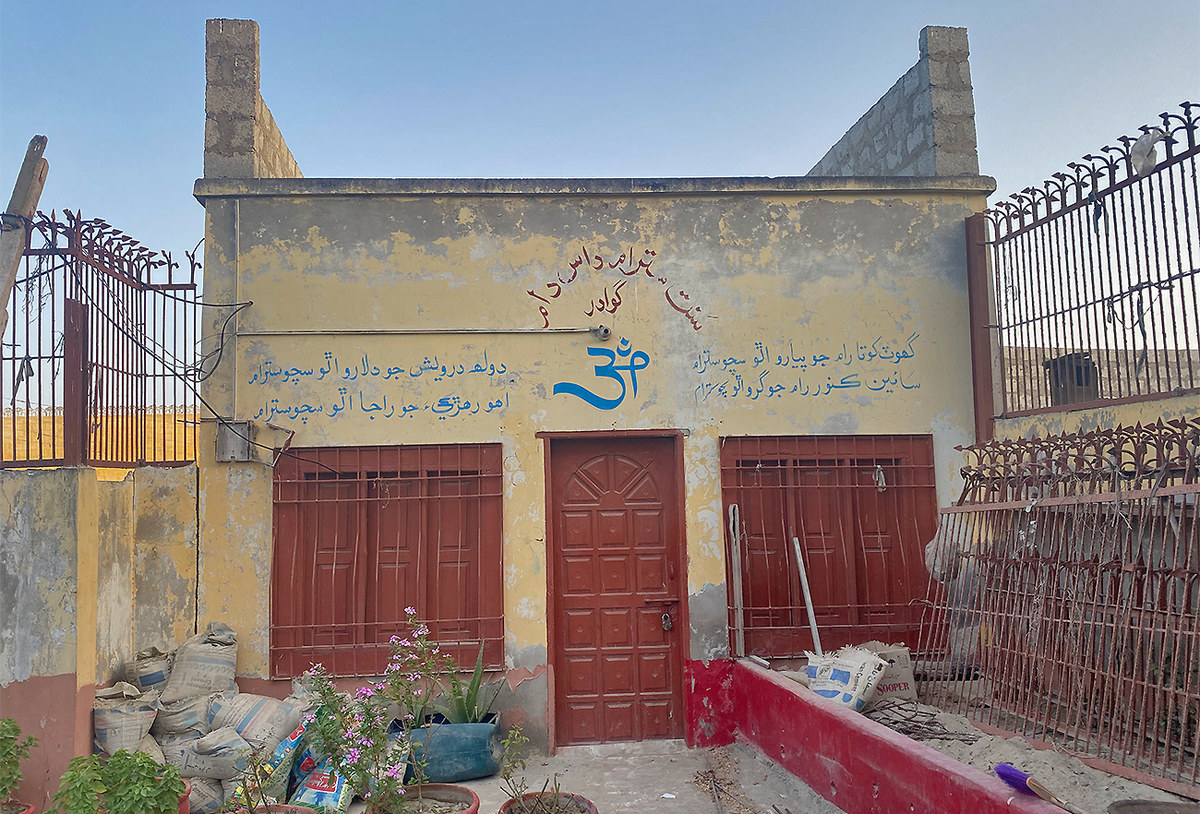
Shri Krishna Mandir, a Hindu temple in Shahi Bazar, Gwadar, Pakistan, on May 19, 2022. (AN Photo)
He also remembered the politician’s response: “We have never refused to help you and we will not disappoint you.”
It was the JUI-F that Mal and others from the few hundred-member Hindu community prayed would win last month’s vote, two decades after the party kept its promise and restored the temple.
“The JUI-F had supported us in rebuilding our place of worship,” Mal’s son, Chandar Kumar, told Arab News, saying their prayer for the party’s victory was both an expression of gratitude and a reflection of Gwadar’s “centuries-old interfaith harmony.”
Gwadar was part of Oman from the late 18th century until a decade after the end of British colonial rule and the partition of the Indian Subcontinent into Muslim-majority Pakistan and Hindu-majority India in 1947. Partly ceded to and partly bought by the Pakistani government, the coastal corner of Balochistan came fully under its jurisdiction in 1958. For centuries before that, the fishing village was exposed to diverse cultural and religious influences and home to Omani Arabs, Hindus, Ismaili and Baloch communities.
Mal took over custody of the temple in the 1990s, when its previous caretaker left to reunite with his family members who, like most Hindus, migrated to India after the partition.
The building was dilapidated and some of its walls had collapsed, Mal said, adding that he had tried to renovate it himself, but after years of struggle gave up and decided to seek help from the area’s Muslim community.
JUI-F district chief Maulana Abdul Hameed Inquilabi, who helped rebuilt the temple, said a culture of interfaith harmony had “broadened” the thinking of the people of Gwadar.
“Gwadar is different from the rest of the cities [in Pakistan]. Here we work together and we live together, here sectarianism has no place,” he said, “Our minorities here have always given us love and we have given them our love.”
“We have broadened our thinking, which has helped us a lot,” Inquilabi added. “One can live together with others while following one’s own religion.”
Diversity, according to Nasir Rahim Sohrabi, a local educationist and historian, had been a permanent feature of life in Gwadar, where traders of different faiths would arrive from other parts of South Asia and the Middle East.
“The people of Gwadar had the chance to live with Ismailis and Hindus,” Sohrabi told Arab News. “Locals would also travel to India, countries in Africa, Iraq and Oman, which had widened their horizons.”
The jamatkhana, the Hindu temple and the mosque standing next to each other were for Sohrabi an example of Gwadar’s “exemplary coherence.”
“The people of Gwadar,” he said, “have always accepted people of different faiths with open arms.”
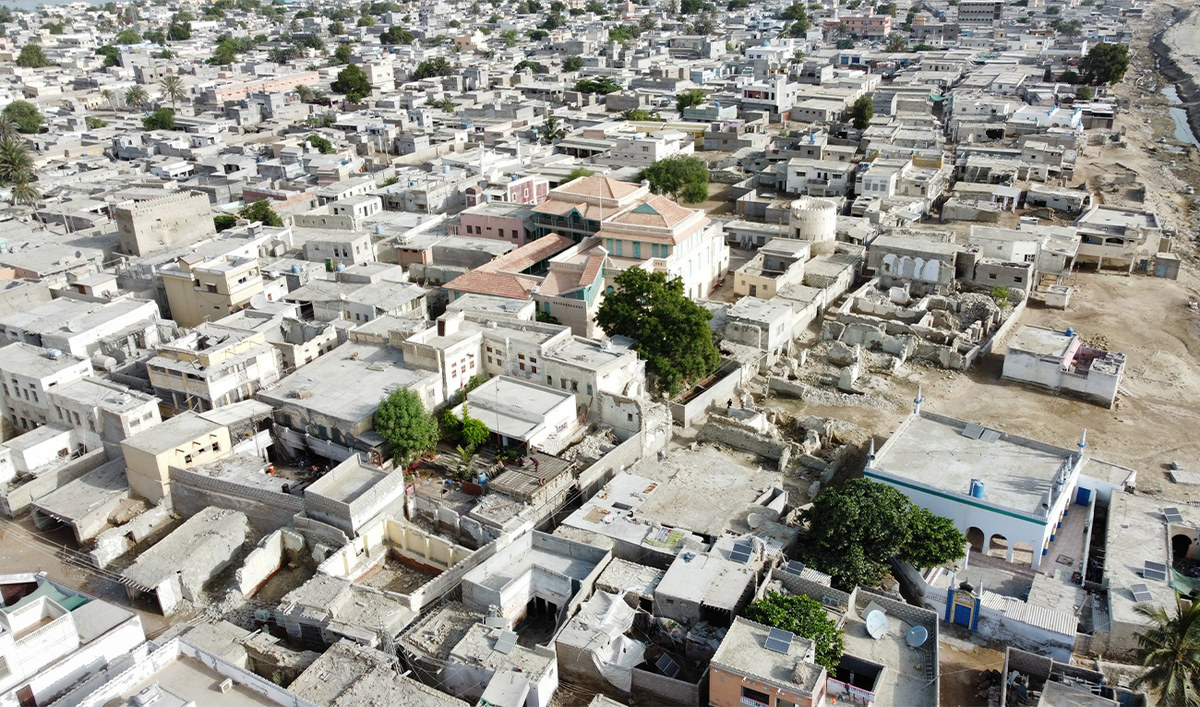
The photograph shows aerial view of Shri Krishna Mandir, a congregational place of Ismailis and a Sunni mosque standing next to each other in Gwadar, Pakistan, on May 19, 2022. (AN Photo/Naveed Muhammad)


