UAE In-Focus: Nasdaq Dubai welcomes two Sukuk issuances; Airlink and Emirates announce codeshare; First free-zone market

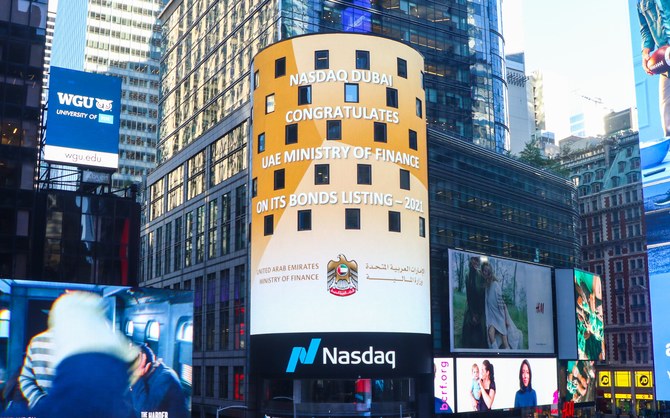
Nasdaq Dubai announced on Monday the listing of two Sukuk issuances by the Government of Indonesia valued at 11.9 billion dirhams ($3.25 billion). (Supplied/File)
Short Url
Updated 07 June 2022
Follow

UAE In-Focus: Nasdaq Dubai welcomes two Sukuk issuances; Airlink and Emirates announce codeshare; First free-zone market

DUBAI: Nasdaq Dubai announced on Monday the listing of two Sukuk issuances by the Government of Indonesia valued at 11.9 billion dirhams ($3.25 billion), according to Emirates News Agency WAM. 

Two tranches consist of 6.4 billion dirhams in five-year Trust Certificates with a 4.40 percent yield and 5.5 billion dirhams in 10-year Trust Certificates with a 4.70 percent yield.

Indonesia’s government has been one of the largest issuers of Sukuk on Nasdaq Dubai, and the new listings increased the total amount of Sukuk listed on Nasdaq Dubai to 80.8 billion dirhams, the statement added. 

Dubai has emerged as one of the largest Sukuk listing centers in the world, with a total listed value of 297 billion dirhams, the statement concluded.

Airlink and Emirates activate codeshare partnership

Emirates and Airlink have officially activated a codeshare agreement, which will provide customers with a single booking reference across eight domestic South African cities. This will be provided via the airline’s gateways in Johannesburg, Cape Town, and Durban. 

Emirates customers can now book additional destinations from Johannesburg, Cape Town and Durban, including eight places from Johannesburg, five other from Cape Town and one point from Durban, according to a press release issued by Dubai Media Office. 

Travelers can book their itineraries on Emirates' website, with travel agents as well as online travel agents, it added. 

Dubai’s first free-zone market to open soon

A free market that will see customs fees waived on goods is set to open in Dubai.

Yiwu, located in Jebel Ali Free Zone, will be the Middle East's first smart free-zone market serving retail and wholesale industries.

The market has been established in partnership with China Commodity City Group and DP World with an investment of 600 million dirhams ($163 million).

As part of the project, goods can be moved directly from the airfield or quayside into storage areas without incurring additional customs fees, according to a press release.

Yiwu Market offers 100 percent foreign ownership, 100 percent foreign repatriation of capital and profits, and no re-export tariffs, it added.

Chief Operating Officer of Parks and Zones at DP World UAE Ahmad Al Haddad said: “Jafza has helped traders maximize opportunities by giving them access to 60 percent of the world’s GDP (gross domestic product) through air, sea, and road transport.”

The services offered are secure payment portals for electronic transactions, inventory management, custom declarations, and hassle-free cargo gate clearance.


IMF approves $2.3bn for Egypt amid recovery, as lender reengages with Syria’s resurgent economy

Updated 8 sec ago
Follow

IMF approves $2.3bn for Egypt amid recovery, as lender reengages with Syria’s resurgent economy

RIYADH: The International Monetary Fund has approved the disbursement of $2.3 billion to Egypt following the completion of combined reviews under its Extended Fund Facility and Resilience and Sustainability Facility.

The lender announced on Feb. 25 that the funds, comprising about $2 billion under the EFF and $273 million under the RSF, will support the country’s ongoing stabilization efforts.

The approval extends Egypt’s 46-month EFF arrangement to Dec. 15, and brings total disbursements under the program to roughly $5.2 billion.

The move will bolster the engine of the Arab world’s third-largest economy. With a population exceeding 112 million and a nominal gross domestic product of roughly $400 billion, Egypt’s economic stability is crucial for the region.

The country’s consumer market and strategic position, anchored by the Suez Canal, make its fiscal health a leader for emerging markets in the Middle East and North Africa.

According to the IMF, Egypt’s macroeconomic landscape has shown marked improvement as policy measures take hold.

Real GDP growth accelerated to 4.4 percent in fiscal year 2024-2025, driven by a broad-based recovery. Inflation has cooled significantly to 11.9 percent as of January, supported by tight monetary and fiscal policies.

Nigel Clarke, IMF deputy managing director and chair, said: “The authorities’ stabilization measures continue to take effect. However, further progress on deeper reforms, particularly in divestment in non-strategic sectors and debt management, is needed to reduce risks to attaining key program objectives.”

The external position has also strengthened considerably. The current account deficit narrowed to 4.2 percent of GDP, buoyed by robust remittances and tourism revenues.

Market confidence has rebounded, evidenced by successful international bond issuances, foreign direct investment inflows, and record non-resident investments in domestic debt markets.

This has helped swell gross international reserves to approximately $59.2 billion as of December, up from $54.9 billion a year earlier.

The IMF noted that progress on deeper structural reforms has been “uneven.” While macroeconomic stability has improved, efforts to reduce the state’s economic footprint, particularly regarding the divestment of state-owned assets, have lagged behind targets.

Clarke emphasized the need for sustained domestic revenue mobilization, maintaining exchange rate flexibility, and decisive efforts to reduce state dominance to crowd in private investment and secure durable, inclusive growth.

Separately, the Washington-based lender said Syria’s economy is “continuing to recover” following a staff visit to Damascus, signaling deeper engagement with the country.

An IMF team led by Ron van Rooden visited the Syrian capital from Feb. 15 to 19 to assess the economic situation and discuss reform priorities. It was the latest in a series of intensive engagements as Syria reintegrates regionally following years of isolation.

“Activity has picked up further in recent months, supported by improved consumer and investor sentiment, the continuing return of refugees, increased electricity provision and rainfall, and Syria’s steady regional reintegration,” Rooden said in a statement.

Preliminary data indicate the central government budget ended 2025 with a small surplus, a feat attributed to prudent spending and the Ministry of Finance refraining from central bank financing, a significant shift from previous years.

Inflation has slowed to the “low double digits” by the end of 2025, supported by a tight monetary stance.

The IMF said that Syria has prepared a 2026 budget aimed at increasing spending on healthcare, education, and infrastructure rehabilitation. It stressed that while revenue targets are ambitious, the budget includes safeguards should financing fall short.

The fund agreed to an extensive technical assistance program to support Syria’s economic rehabilitation. This includes capacity building in public financial management, revenue mobilization, and banking sector supervision.

The IMF noted that improving statistics and economic governance could help “pave the way for the resumption of Article IV consultations with Syria,” the Fund’s regular health check of member economies, which have been suspended for years.

IMF staff will continue to work together with multilateral, regional, and bilateral donors to support the authorities’ capacity building efforts, Rooden added.