Saudi Arabia welcomes first foreign Hajj pilgrims since COVID-19 pandemic hit

1 / 10
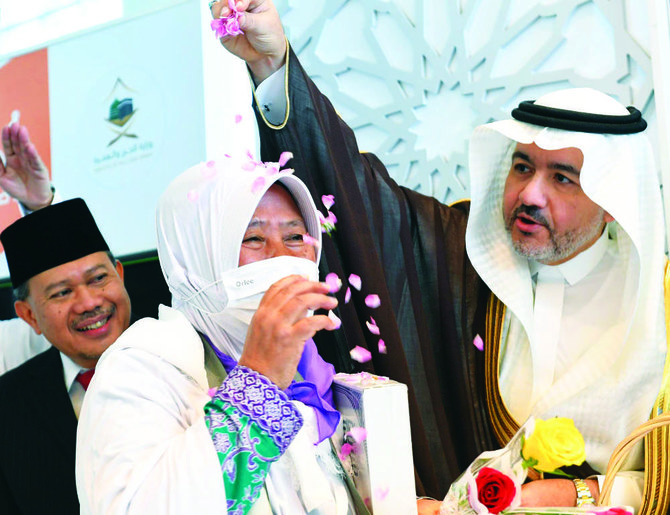
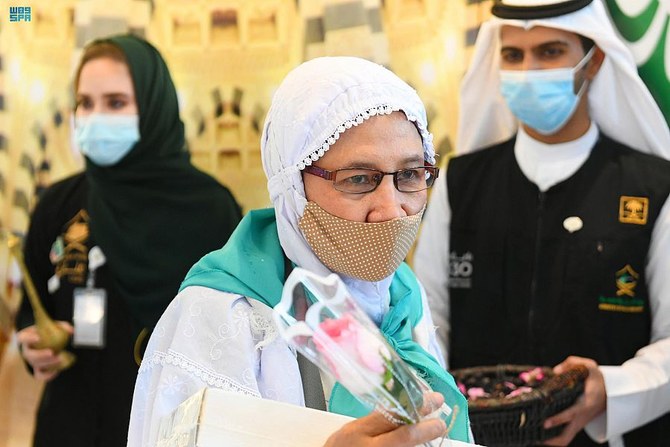
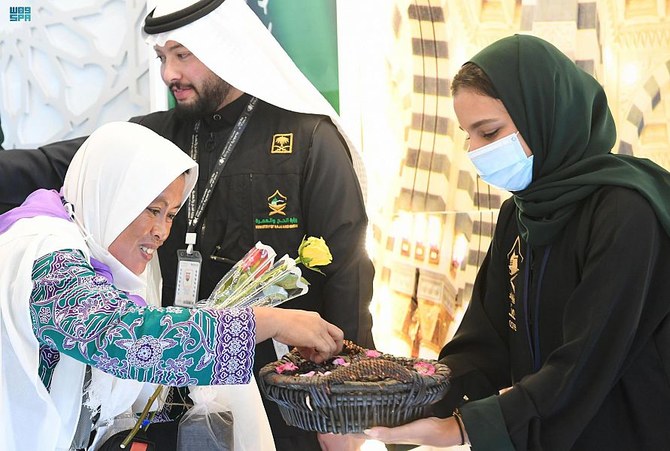
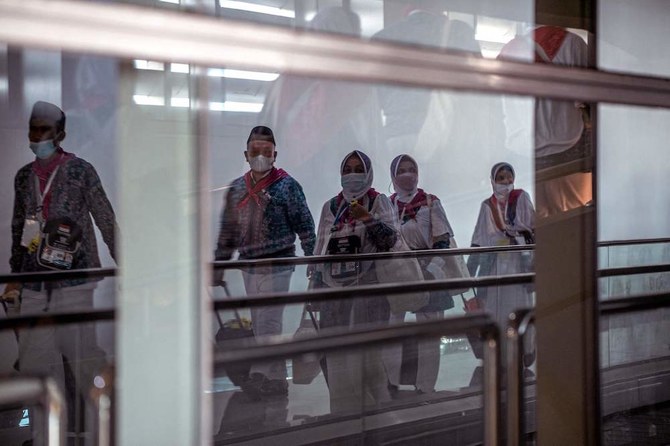
The Indonesian pilgrims were presented flowers, dates and Zamzam water bottles upon arrival. (Twitter: @SPAregions)
2 / 10
The Indonesian pilgrims, who arrived in Madinah from Indonesia, were presented flowers, dates and Zamzam water bottles upon arrival. (Twitter: @SPAregions)
3 / 10
The Indonesian pilgrims, who arrived in Madinah from Indonesia, were presented flowers, dates and Zamzam water bottles upon arrival. (Twitter: @SPAregions)
4 / 10
The Indonesian pilgrims, who arrived in Madinah from Indonesia, were presented flowers, dates and Zamzam water bottles upon arrival. (Twitter: @SPAregions)
5 / 10
The Indonesian pilgrims, who arrived in Madinah from Indonesia, were presented flowers, dates and Zamzam water bottles upon arrival. (Twitter: @SPAregions)
6 / 10
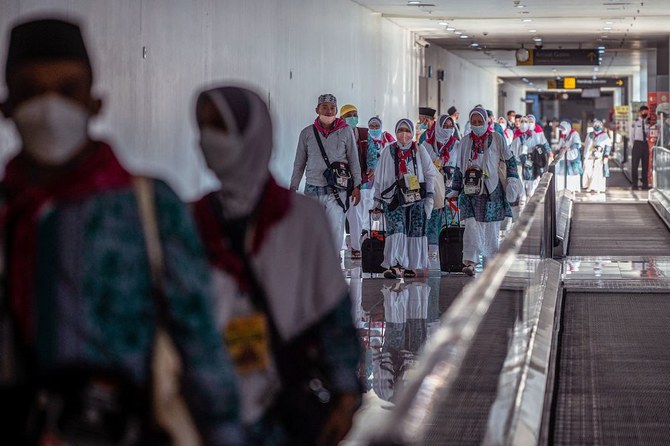
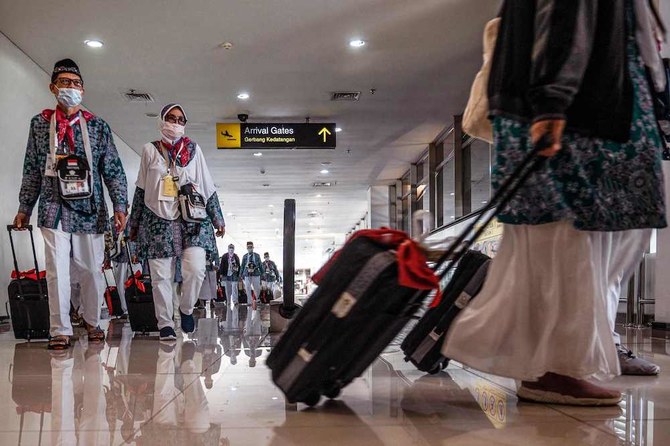
Indonesian pilgrims prepare to depart from Juanda International Airport in Surabaya for the first Hajj pilgrimage since COVID-19 hit. (AFP)
7 / 10
Indonesian pilgrims prepare to depart from Juanda International Airport in Surabaya for the first Hajj pilgrimage since COVID-19 hit. (AFP)
8 / 10
Indonesian pilgrims prepare to depart from Juanda International Airport in Surabaya for the first Hajj pilgrimage since COVID-19 hit. (AFP)
9 / 10
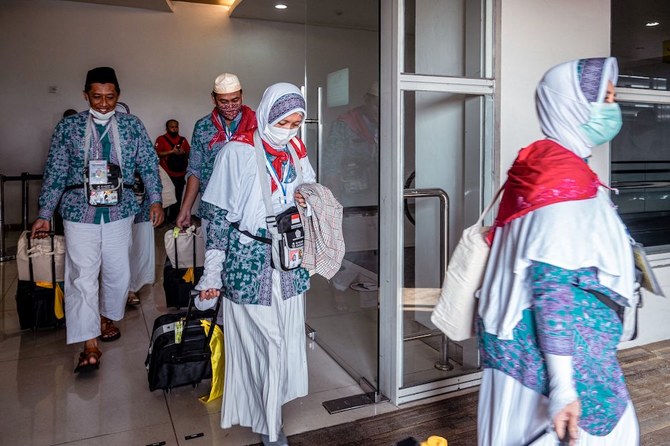
Indonesian pilgrims prepare to depart from Juanda International Airport in Surabaya for the first Hajj pilgrimage since COVID-19 hit. (AFP)
10 / 10
Indonesian pilgrims prepare to depart from Juanda International Airport in Surabaya for the first Hajj pilgrimage since COVID-19 hit. (AFP)
Short Url
Updated 04 June 2022
Follow

Saudi Arabia welcomes first foreign Hajj pilgrims since COVID-19 pandemic hit

  • Registration is now open for local pilgrims, citizens and residents wishing to perform Hajj this year

RIYADH: Saudi Arabia welcomed foreign Hajj pilgrims to Islam’s second holiest city on Saturday, the first since the COVID-19 pandemic hit the country.

The pilgrims, who arrived at Prince Mohammed bin Abdulaziz International Airport in Madinah from Indonesia, were presented flowers, dates and Zamzam water bottles upon arrival.
The flight, carrying 358 pilgrims, was received by Mohammed bin Abdulrahman Al-Bijawe, undersecretary of the Ministry of Hajj and Umrah for visit affairs, the Indonesian ambassador to Saudi Arabia, Dr. Abdulaziz Ahmed, and a number of officials.
Saudi authorities previously implemented tight restrictions on the religious ritual to ensure the health and safety of all worshippers against the coronavirus.

HIGHLIGHT

The flight, carrying 358 pilgrims, was received by Mohammed bin Abdulrahman Al-Bijawe, undersecretary of the Ministry of Hajj and Umrah for visit affairs, the Indonesian ambassador to Saudi Arabia, Dr. Abdulaziz Ahmed, and a number of officials.

The Ministry of Hajj and Umrah said that registration for local pilgrims, citizens and residents wishing to perform Hajj this year continues until Saturday, June 11.
Applicants must be no older than 65 and must have a valid residency permit. The ministry said that priority will be given to those who have not previously performed Hajj and are fully immunized as per their status on the Tawakkalna app.
To perform Hajj this year, citizens and residents are required to have received three doses of COVID-19 vaccine.
The ministry said that registration can be completed through the Eatmarna application, which allows pilgrims to review all available packages, or online at https://localhaj.haj.gov.sa. Pilgrims can create a list of preferred packages, choose from them, add companions and ensure that all their data, such as immunization status, is correct and their requirements met. 
This year’s Hajj season will accommodate 1 million pilgrims, while ensuring people’s safety amid the continuing presence of COVID-19, and quality of services, according to Hajj and Umrah Minister Dr. Tawfiq Al-Rabiah.
“We know that there are many requirements to perform Hajj for this year,” he said, “but the safety of pilgrims and their safe return to their countries remain our priorities.
“In addition, we were keen on using the Hajj technologies, including the pilgrims’ smart ID, which we will keep implementing this year to render the transport of the visitors of Allah easier and to ensure their fast arrival to their locations and tents whether in Mina or Arafat.”


Saudi Arabia led green building performance regionally in 2025: Report

Updated 18 February 2026
Follow

Saudi Arabia led green building performance regionally in 2025: Report

  • Saudi Arabia achieved the highest regional score of 76.31 points and certified more than 1.03 million sq. meters of sustainable building space
  • Results reflect measurable efficiency gains across 6,662 projects completed since 2010, marking a new regional benchmark for measurable sustainability progress

RIYADH: Saudi Arabia led the region in sustainable building performance and environmental impact in 2025, according to the Saaf index developed by the Saudi Green Building Forum.

Saudi Arabia achieved the highest regional score of 76.31 points and certified more than 1.03 million sq. meters of sustainable building space, the Saudi Press Agency reported on Wednesday.

These results reflect measurable efficiency gains across 6,662 projects completed since 2010, marking a new regional benchmark for measurable sustainability progress and institutional excellence.

The achievement underscores Saudi Arabia’s growing influence in advancing sustainable construction across the Middle East and supports the Kingdom’s Vision 2030 objectives for cleaner growth, resource efficiency and climate resilience through data‑driven environmental performance.

Faisal Al‑Fadl, secretary‑general of SGBF, said that 2025 represented a major turning point toward a measurable, institutional sustainability strategy that united policy, technology and practice.

He added that the approach extended beyond renewable energy, clean water and eco‑friendly materials to embed sustainability in economic planning and public development programs, made possible through integrated efforts with regional governments and public institutions.

The Saaf index provides a specialized regional framework for measuring efficiency and resilience through the Sufficiency and Resilience Composite Index, or SCI, enabling precise performance assessments.

Findings show that the sector has evolved into a cohesive strategy integrating project delivery, professional capacity building, market innovation and climate action.

According to the SGBF review, Saudi  Arabia’s achievements reflect its ability to combine quality implementation, institutional maturity and scale.

Environmentally, green building projects achieved an estimated 62,800 tonnes  of  carbon‑equivalent annual reduction and earned 29 professional recognitions, reinforcing growing international acknowledgment of Saudi leadership in sustainability.

The data also underscore SGBF’s role as a professional partner in advancing methodologies, applications and impact measurement within non‑governmental frameworks that link policy and practical execution.

More than 7,300 professionals across 22 Arab countries engaged with the Saaf platform in 2025, alongside numerous business‑driven initiatives expanding the region’s sustainable‑development footprint.

Al‑Fadl said that the period from 2025 to 2026 would act as a bridge toward Vision 2030, strengthening a model in which sustainable buildings were managed by impact, measured through indicators and implemented via lasting partnerships.

SGBF serves as the Kingdom’s leading platform for advancing sustainable construction and green design. It unites experts, innovators and practitioners dedicated to building environmentally responsible and high‑performance structures.

Through continuous education, certification and collaboration, SGBF drives the transformation of Saudi Arabia’s building sector — minimizing environmental impact, promoting resource efficiency and improving overall quality of life for communities nationwide.