

Pakistan Ulema Council urges Hajj pilgrims to abide by ‘code of conduct’ in Saudi Arabia

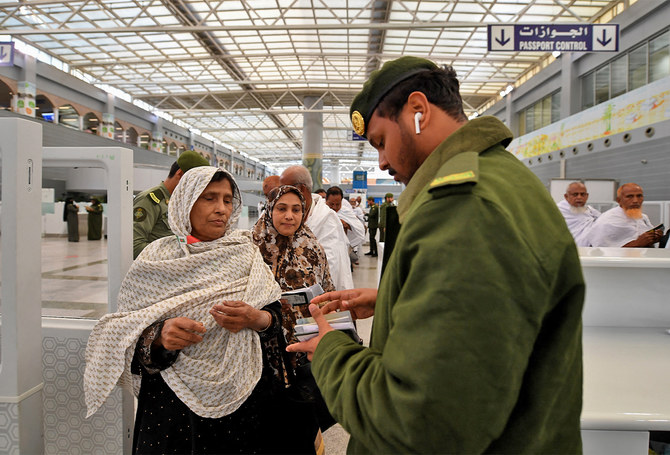
Muslim pilgrims go through passport control upon their arrival to King Abdulaziz International Airport in Jeddah on July 7, 2019, prior to the annual Hajj pilgrimage in the holy city of Mecca. (AFP/File)
Short Url
Updated 03 June 2022
Follow

Pakistan Ulema Council urges Hajj pilgrims to abide by ‘code of conduct’ in Saudi Arabia

  • Saudi Arabia has allotted Pakistan a quota of 81,132 pilgrims for this year’s Hajj
  • The kingdom has allowed up to one million people to perform the annual ritual this year

ISLAMABAD: The Pakistan Ulema Council on Friday urged Pakistani Hajj pilgrims to abide by the “code of conduct” prescribed by Saudi Arabia and not to violate the rules of the kingdom.

The statement comes a month after Madinah police arrested at least five Pakistani nationals for “abusing and insulting” Pakistani Information Minister Marriyum Aurangzeb and Minister for Narcotics Control Shahzain Bugti at the Prophet’s Mosque in the city. 

Videos shared online showed some individuals chanting slogans as the ministers, who were part of Prime Minister Shehbaz Sharif’s delegation, visited the Prophet’s Mosque. Police also registered cases against former prime minister Imran Khan and members of his party in Pakistan for sloganeering against the delegation as part of what they called a “planned-out scheme and conspiracy.” 

On Friday, the Pakistan Ulema Council urged Pakistani pilgrims to focus on worship and not to violate laws during their stay in Saudi Arabia.

“During the Hajj days, do not try to establish a political arena in Saudi Arabia and especially in Makkah, Madinah, Mina and Arafat and do not be a part of any such effort,” the council said in a statement.

“Pilgrims should pay attention to worship and avoid to become part of any political and sectarian debates and gatherings.”

This year, Saudi Arabia has allotted Pakistan a quota of 81,132 pilgrims. Pakistan’s religious affairs ministry on Friday issued a schedule of Hajj flights, with the first plane leaving for Saudi Arabia on June 6.

The kingdom has allowed up to one million people to perform the annual ritual this year, expanding it to participants from outside Saudi Arabia after a two-year hiatus due to the COVID-19 pandemic.

However, the pilgrims must be under 65 years and fully vaccinated against the coronavirus.


Pakistan says UN liquidity crisis undermining peacekeeping, urges predictable financing

Updated 7 sec ago
Follow

Pakistan says UN liquidity crisis undermining peacekeeping, urges predictable financing

  • Pakistan is one of world’s top troop-contributing countries and has deployed more than 250,000 peacekeepers to 48 UN missions
  • If financial commitments wane, the readiness of troop contributing countries to maintain forces can also be affected, envoy warns

ISLAMABAD: Pakistan has warned that a liquidity crisis at the United Nations (UN) is undermining the effectiveness of peacekeeping missions, warning of its “serious consequences” for mandate delivery, civilian protection and deterrence against violence.

Pakistan is one of the world’s top troop-contributing countries and has deployed more than 250,000 peacekeepers to 48 UN missions across four continents over the past eight decades. A total of 182 of its peacekeepers have also lost their lives while serving under the UN flag.

Speaking at the opening of the Special Committee on Peacekeeping Operations, Pakistan’s Permanent Representative to the UN, Asim Iftikhar Ahmad, said several missions have transitioned or drawn down in recent years and no new UN peacekeeping mission has been established in over a decade, despite rising global instability and the highest levels of conflict since World War-II.

“If financial commitments wane and missions continue to contract without clear strategic direction, the readiness of troop contributing countries to maintain forces earmarked for UN deployment could also be affected, including standby arrangements, rapid deployment capabilities and specialized units,” Ahmad said, calling for a “serious and structured review” of financial architecture underpinning UN peacekeeping.

The liquidity crisis has reduced patrols, mobility and field presence, according to the Pakistani envoy. UN peacekeeping must become more agile, focused and better equipped to address evolving threats, including through technology and stronger partnerships.

“Protection of civilians, deterrence against violations, and ceasefire monitoring and verification remain foundational tasks,” he said. “Lack of political progress should not be used as a pretext for withdrawing missions.”

Pakistan has contributed both military and police personnel to UN operations, deploying more than 50 formed police units to missions including Haiti, Darfur, Timor-Leste and Côte d’Ivoire, according to Pakistan’s UN mission.

Pakistan’s top diplomat at the UN also flagged the issue at a UN Security Council briefing on peacekeeping police components this month.