

Anime Village opens as part of City Walk Jeddah, first of its kind in Middle East

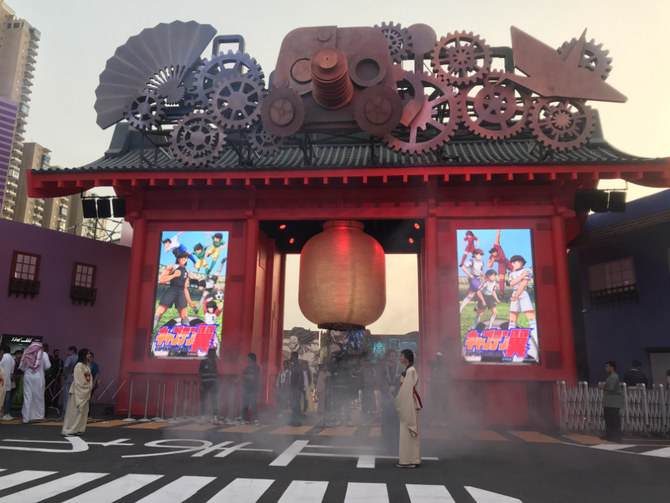
Anime Village, one of the nine zones at the City Walk, is the last zone to open as part of Jeddah Season. The zone will be open until the end of June. (AN photo by Nada Jan)
Short Url
Updated 03 June 2022
Follow

Anime Village opens as part of City Walk Jeddah, first of its kind in Middle East

  • Anime Village offers cinematic shows, musical performances, manga artist meetups, interviews with creators
  • Zone has areas inspired by iconic series such as “Attack on Titan,” “Naruto,” “Captain Tsubasa” and “Gundam"

JEDDAH: A dream come true for many anime fans in the Kingdom, on May 19 City Walk in Jeddah opened its last zone, Anime Village, the first of its kind in the Middle East. The zone will be open until the end of June.

Anime Village offers a variety of activities like cinematic shows, musical performances, manga artist meetups, interviews with creators, parades and much more.

The zone has several areas inspired by iconic anime series such as “Attack on Titan,” “Naruto,” “Captain Tsubasa” and “Gundam.”  

The biggest attraction is Konoha Village, which features the main set of the popular anime “Naruto,” including life-size figures of the show’s characters and a little museum displaying items and images from famous scenes in the anime.

The second biggest area is the Animaze, where visitors can walk through a maze while reading about famous anime series, including “Hunter x Hunter,” “Ghost in the Shell,” “My Hero Academy,” “Demon Slayer,” “Bleach” and “Jujutsu Kaisen.” Visitors can take pictures with their favorite characters displayed in the maze.

There is also a PAC-Man arcade, Japanese restaurant Kimono, a Hello Kitty store and Japanese anime store Animate, the first to open in the Middle East.

FASTFACTS

• Anime Village offers a variety of activities like cinematic shows, musical performances, manga artist meetups, interviews with creators, parades and much more.

• The zone has several areas inspired by iconic anime series such as ‘Attack on Titan,’ ‘Naruto,’ ‘Captain Tsubasa’ and ‘Gundam.’

• The biggest attraction is Konoha Village, which features the main set of the popular anime ‘Naruto,’ including life-size figures of the show’s characters and a little museum displaying items and images from famous scenes in the anime.

The comic books store belongs to Saudi manga magazine “Manga Arabia.” Besides distributing and promoting local manga magazines, the store offers a photoshoot booth, name cards written in Japanese, festive makeup and a coloring corner for children.

In other areas dedicated to anime and manga series like “Attack On Titan,” “Godzilla,” “Captain Tsubasa,” and “Gundam,” visitors can enjoy virtual reality games and take photos with their favorite characters.

The village kicked off its grand opening with a show by Saudi YouTubers, the “Anime Icons Show,” also known as “Ai Show,” followed by a cosplay parade, a Rasha Rizk concert and a screening of “Jujutsu Kaisen.”

The second day offered a live interview and meet-and-greet with Miyako Cojima, the author of the most famous Japanese horror stories, and her husband Norman England, a director, actor, horror story author and the leading authority on “Godzilla.”

The Japanese singer Eir Aoi held her first concert in the Kingdom and became the first Japanese artist to perform in Saudi Arabia. She shared her experience on Twitter, writing: “There were a lot of anime booths and people who love Japanese anime, and many people cosplaying! Thanks Saudi for giving me the best time.”

At the end of the grand opening, the village invited Cojima and England on the stage again and held a cosplaying parade. Rizk performed on stage for the last time and threw a show with DJ Nariman.

Speaking to Arab News about their experiences in the Kingdom, England said. “We love Saudi! Everyone is so nice.” He also shared a story about the friendliness of the people he encountered at the Red Sea Mall.

Cojima said that she did not expect people in the region to have such an interest in manga and that her short trip to the Kingdom proved her wrong.

“It has been only two days for me here, and the vibe of Saudi culture is very impactful, and I could sense that in the local manga that they have created with Manga Arabia.”

National program identifies 165 native plants for afforestation efforts in Asir

Updated 29 December 2025
Follow

National program identifies 165 native plants for afforestation efforts in Asir

  • The survey is part of broader plans focused on restoring degraded land, using native vegetation 

JEDDAH: Saudi Arabia’s National Afforestation Program has identified more than 165 species of native plants suitable for afforestation in the Asir region, highlighting the ecological diversity of one of the Kingdom’s most environmentally varied areas, the Saudi Press Agency reported.

The findings form part of broader national efforts to expand vegetation cover, address land degradation, and support sustainability goals linked to the Saudi Green Initiative and Vision 2030.

According to the program, the identified species are distributed across a wide range of natural environments in Asir, including mountainous terrain, highlands, slopes, valleys, plains, rocky landscapes, and coastal areas stretching from the Red Sea to Tihama.

The species belong to numerous plant families, including Fabaceae, Anacardiaceae, Burseraceae, Capparaceae, Ebenaceae, Euphorbiaceae, Malvaceae, Myrtaceae, Oleaceae, and Primulaceae, among others.

Plants suitable for afforestation range from large and small trees to perennial and annual shrubs, herbs, succulents, bulbs, and climbing plants. 

Among the most notable species identified are the grey mangrove, mastic tree, mooring or ben tree, juniper, sycamore fig, wild olive, henna, wild jasmine, hawthorn, and arak.

The Saudi Arabian Botanical Society described the announcement as an important step in protecting plant diversity and strengthening the ecosystem conservation in the Kingdom. 

Munirah bin Hamad Al-Hazani, founder and president of the society, said that prioritizing native species is central to sustainable afforestation.

“Focusing on the cultivation of native plants adapted to diverse environments forms the cornerstone of sustainable afforestation projects, as it plays a pivotal role in enhancing vegetation cover, combating land degradation, and conserving natural and financial resources,” she told Arab News.

Al-Hazani added that long-term success depends on cooperation between government bodies and the nonprofit sector, alongside community involvement and environmental awareness programs.

The National Afforestation Program has increasingly emphasized community participation, working with government agencies, private companies, and nonprofit organizations to support planting initiatives and environmental education. Its approach includes promoting volunteerism and discouraging harmful environmental practices, while focusing on the use of native plants adapted to local conditions.

Parallel efforts are underway in other regions of the Kingdom to support vegetation restoration through research and infrastructure development. In Jouf, often referred to as the Kingdom’s food basket, the King Salman bin Abdulaziz Royal Reserve Development Authority has established a Central Nursery and a Wild Seeds Research and Production Station to address the growing demand for reliable sources of native seeds and seedlings.

The project was launched in 2023 under the directive of Prince Abdulaziz bin Saud bin Naif, the minister of interior and chairman of the authority’s board of directors. 

Since then, the facilities has become a key component of vegetation restoration efforts within the reserve.

The authority has focused on building operational capacity by recruiting and training specialists to manage cultivation and research activities. The research and production station includes 14 mother-seed production fields containing over 400,000 trees and shrubs. 

Planting began in late 2024, with more than 30 native plant species represented, selected for their role in the reserve’s natural ecosystem. 

The facility also includes two seed storage units with a combined capacity of 3,000 kilograms. Seeds are collected annually from multiple sites within the reserve and used for seedling production habitat rehabilitation.

The Central Nursery spans 6,000 square meters and includes 30 greenhouses spanning 1,500 square meters, as well as two shade houses used during summer months. A plant hardening facility, designed to prepare seedlings for natural environmental conditions, covers 10,000 square meters and is divided into seven sections. The nursery’s annual production capacity reaches 1.5 million seedlings, representing more than 15 native plant species. 

Together, these initiatives underscore the growing role of native plant research and propagation in Saudi Arabia’s afforestation strategy, particularly as the Kingdom works to balance environmental restoration with long-term sustainability goals.