

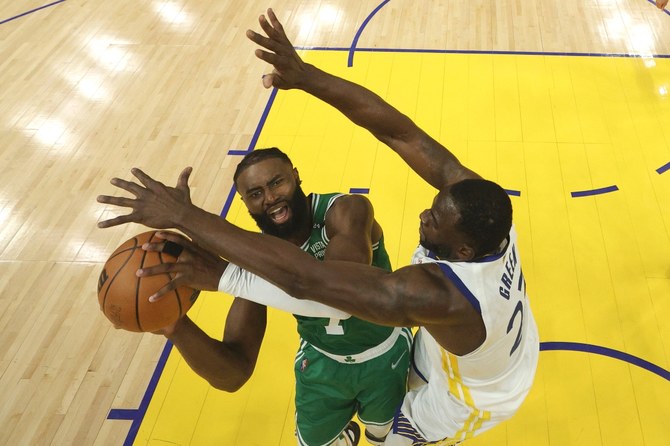
Celtics use huge 4th quarter to  beat Warriors in Game 1 of NBA Finals

The Celtics are looking to capture their record-breaking 18th title, which would move them past the Lakers, and now are just three wins away from doing it. (Supplied)
Short Url
Updated 03 June 2022
Follow

Celtics use huge 4th quarter to  beat Warriors in Game 1 of NBA Finals

  • Boston made their first seven tries from long distance in the fourth and wound up 9 of 12 beyond the arc over the final 12 minutes as almost everybody got involved in the 3-point flurry

SAN FRANCISCO: Jaylen Brown fueled a comeback charge and scored 24 points, Al Horford hit six 3-pointers and the Boston Celtics rode the most lopsided fourth quarter in NBA Finals history to a 120-108 victory over the Golden State Warriors in Game 1 on Thursday night.

Horford finished with 26 points and the Celtics outscored the Warriors 40-16 in the final 12 minutes after trailing by 15 points late in the third quarter.

Boston made their first seven tries from long distance in the fourth and wound up 9 of 12 beyond the arc over the final 12 minutes as almost everybody got involved in the 3-point flurry. Jayson Tatum was the lone Celtics regular who struggled offensively, finishing 3 for 17.

Stephen Curry scored 34 points in his return to the NBA’s big stage for the first time in three years, but the Warriors couldn’t sustain momentum from a 38-point third quarter that put them ahead 92-80 going into the final 12 minutes.

Game 2 in the best-of-seven series is Sunday night back at Chase Center.

The Celtics’ comeback was the biggest in the finals after three quarters since Michael Jordan’s Bulls overcame a 15-point deficit to beat the Trail Blazers in Game 6 in 1992.

Derrick White’s 3-pointer over Curry with 5:40 remaining tied the game at 103, then Horford hit from deep the next time down as the Celtics took their first lead since halftime.

The Celtics are looking to capture their record-breaking 18th title, which would move them past the Lakers, and now are just three wins away from doing it.

Brown, who starred at nearby California for one college season, made consecutive baskets that tied the game at 47 with 5:03 left before halftime and the Celtics led 56-54 at the break. Golden State then used a signature third-quarter spurt, pouring in 38 points to build a big lead.

Brown then scored five quick points early in the fourth and assisted on an alley-oop dunk to Robert Williams III as the Celtics pulled back within 92-87 with 9:35 remaining. Brown’s 3 at 8:22 made it 94-92 before Klay Thompson answered with a 3.

Andrew Wiggins scored six of Golden State’s first 14 points and wound up with 20 in his finals debut, Draymond Green grabbed 11 rebounds before fouling out with 48.3 seconds left. Thompson contributed 15 points as the Warriors began their sixth finals in eight years after making five straight trips from 2015-19 and winning three championships.

They’ll have to win this one from behind after being 21-2 in their previous Game 1s under Steve Kerr.

“It’s a different feeling. You obviously go into Game 2 with more of a sense of desperation. That’s all part of this stuff. We’ve been in this position before,” Kerr said. “Boston played a brilliant quarter. They came in and earned the win.”

Curry scored a smooth 21 points in the opening period on 7-for-8 shooting, including 6 of 8 made 3s — missing a half-court heave at the buzzer. And Boston struggled to keep up with the Warriors’ snappy ball movement and shooters at every spot on the floor.

Otto Porter Jr. returned from a two-game absence to score 12 points off the bench for the well-rested Warriors. Golden State ended its Western Conference final in Game 5 against Dallas a week earlier at home, while Boston was pushed to the limit with a Game 7 victory at Miami last Sunday.

Golden State dropped to 9-1 this postseason at home, where a sellout crowd in yellow finals T-shirts chanted “M-V-P!” for Curry at every chance.

Marcus Smart scored 18 points with four 3s for Boston. The Celtics star took criticism from Kerr for what the Golden State coach called “a dangerous play” lunging at Curry’s left foot on March 16 in a 110-88 Boston rout that sidelined the 2021 scoring champion for a month before his return in Game 1 of the first round facing Denver.

Now the hard work starts for a Warriors team that went a league-worst 15-50 during the pandemic-shortened 2019-20 season two years ago and lost to Memphis in the play-in game last year before eliminating the Grizzlies in the first round this season.

CURRY’S FIRST QUARTER

Curry’s six 3s in the opening 12 minutes were the most ever in any quarter of the NBA Finals. In addition, the 21 points were most since Michael Jordan’s 22 in the fourth quarter of Game 4 vs. Phoenix in 1993.

The Celtics and Warriors combined for 20 first-half 3s, an NBA Finals first-half record.

TIP-INS

Celtics: Williams started after being listed as questionable with soreness in his surgically repaired left knee and finished with eight points while playing 24 minutes. Coach Ime Udoka expected him to be limited to about 20 minutes as has been the recent pattern. ... Boston and the Warriors were even on the boards at 39. ... Tatum was 2 for 9 in the first half and 3 for 17 overall for 12 points.

Warriors: F Andre Iguodala (injured disc in neck), G Gary Payton II (broken left elbow) and Porter (left foot soreness) all were back. 2015 NBA Finals MVP Iguodala checked in with 2:36 left in the first to huge cheers after he missed 12 games. ... Golden State is 21-3 in postseason Game 1s dating to the 2014-15 season when the Warriors captured the franchise’s first championship in 40 years — and they had won 13 straight playoff series openers at home, third-longest streak in NBA history, before this.


Middle East war puts Asian Football Confederation in a tricky situation

Updated 59 min 5 sec ago
Follow

Middle East war puts Asian Football Confederation in a tricky situation

  • Asian football has long been structured around regions, with competitions split between East and West
  • With conflict in the Middle East escalating on Feb. 28, the AFC was forced into emergency mode as the knockout stages of its club competitions approach

DAMMAM: Football in Asia has never been an easy task to manage. Long flights, numerous time zones, conflicting calendars, vastly different football cultures and — perhaps more than any other confederation in the world — politics.
While the war in the Middle East falls under the AFC’s umbrella, its direct effects have so far been limited to the clubs in West Asia. Asian football has long been structured around regions, with competitions split between East and West, although for a period, the second-tier AFC Cup operated in five separate regions.
As a result, AFC club competitions in East Asia continued uninterrupted in the first week of March. A crowd of 31,225 watched Johor Darul Ta’zim’s historic 3-1 victory over Sanfrecce Hiroshima in the AFC Champions League Elite round of 16. Bangkok United defeated Tampines Rovers in the AFC Champions League Two quarter-final, and an all-Cambodian clash between Phnom Penh Crown and PKR Svay Rieng in the AFC Challenge League ended in a 4-1 victory for the visitors.
The situation in West Asia, however, is vastly different.
With the conflict in the Middle East escalating on Feb. 28, the AFC was forced into emergency mode as the knockout stages of its club competitions approach.
Within 24 hours, the confederation announced that all first-leg matches involving West Asian clubs in AFC competitions would be rescheduled until further notice. The same decision was taken for the second-leg matches fixtures just 48 hours later.
Domestic football has also been heavily disrupted. Leagues in Qatar, Bahrain, Kuwait and Lebanon have been postponed indefinitely, with matches continuing behind closed doors in Jordan.
Leagues in Saudi Arabia, Oman, Iraq and Syria continue to operate, but flights in the region are limited.
With the season already compressed by the FIFA Arab Cup, FIFA Intercontinental playoffs and the upcoming FIFA World Cup, member associations throughout the Middle East now find themselves scrambling alongside the AFC to solve a problem that ultimately lies outside their control.
Another issue looms on the horizon. The AFC Champions League final stage will be hosted in Saudi Arabia next month for the second year in a row. While football has not halted in the Kingdom and the security situation is stable, it remains to be seen whether East Asian clubs will be willing to travel if the conflict continues.
What is the real solution, fans ask?
One proposal that has been circulated is to centralize the knockout rounds from the Round of 16 stage instead of the quarter-finals. That option, however, presents its own challenges. East Asian clubs have already begun their journey in the round of 16, and the idea of centralized hosting has historically not been popular across the continent.
When Saudi Arabia and Qatar were selected to host the AFC World Cup Qualifiers fourth round last year, the decision sparked backlash from Indonesia, Iraq, Oman and the UAE. More recently, journalist Ali Al-Marshoud claimed on Saudi sports program “In the 90” that the UAE’s Al-Wasl rejected a proposal for their AFC Champions League Two quarter-final against Al-Nassr as a single-leg match in Jeddah.
The AFC therefore finds itself in a difficult position. It cannot control regional geopolitics, nor can it influence government policies. At the same time, there is no guarantee that East Asian clubs will travel to the region, or that West Asian clubs will agree to surrender their right to play matches at home.
The conflict has also begun to affect international football.
With the FIFA World Cup intercontinental playoffs scheduled for later this month and Iraq facing a crucial qualifier in Mexico on March 31, uncertainty continues to grow.
In a statement released by the Iraqi Football Association, officials confirmed they were in constant contact with FIFA and the AFC regarding potential travel complications.
Head coach Graham Arnold is currently unable to leave the UAE, while several players and staff have struggled to obtain visas to Mexico due to embassy closures. All the while flights through Iraqi airspace have been suspended.
Political complications are not new to Asian football. For years, Saudi and Iranian clubs played each other at neutral grounds. Conflicts in Syria, Palestine, Iraq and Lebanon also forced the AFC to adopt special arrangements at various times. And of course, the COVID-19 pandemic, which fundamentally reshaped the state of football in Asia.
Yet the current situation presents a different scale of challenge.
For the first time in modern history, the AFC must navigate a regional conflict that touches nearly every part of the confederation. With the season entering its decisive stages and the largest World Cup in history approaching, solutions must be found quickly, or Asian football risks a crisis that could reshape the continental game.