

Queen Elizabeth II: a lifetime of service

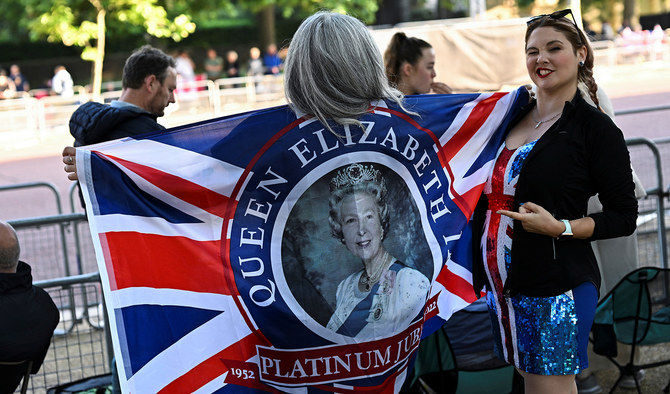
Women hold a flag with Britain's Queen Elizabeth's picture on it during the Queen's Platinum Jubilee celebrations in London, on June 2, 2022. (REUTERS)
Short Url
Updated 02 June 2022
Follow

Queen Elizabeth II: a lifetime of service

  • No British monarch in history has celebrated a Platinum Jubilee
  • Her popularity with the public has remained consistently high

LONDON: Elizabeth II has been on the throne since she was 25, an ever-present figure for the lives of most people in Britain, as well as one of the most recognisable people around the world.

Now 96, difficulties in walking and standing have made her dwindling number of public appearances in recent years decline further.

Her eldest son and heir Prince Charles, 73, has gradually assumed more responsibilities to prepare him for the time when he takes over.

But she still regularly hosts foreign dignitaries and diplomats. According to those who know her, she remains sharp as a tack.

The death in April last year of her husband of 73 years, Prince Philip, inevitably affected her deeply and she cut a lonely figure at his funeral, which was held under coronavirus restrictions.

She has spent most of her time at her favoured Windsor Castle home west of London, after leaving Buckingham Palace at the start of the pandemic in early 2020.

No British monarch in history has celebrated a Platinum Jubilee and her 70-year reign is reflected by her presence almost everywhere, from stamps and banknotes to her cypher on post boxes.

Her popularity with the public has remained consistently high, even as deference lessened and attitudes changed towards the monarchy over the decades.

Elizabeth Alexandra Mary Windsor was born in London on April 21, 1926, and only became queen by an accident of history.

Her father became king George VI in 1936 when his elder brother, Edward VIII, abdicated to marry a twice-divorced American, Wallis Simpson. That made princess "Lilibet" heir to the throne.


As German bombs rained down on London in World War II, she and her younger sister Margaret were evacuated to Windsor.

At the age of 19, she became an army mechanic and driver on the Home Front, endearing herself to Britons for her part in the war effort. 

At 21, she married Philip Mountbatten, the son of a Greek prince, in a ceremony that brought a dash of glamour to austere post-war Britain.

The couple were in Kenya on February 6, 1952, when news reached them of her father's death, making her the new monarch.

She returned to Britain immediately and on June 2, 1953, was crowned queen of the United Kingdom, Australia, Canada, New Zealand, South Africa, Pakistan and Ceylon (modern-day Sri Lanka).

Currently, she is head of state in the United Kingdom and 14 other Commonwealth countries.

With a sense of duty instilled in her since childhood, the queen carried out hundreds of engagements each year, from receptions for foreign dignitaries to awarding civilian and military honours, and royal visits around the world.

Elizabeth spent an unscheduled night in hospital last October after undergoing unspecified tests. Doctors have since advised her to rest and reduce her workload.

For support in fulfilling her duties, she has turned to her immediate family but one without two notable members -- second son Prince Andrew and grandson Harry.

Andrew, often considered to be her favourite son, has been stripped of his royal functions due to his links to the convicted sex offenders Jeffrey Epstein and Ghislaine Maxwell.

Harry quit royal life in 2020 and moved to the United States, from where he and his wife Meghan accused the family of racism.

Over the decades, the queen has been seen as a rock of stability in the turbulence of royal life. In 1992 -- a year she called her "annus horribilis" -- three of her four children split from their partners, and Windsor Castle went up in flames.

But she faced criticism in 1997 for misjudging the public mood after the death of princess Diana in a Paris car crash, by initially refusing to return to London and fly the flag at half-mast over Buckingham Palace.

Even though she makes a recorded televised address every Christmas Day, she has never given an interview and is careful not to divulge her personal opinions.

As head of a constitutional monarchy, she is politically neutral, and her weekly private conservations with the prime minister of the day about current issues remain just that -- private.

Summers have typically meant a stay at her Balmoral retreat in northeast Scotland, where she swaps her self-styled "uniform" of formal hats and matching outfits for the country look, complete with a simple headscarf and Wellington boots.


How a Syrian refugee chef met Britain’s King Charles

Updated 3 sec ago
Follow

How a Syrian refugee chef met Britain’s King Charles

LONDON: Pots clanged and oil sizzled inside the London kitchen of Syrian chef Imad Alarnab, as the former refugee who fled his country’s civil war recalled hosting King Charles III.
When the chef left his war-torn homeland in 2015, he never imagined that one day he would watch as cameras flashed and wide-eyed crowds greeted the monarch arriving at his Soho restaurant last year.
Alarnab, 48, said he had asked the king to come to the popular eatery when he met him at Buckingham Palace before an event honoring humanitarian work in 2023.
“I told him ‘I would love for you to visit our restaurant one day’ and he said: ‘I would love to’... I was over the Moon to be honest.”
The chef has come a long way since he arrived in London after an arduous journey from Damascus with virtually no money in his pocket.
Fearing for his life, he had escaped Syria after his family was uprooted again and again by fighting.
His culinary empire — restaurants, cafes, and juice bars peppered across the Syrian capital — had been destroyed by bombing in just six days in 2013.
Alarnab spent three months crisscrossing Europe in the back of lorries, aboard trains, on foot and even on a bicycle before he reached the UK.
“When I left, I left with nothing,” he told AFP, as waiters whirled past carrying steaming plates of traditional Syrian fare.
Starving and exhausted, he spent the last of his money on a train ticket to Doncaster where his sister lived.
“Love letter from Syria”
To make a living, Alarnab initially picked up any odd jobs, such as washing and selling cars, saving enough to bring his wife and three daughters over after seven months.
His love of cooking never left him though. In France, while he was sleeping on the steps of a church, Alarnab had often cooked for hundreds of other refugees.
“I always dreamed of going back to cooking,” he said.
So it wasn’t long before he found himself back in the kitchen, cooking up a storm across London with his sold-out supper clubs, bustling pop-up cafes, and crowded lunchtime falafel bars.
Alarnab’s friends gave him the initial boost for his first pop-up in 2017, and profits from his new catering business then covered the costs of later events.
He now runs two restaurants in the city — one in Soho’s buzzing Kingly Court and another nestled in a corner of the vibrant Somerset House arts center.
“I was looking for a city to love when I found London,” Alarnab said, adding it had offered him “space to innovate” and add his own modern twist to classic Syrian dishes.
Far from home, Alarnab said his word-of-mouth success had grown into a “love letter from Syria to the world” that needs no translation.
“You don’t really need to speak Arabic or Syrian to know that this is the best falafel ever,” he said, pointing to a row of colorful plates.
“There is hope”
For Alarnab, spices frying, dough rising and cheese melting inside a kitchen offered an unlikely escape from the real world.
“All my problems, I leave them outside the kitchen and walk in fresh.”
When he fled Syria, Alarnab thought going back to Damascus was forever off the table.
Yet he returned for the first time in October, almost a year to the day after longtime leader Bashar Assad was toppled in a lightning rebel offensive — ending almost 14 years of brutal civil war.
He walked the familiar streets of his old home, where his late mother taught him to cook many years ago.
“To return to Damascus and for her not to be there, that was extremely difficult.”
Torn between the two cities, Alarnab said he longed to one day rebuild his home in Damascus.
“I wish I could go back and live there. But at the same time, I feel like London is now a part of me. I don’t know if I could ever go back and just be in Syria,” he said.
Although Syrians still bear the scars of war, Alarnab said he had seen “hope in people’s eyes which was missing when I left in 2015.”
“The road ahead is still very long, and yes this is only the beginning — but there is hope.”